By Eric Andrew Kristof, RN, CAHIMS | Healthcare IT Professional | HIMSS Arkansas Chapter Member
About This Series: The HIMSS Word of The Day is a running blog series drawing from the HIMSS Dictionary of Health Information and Technology Terms, Acronyms, and Organizations, 6th Edition (2025) — the authoritative reference for healthcare IT professionals and the primary study resource for CAHIMS and CPHIMS certification. Each post paraphrases the term in plain language, grounds it in real-world healthcare IT context, and adds a bedside nursing perspective you won’t find in a textbook.
📖 The Term: Authenticity
Source: HIMSS Dictionary of Health Information and Technology Terms, Acronyms, and Organizations, 6th Edition (2025)
🔍 Plain-Language Definition
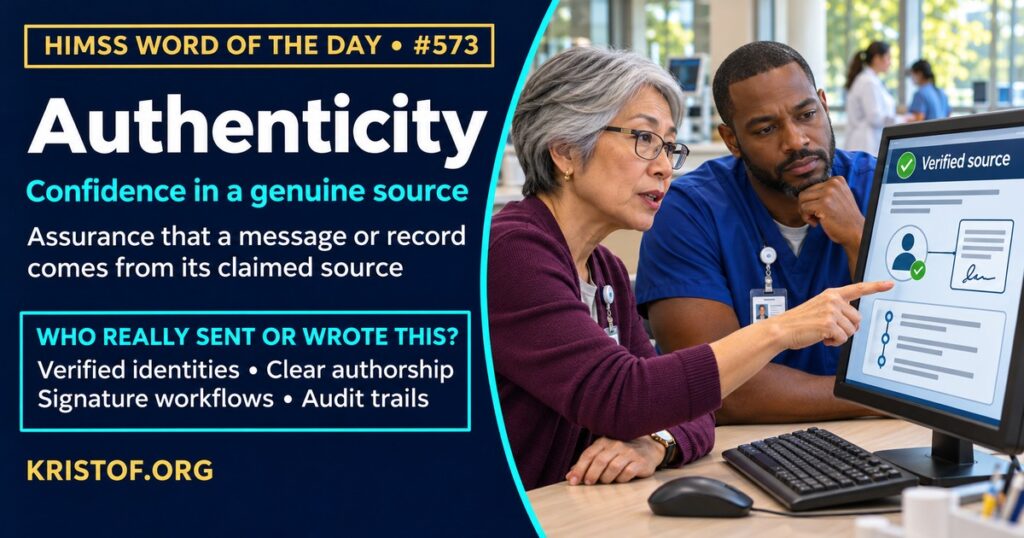
The HIMSS Dictionary describes authenticity as confidence that any message, transaction, or information exchange really comes from the party it names, and says that this confidence depends on proof of identity. In practice the word bundles two questions: who actually sent or wrote this, and can that claim be checked?
The NIST Computer Security Resource Center glossary lists several wordings drawn from different NIST publications. Some entries, including ones attributed to SP 800-38B and SP 800-63-4, describe authenticity as the property that data originated from its purported source. Others, attributed to SP 800-37 Revision 2 and SP 800-53 Revision 5, describe being genuine and able to be verified and trusted, along with confidence in the validity of a transmission, a message, or its originator. Several of those entries point readers to authentication, which is the related process.
| Related term | How it relates to authenticity |
|---|---|
| Authenticity | The property that a message, record, or entry really comes from its claimed source |
| Authentication | The process used to establish confidence in a claimed identity or source |
| Integrity | Protection of information from improper change or destruction |
| Non-repudiation | The ability to prevent a sender or signer from credibly denying an action |
| Authorization | What a verified identity is permitted to see or do |
The table is a teaching sketch and not an official taxonomy.
⚠️ Exam Alert: Authenticity asks whether the source is genuine, integrity asks whether the content has been improperly changed, authentication is the process of checking identity, and authorization decides what that identity may do. A message can arrive unaltered and still come from an impostor, and a genuine sender’s message can be altered in transit, so the two properties are not interchangeable.
🌐 Why It Matters: Real-World Healthcare IT Context
Research directly on authenticity is limited. PubMed searches on authenticity, authentication, and digital signatures in electronic records returned many off-target results and a number of blockchain framework papers, and few that examined how organizations establish who authored a record. The articles cited below are a review, a commentary, and a discussion article, and none reports outcome data in its abstract. For that reason, this post relies mainly on NIST, the HIPAA regulation text, and CMS guidance.
What the HIPAA Security Rule says. The technical safeguards in 45 CFR 164.312, as shown on Cornell’s Legal Information Institute site, include a standard for person or entity authentication, which calls for procedures to verify that anyone seeking access to electronic protected health information is who they claim to be. Under the integrity standard, there is also an implementation specification titled “mechanism to authenticate electronic protected health information,” which the same page labels addressable. Addressable does not mean optional, and 45 CFR 164.306(d) describes what the label requires. The two provisions address different things: one concerns the identity of a person seeking access, and the other, judging by its title, concerns data. Readers should consult the regulation for its full wording.
A federal proposal that may change the label. HHS published a proposed update to the Security Rule in January 2025 that would remove the distinction between required and addressable specifications. Secondary summaries from mid-2026 describe the proposal as not yet final, and they disagree about timing. Check HHS for the current status before relying on the addressable label.
What CMS says about signatures. The CMS fact sheet Complying with Medicare Signature Requirements (MLN905364) addresses Medicare medical review. It says the practitioner who ordered or provided a service authenticates the entry with a handwritten or electronic signature, describes protections against modification as part of the expectations for electronic signatures, and generally does not accept stamped signatures, with a narrow exception for authors who have a physical disability. It also describes signature logs and attestation statements for addressing illegible or missing signatures. The version reviewed for this post is dated July 2025 and lists additions on stamped signatures, artificial intelligence, and attestations and signature logs, so the current version should be checked. Other payers and state laws may set different rules, and the fact sheet is about Medicare claim review, not a general definition of authenticity.
When a signature is ambiguous. Victoroff, in Patient Safety in Surgery (2012), wrote that electronic signatures attached to EHR entries can carry different logical and legal meanings for different users. The article says traditional signature functions, such as identity verification, attestation, consent, authorization, and non-repudiation, can become ambiguous in workflows that include logins, auto-fill, and audit trails. This is a discussion article, not a study, and EHR workflows have changed since 2012.
Copied text and authorship. Weis and Levy, in Chest (2014), reviewed the content-importing tools used in EHR documentation, including their benefits and risks. They wrote that these tools created new problems, including authorship attribution, data integrity, and regulatory concerns about the accuracy and medical necessity of billed services. They also reviewed institutional policies and offered best practice recommendations. It is a review, and the abstract gives no figures.
Generative AI and authentic data. Kim and colleagues, in The Journal of Law, Medicine & Ethics (2026), published a commentary on how generative AI challenges the authenticity and integrity of scientific data. They proposed data-attestation requirements to strengthen accountability, preserve access to original research records, and help journals and institutions distinguish authentic evidence from synthetic or fabricated data. The paper concerns research data, so applying it to clinical documentation would be an inference. The topic is moving quickly, and newer guidance may exist.
Common authenticity problems:
- Treating a valid login as proof that the named person wrote an entry, when credentials are shared or sessions are left open
- Confusing authenticity with integrity or authorization
- Ambiguous signature meaning in EHR workflows, as Victoroff describes
- Copied or imported text whose original author is unclear, as Weis and Levy discuss
- Unsigned, illegibly signed, or stamped entries during Medicare medical review, per the CMS fact sheet
- Synthetic or machine-generated content that is hard to tell from the original, as Kim and colleagues discuss for research data
- Assuming the addressable label is permanent while a federal proposal is pending
What supports authenticity:
- Person or entity authentication procedures under the HIPAA Security Rule
- Unique user credentials and clear signature or attestation workflows
- Audit trails that record who did what and when
- Cryptographic methods, such as digital signatures, where an organization uses them
- Signature logs and attestation statements for Medicare review, as CMS describes
- Written policies on copy-forward and on AI-drafted text, which Weis and Levy and the CMS fact sheet suggest are worth having
🏥 The Nurse’s Perspective: Clinical, Bedside, & Workflow
For nurses, authenticity usually shows up as one question: who wrote this entry, and can the record be trusted to say so?
At the Bedside
Nurses sign in with personal credentials, and the entries made under them, such as assessments, medication administration, and notes, carry that identity. A shared login or an unattended open session makes the author of an entry uncertain, which can matter later in a review. Entries made after the fact or on behalf of someone else are handled under organizational policy, and nurses who follow that policy keep the record clear about who did what.
In Clinical Workflow
Authorship questions surface when notes are copied forward, when entries need a cosignature, and when a reviewer asks who documented a finding. Nurse informaticists and compliance staff may use audit trails to answer those questions. Drafts produced by AI documentation tools raise the same question in a new form, and the CMS fact sheet now addresses artificial intelligence, so local policy and the current fact sheet should be checked together.
In EHR Implementation (Go-Live Perspective)
During an Epic Go-Live, analysts at the elbow often field login problems, badge or password issues, and session time-outs, all of which touch authentication. Project teams usually test how entries are attributed, including cosign and late-entry workflows, though the exact configuration varies by organization. Nurses who help test these workflows can confirm that the name and time on an entry match what actually happened.
🎓 CAHIMS / CPHIMS & HIMSS Perspective
CAHIMS Exam Domain Mapping
Authenticity connects security, regulation, and documentation practice:
| CAHIMS Domain | How Authenticity Appears |
|---|---|
| Healthcare & Technology Environments | The HIPAA Security Rule, CMS signature guidance, and secure exchange of information |
| Clinical Informatics | Authorship, attestation, and the trustworthiness of clinical documentation |
| Healthcare Information & Systems Management | Authentication controls, audit trails, and signature workflows |
| Management & Leadership | Policies on credentials, copy-forward, and AI-generated content |
Key Terms to Know Alongside Authenticity
- Authentication — the process of verifying a claimed identity
- Digital signature — a cryptographic method that can support authenticity and non-repudiation
- Electronic signature — an electronic way of showing a person’s intent to sign a record
- Data integrity — assurance that data has not been improperly changed
- Audit trail — a record of who accessed or changed information, and when
- Documentation integrity — the accuracy, completeness, and attribution of clinical documentation
HIMSS Organizational Position
HIMSS offers education and research on health information and technology topics through its Resource Center. Members can find related information on the HIMSS Resource Center page.
🧭 More HIMSS Word of The Day Terms
Related terms in the Cybersecurity and Privacy series:
- Contingency Plan
- S/MIME (Secure Multipurpose Internet Mail Extensions)
- SSH (Secure Shell)
- Hash Function
Browse all Cybersecurity and Privacy terms or the A–Z glossary.
🔗 Explore Further: External References
- NIST — Computer Security Resource Center Glossary: authenticity https://csrc.nist.gov/glossary/term/authenticity
- 45 CFR 164.312 — Technical safeguards (Legal Information Institute, Cornell Law School) https://www.law.cornell.edu/cfr/text/45/164.312
- CMS — Complying with Medicare Signature Requirements (MLN905364) https://www.cms.gov/files/document/mln905364-complying-medicare-signature-requirements.pdf
- Weis and Levy (2014), Chest — Copy, paste, and cloned notes in electronic health records: prevalence, benefits, risks, and best practice recommendations https://pubmed.ncbi.nlm.nih.gov/24590024/
- Victoroff (2012), Patient safety in surgery — Electronic health records: what does your signature signify? https://pubmed.ncbi.nlm.nih.gov/22888846/
- Kim et al. (2026), The Journal of law, medicine & ethics — Assuring Data Authenticity in the Age of Generative AI https://pubmed.ncbi.nlm.nih.gov/42878514/
- HIMSS — Resource Center https://www.himss.org/resource-center
Term source: HIMSS Dictionary of Health Information and Technology Terms, Acronyms, and Organizations, 6th Edition (2025). All definitions in this series are paraphrased for editorial purposes. Readers are encouraged to consult the primary source for exact language.
Eric Andrew Kristof, RN, CAHIMS is a Healthcare IT professional and HIMSS Arkansas Chapter member based in Hot Springs Village, AR, with hands-on Epic Go-Live experience and a diverse healthcare and IT background. He writes at kristof.org at the intersection of clinical care and healthcare technology.
Leave a Reply