By Eric Andrew Kristof, RN, CAHIMS | Healthcare IT Professional | HIMSS Arkansas Chapter Member
About This Series: The HIMSS Word of the Day is a running blog series drawing from the HIMSS Dictionary of Health Information and Technology Terms, Acronyms, and Organizations, 6th Edition (2025) — the authoritative reference for healthcare IT professionals and the primary study resource for CAHIMS and CPHIMS certification. Each post paraphrases the term in plain language, grounds it in real-world healthcare IT context, and adds a bedside nursing perspective you won’t find in a textbook.
📖 The Term: Certified Health IT Product List (CHPL)
Source: HIMSS Dictionary of Health Information and Technology Terms, Acronyms, and Organizations, 6th Edition (2025)
🔍 Plain-Language Definition
The Certified Health IT Product List (CHPL) is the comprehensive, authoritative listing of health information technology that has been tested and certified under the ONC Health IT Certification Program. Each listed product has been tested by an ONC-Authorized Testing Laboratory (ONC-ATL) and certified by an ONC-Authorized Certification Body (ONC-ACB) as meeting criteria adopted by the Secretary of HHS.
In plain terms, the CHPL is the public record of what a certified product can do. Hospitals, clinics, researchers, and policy programs use it to check which certification criteria a product meets, which version is certified, and under which conditions.
| Element | What It Is | Why It Matters |
|---|---|---|
| ONC Health IT Certification Program | Voluntary federal program that certifies health IT against criteria | Sets the baseline capabilities |
| ONC-ATL | Lab that tests products | Verifies functions work as specified |
| ONC-ACB | Body that issues certification | Grants and oversees certification |
| Certification Criteria | Defined capabilities and standards products must meet | Examples include APIs and data export |
| CHPL | Public database of certified products | Lets buyers and programs verify certification |
| CEHRT | Certified EHR technology as defined for CMS programs | Used in Promoting Interoperability reporting |
⚠️ Exam Alert: The CHPL lists certified products and their criteria. Certification confirms that a product met specified testing, not that it is usable, safe, or configured well in a particular hospital. CEHRT is a CMS program concept built on certified criteria, so it is related to the CHPL but not the same thing.
🌐 Why It Matters: Real-World Healthcare IT Context
Certification started as a way to give buyers and federal incentive programs a reliable way to know that EHRs had essential capabilities such as recording problems and medications, supporting e-prescribing, and exchanging data. Today it remains the foundation for the definition of certified EHR technology used in CMS programs, and the CHPL is where that status is checked.
Certification is tied to specific criteria and versions. A product may be certified for some criteria and not others, and listings show which criteria apply, any additional software needed, and links to developer information such as real world testing plans and results, API documentation, and attestations to conditions of certification. For buyers, the CHPL helps confirm that a vendor’s claims match the public record before a contract is signed.
The program is changing. The HTI-1 final rule, released in December 2023, updated the program, added a decision support interventions criterion, and refreshed data and API standards. The HTI-5 final rule, a deregulatory action, reduces burden on health IT developers by streamlining the program. According to ONC, of the 60 certification criteria in the program, the HTI-5 final rule removed 14 and revised seven, while 39 were retained without change, including new and revised criteria adopted in the HTI-4 rule on electronic prior authorization and real-time prescription benefit. ONC also made conforming edits to several conditions and maintenance of certification requirements and scaled back real world testing requirements. Organizations should check the Federal Register and the CHPL for effective dates and for how specific products and criteria are affected.
Certification does not equal quality. A cross-vendor study that tried to implement three clinically important decision support rules in eight certified EHRs found that five could implement all three rules and three could not implement any, and one did not allow users to customize decision support rules at all. A separate study of 1,272 hospitals found substantial variation in quality measures across and within EHR vendors, with vendor explaining only a small share of the differences. Together these studies show that implementation, configuration, and local governance matter at least as much as certification.
The CHPL is also useful beyond purchasing. Developers check criteria and standards, researchers study adoption, and compliance teams confirm that the version a hospital actually runs is the certified one, especially when reporting for programs that depend on certified technology.
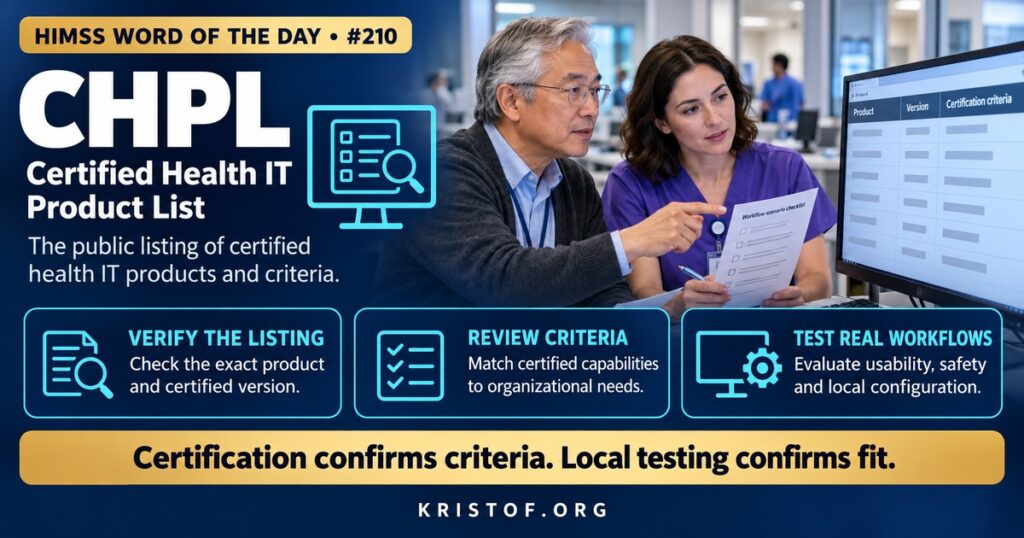
Good practice for buyers includes verifying the exact product and version on the CHPL, reviewing the criteria relevant to local needs, reading real world testing materials, asking how updates will maintain certification, and including certification maintenance in the contract.
Common CHPL and certification misunderstandings:
- Assuming certified means usable or safe
- Checking the vendor but not the specific product version
- Assuming all criteria listed in older rules still apply
- Confusing the CHPL with the CMS definition of CEHRT
- Not tracking changes to criteria and program requirements
- Treating certification as a substitute for scenario testing
What supports smart use of the CHPL:
- Verify product, version, and criteria before signing
- Pair certification review with scenario-based demonstrations
- Track program changes and their effective dates
- Include certification maintenance in vendor contracts
- Review developer disclosures and real world testing results
- Align reporting with the certified version in production
🏥 The Nurse’s Perspective: Clinical, Bedside, & Workflow
Most nurses never open the CHPL, yet the criteria behind it shape the tools nurses use and the data those tools can exchange.
At the Bedside
Features such as medication lists, problem lists, allergy documentation, and data export exist in part because certification criteria required them. Changes to criteria over time can affect which functions vendors maintain.
Certified does not mean the screen fits the way nurses work. Usability, alert design, and workflow depend on local build and configuration, so bedside feedback remains essential.
In Clinical Workflow
Nurse leaders and informaticists can join selection committees and ask practical questions: how workflows perform with realistic scenarios, how nursing documentation is supported, and how product updates will be tested.
When regulations change, such as removal or revision of certification criteria, organizations decide which capabilities to keep. Nursing input helps preserve workflows that matter to patient care even if they are no longer required for certification.
Nurse informaticists also help clinicians understand terms such as CEHRT when quality reporting or incentive programs depend on certified technology.
In EHR Implementation (Go-Live Perspective)
An Epic Go-Live depends on a product that is certified and on a build that uses it well. Teams verify that the version being deployed matches the certified version for the programs the organization reports to, and they plan upgrades with certification in mind.
At-the-elbow support analysts see how certified functions work in real workflows. Their observations about gaps, such as missing documentation options or confusing steps, inform optimization lists and vendor feedback.
🎓 CAHIMS / CPHIMS & HIMSS Perspective
CAHIMS Exam Domain Mapping
The CHPL appears in policy, procurement, and standards questions:
| CAHIMS Domain | How the CHPL Appears |
|---|---|
| Healthcare & Technology Environments | ONC certification program, HTI rules, CMS programs |
| Clinical Informatics | Certified capabilities versus usability and safety in practice |
| Healthcare Information & Systems Management | Product selection, version tracking, API and interoperability criteria |
| Management & Leadership | Vendor contracts, compliance reporting, program changes |
Key Terms to Know Alongside the CHPL
- ONC Health IT Certification Program — voluntary program that tests and certifies health IT
- ONC-ATL — Authorized Testing Laboratory that tests products
- ONC-ACB — Authorized Certification Body that certifies products
- Certified EHR Technology (CEHRT) — certified technology as defined for CMS programs
- Real World Testing — developer plans and results showing certified functions work in use
- HTI Rules — ONC rulemakings that update interoperability and certification requirements
HIMSS Organizational Position
HIMSS advocates for interoperability and policies that support effective health IT through its public policy work, education, and research. Members can find related resources through the HIMSS Resource Center and Public Policy and Advocacy pages.
🔗 Explore Further: External References
- ONC — Certified Health IT Product List (CHPL) https://chpl.healthit.gov/
- ONC — About the ONC Health IT Certification Program https://healthit.gov/certification-health-it/about-onc-health-it-certification-program/
- ONC — HTI-5 Final Rule https://healthit.gov/resources/health-data-technology-and-interoperability-onc-deregulatory-actions-to-unleash-prosperity-hti-5-final-rule
- ONC — HTI-1 Final Rule https://healthit.gov/regulations/hti-rules/hti-1-final-rule/
- McCoy et al. (2015), JAMIA — Cross-Vendor Evaluation of Key User-Defined Clinical Decision Support Capabilities: A Scenario-Based Assessment of Certified Electronic Health Records With Guidelines for Future Development https://pubmed.ncbi.nlm.nih.gov/26104739/
- CMS — Promoting Interoperability Programs https://www.cms.gov/medicare/regulations-guidance/promoting-interoperability-programs
Term source: HIMSS Dictionary of Health Information and Technology Terms, Acronyms, and Organizations, 6th Edition (2025). All definitions in this series are paraphrased for editorial purposes. Readers are encouraged to consult the primary source for exact language.
Eric Andrew Kristof, RN, CAHIMS is a Healthcare IT professional and HIMSS Arkansas Chapter member based in Hot Springs Village, AR, with hands-on Epic Go-Live experience and a diverse healthcare and IT background. He writes at kristof.org at the intersection of clinical care and healthcare technology.
Leave a Reply