By Eric Andrew Kristof, RN, CAHIMS | Healthcare IT Professional | HIMSS Arkansas Chapter Member
About This Series: The HIMSS Word of the Day is a running blog series drawing from the HIMSS Dictionary of Health Information and Technology Terms, Acronyms, and Organizations, 6th Edition (2025) — the authoritative reference for healthcare IT professionals and the primary study resource for CAHIMS and CPHIMS certification. Each post paraphrases the term in plain language, grounds it in real-world healthcare IT context, and adds a bedside nursing perspective you won’t find in a textbook.
📖 The Term: Electronic Prescriptions for Controlled Substances (EPCS)
Source: HIMSS Dictionary of Health Information and Technology Terms, Acronyms, and Organizations, 6th Edition (2025)
🔍 Plain-Language Definition
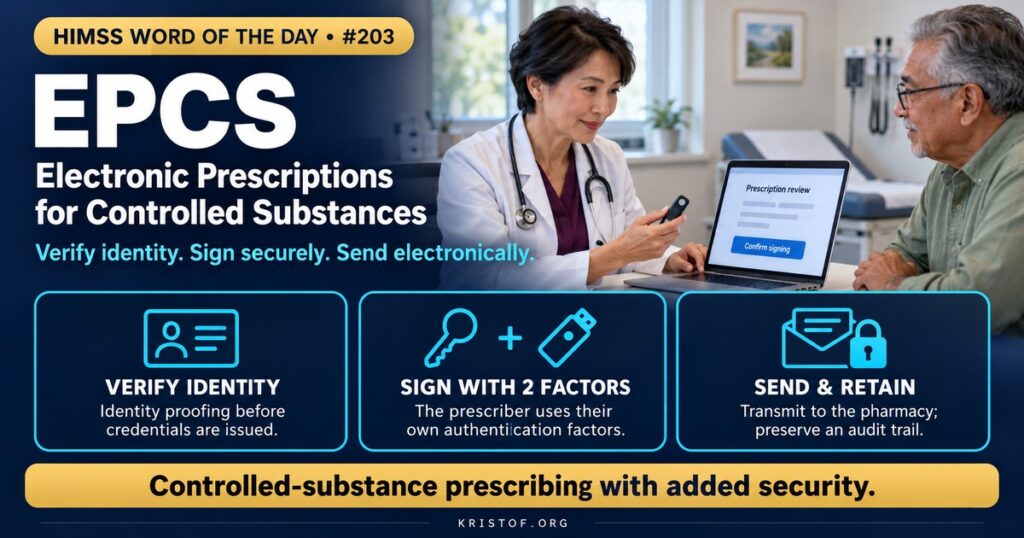
EPCS (Electronic Prescriptions for Controlled Substances) is the practice of writing, transmitting, receiving, and archiving prescriptions for controlled substances electronically. It is allowed under federal regulations from the Drug Enforcement Administration (DEA) that set strict requirements for identity, authentication, software, and auditing.
The HIMSS Dictionary describes EPCS as technology that helps address prescription drug abuse by letting practitioners prescribe electronically while addressing forged and stolen prescriptions through prescriber authentication, stronger security standards, and activity auditing. Before the DEA’s interim final rule, published in 2010 and effective that June, controlled substances generally could not be prescribed electronically in the United States.
| EPCS Requirement | What It Means | Why It Matters |
|---|---|---|
| Identity Proofing | Prescriber’s identity verified before getting credentials | Prevents impersonation |
| Two-Factor Authentication | Two of three factors: know, have, are | Protects the signing step |
| Certified Application | Software meets DEA technical requirements | Ensures audit, controls, and integrity |
| Logical Access Control | Permissions to sign controlled substance prescriptions are restricted | Limits who can prescribe |
| Audit Trail | Records of key actions kept | Supports investigation and accountability |
| Pharmacy Receipt and Archive | Pharmacies receive and retain electronic prescriptions | Closes the loop |
⚠️ Exam Alert: E-prescribing is the electronic transmission of prescriptions in general. EPCS adds DEA-required identity proofing and two-factor signing for controlled substances. A PDMP is a state database of dispensed controlled substances, which is separate from EPCS, although the two often work together in the prescriber’s workflow.
🌐 Why It Matters: Real-World Healthcare IT Context
Paper prescriptions for controlled substances are easy to forge, alter, or steal. EPCS replaces the paper pad with a secure electronic process that proves who the prescriber is, protects the content from alteration, and records what happened. It also supports safer workflows, such as legible orders and direct transmission to the pharmacy.
The DEA requirements are detailed. An individual practitioner must obtain a two-factor authentication credential after identity proofing by an approved credential service provider that meets Assurance Level 3 or above under the NIST guidance incorporated by the rule, or from a qualifying certification authority. Institutions may use a credentialing office to perform identity proofing for practitioners who prescribe through the institution’s application, including matching government-issued photo identification to the person and confirming current DEA and state authorization. To sign a prescription, the practitioner authenticates using two of three factors: something known, something possessed, or something the practitioner is. If a hard token is used, it must be separate from the computer being accessed and meet specified cryptographic standards.
The software must also meet requirements. The application must link each prescriber to a DEA registration, support logical access controls limiting who can sign controlled substance prescriptions, and be audited or certified by a third party. At least two people at each registered location must be designated to manage access control, and one must check that each prescriber’s DEA registration and state authorization are current before granting signing permission.
Federal policy has also pushed adoption. Section 2003 of the SUPPORT Act generally requires that Schedule II through V controlled substances covered under Medicare Part D and Medicare Advantage prescription drug plans be prescribed electronically. CMS runs an EPCS program with measurement years and compliance thresholds, separate from state requirements. Many states have their own mandates as well.
Evidence on experience and impact is encouraging. An early survey of prescribers in one community setting found that most users reported EPCS was less burdensome than expected, with improvements in prescription accuracy and monitoring and a perceived decrease in medication errors and diversion, although limited pharmacy participation and technology reliability were barriers. Studies of New York’s mandate found reductions in opioid prescribing: one analysis of Medicare Part D data found fewer opioid prescriptions per prescriber in the first year, and a single-center emergency department study found a 53 percent absolute decrease in opioid prescriptions after the mandate. These studies show associations during a period when other opioid-related efforts were also underway, so they should not be read as proof that EPCS alone caused the change.
Implementation challenges are practical: identity proofing logistics, token distribution and loss, workflow changes for signing, downtime plans, and keeping access lists current as staff join and leave.
Common EPCS challenges:
- Delays in identity proofing and credential issuance
- Lost or forgotten tokens and failed authentication
- Access lists not updated when staff leave
- Workflows that push signing away from the prescriber
- Pharmacies unable to receive electronic controlled substance orders
- Confusion between state and federal requirements
What supports effective EPCS:
- Early enrollment and identity proofing of prescribers
- Reliable two-factor options with support for lost tokens
- Clear access governance and periodic review
- Integration with PDMP checks in the prescribing workflow
- Downtime procedures for controlled substance prescribing
- Education on EPCS and state requirements
🏥 The Nurse’s Perspective: Clinical, Bedside, & Workflow
Nurses do not sign controlled substance prescriptions, but they work beside prescribers who do, and EPCS shapes daily workflow in clinics, emergency departments, and discharge processes.
At the Bedside
Discharge medication lists often include controlled substances, so nurses reviewing the list with patients benefit from knowing that prescriptions are sent electronically to a chosen pharmacy. Confirming the pharmacy and discussing safe storage and disposal supports medication safety.
Patients may ask why a paper prescription is not handed over. Explaining that the prescription is sent securely to the pharmacy helps, as does confirming the pharmacy is correct before the patient leaves.
In Clinical Workflow
Nurses in ambulatory settings often prepare refill requests and pend orders for providers to sign. Understanding that signing a controlled substance prescription requires the prescriber’s own two-factor authentication explains why these orders cannot be completed on someone else’s behalf.
Credentials should never be shared. Tokens, phones used for authentication, and logins belong to the individual, and using another person’s credentials violates both policy and federal rules.
Nurse informaticists help design workflows that connect PDMP review, EPCS, and patient education, and they help evaluate downtime processes when electronic signing is unavailable.
In EHR Implementation (Go-Live Perspective)
An Epic Go-Live includes EPCS setup for prescribers, including identity proofing, token enrollment, and testing. Support teams plan for the first days when providers sign prescriptions in a new system and need quick help with authentication problems.
At-the-elbow support analysts help prescribers and their nursing partners with the new steps, document recurring problems, and escalate token and access issues so clinics are not delayed.
🎓 CAHIMS / CPHIMS & HIMSS Perspective
CAHIMS Exam Domain Mapping
EPCS appears in regulatory, security, and workflow questions:
| CAHIMS Domain | How EPCS Appears |
|---|---|
| Healthcare & Technology Environments | DEA regulations, SUPPORT Act, state mandates |
| Clinical Informatics | Prescribing workflow, PDMP integration, medication safety |
| Healthcare Information & Systems Management | Two-factor authentication, access control, certified software |
| Management & Leadership | Compliance, enrollment, governance of prescriber access |
Key Terms to Know Alongside EPCS
- Two-Factor Authentication — verifying identity with two of three factor types
- Identity Proofing — process of verifying a person’s identity before issuing credentials
- Prescription Drug Monitoring Program (PDMP) — state database tracking controlled substance dispensing
- E-Prescribing — electronic transmission of prescriptions from prescriber to pharmacy
- NCPDP SCRIPT — standard for electronic prescription messages
- Logical Access Control — rules limiting who can perform sensitive functions in software
HIMSS Organizational Position
HIMSS supports safe medication use and standards-based electronic exchange through education and its clinical informatics communities. Members can find related resources through the HIMSS Resource Center.
🔗 Explore Further: External References
- eCFR — 21 CFR Part 1311, Subpart C, Electronic Prescriptions https://www.ecfr.gov/current/title-21/chapter-II/part-1311/subpart-C
- CMS — EPCS Program https://www.cms.gov/medicare/e-health/eprescribing/cms-eprescribing-for-controlled-substances-program
- DEA Diversion Control Division https://www.deadiversion.usdoj.gov/
- Thomas et al. (2013), JAMIA — Early Experience With Electronic Prescribing of Controlled Substances in a Community Setting https://pubmed.ncbi.nlm.nih.gov/23564630/
- Pylypchuk et al. (2022), Medical Care Research and Review — Impact of Electronic Prescribing of Controlled Substances on Opioid Prescribing: Evidence From I-STOP Program in New York https://pubmed.ncbi.nlm.nih.gov/33703961/
- Danovich et al. (2019), Journal of Emergency Medicine — Effect of New York State Electronic Prescribing Mandate on Opioid Prescribing Patterns https://pubmed.ncbi.nlm.nih.gov/31256931/
Term source: HIMSS Dictionary of Health Information and Technology Terms, Acronyms, and Organizations, 6th Edition (2025). All definitions in this series are paraphrased for editorial purposes. Readers are encouraged to consult the primary source for exact language.
Eric Andrew Kristof, RN, CAHIMS is a Healthcare IT professional and HIMSS Arkansas Chapter member based in Hot Springs Village, AR, with hands-on Epic Go-Live experience and a diverse healthcare and IT background. He writes at kristof.org at the intersection of clinical care and healthcare technology.
Leave a Reply