By Eric Andrew Kristof, RN, CAHIMS | Healthcare IT Professional | HIMSS Arkansas Chapter Member
About This Series: The HIMSS Word of the Day is a running blog series drawing from the HIMSS Dictionary of Health Information and Technology Terms, Acronyms, and Organizations, 6th Edition (2025) — the authoritative reference for healthcare IT professionals and the primary study resource for CAHIMS and CPHIMS certification. Each post paraphrases the term in plain language, grounds it in real-world healthcare IT context, and adds a bedside nursing perspective you won’t find in a textbook.
📖 The Term: Vendor
Source: HIMSS Dictionary of Health Information and Technology Terms, Acronyms, and Organizations, 6th Edition (2025)
🔍 Plain-Language Definition
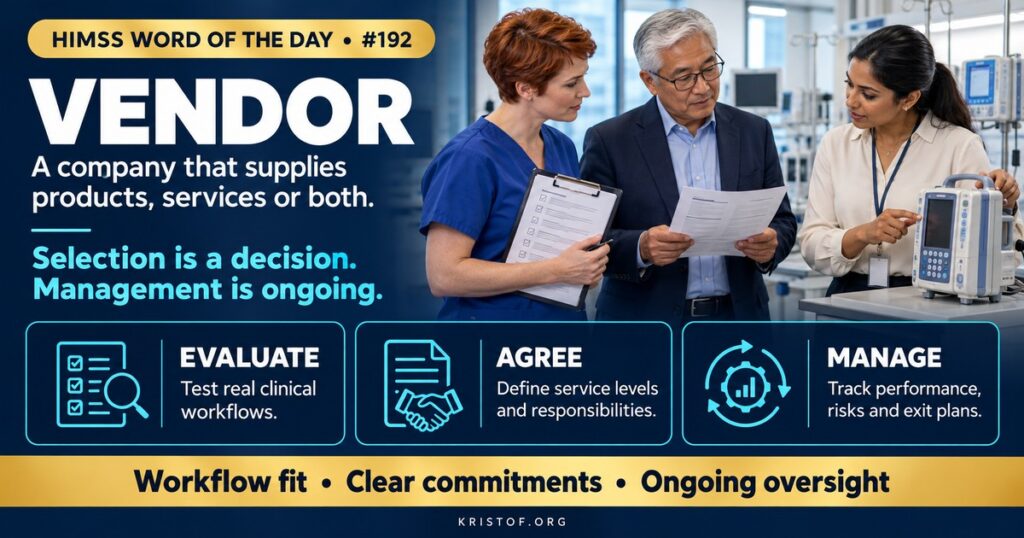
A vendor is a company that provides products, services, or both. In healthcare IT, the word covers a wide range of suppliers: EHR developers, medical device manufacturers, cloud hosting providers, revenue cycle services, consultants, and the staffing firms that support go-lives.
The HIMSS Dictionary keeps the definition short, which fits how broadly the word is used. What matters in practice is the relationship, including what is promised, who is accountable when something fails, and how the vendor’s own suppliers affect the hospital.
| Vendor Type | What It Provides | Example Concern |
|---|---|---|
| EHR Vendor | Core clinical and revenue systems | Upgrade schedule, configuration control |
| Device Manufacturer | Monitors, pumps, scanners | Patching, wireless support, integration |
| Cloud or Hosting Provider | Infrastructure and software as a service | Availability, business associate obligations |
| Specialty Application Vendor | Targeted tools such as analytics or scheduling | Interface effort, long-term support |
| Service or Consulting Firm | Implementation, analysts, training | Knowledge transfer, quality of staffing |
| Revenue Cycle or Clearinghouse Vendor | Claims and payment processing | Concentration risk, continuity |
⚠️ Exam Alert: A vendor supplies products or services. A business associate is a HIPAA role for an outside party that handles protected health information on behalf of a covered entity. A vendor can be a business associate, but not every vendor is one. Selection is a process, while vendor management is the ongoing relationship after the contract is signed.
🌐 Why It Matters: Real-World Healthcare IT Context
Hospitals rarely build their own core systems. They buy or license them, so vendor decisions shape clinical workflow, safety, budgets, and security for many years. Choosing a vendor is one decision. Managing the relationship is a continuing responsibility.
Research suggests that the vendor name alone does not guarantee quality. A study of 1,272 hospitals in 2018 compared results by EHR vendor across four measures: the Leapfrog computerized provider order entry evaluation, CMS star ratings, hospital-acquired condition scores, and readmission ratios. Performance varied across and within vendors, no vendor was linked to higher performance on all measures, and vendor explained only a small share of the variation in quality, between about 1 and 8 percent depending on the measure. Implementation, configuration, governance, and local practice appear to matter at least as much as the product.
Contracts and transparency matter too. ONC rules restrict certain contract terms, often called gag clauses, that once limited users from sharing screenshots or discussing usability and safety problems. A later review of peer-reviewed EHR usability and safety articles found that screenshots stayed uncommon both before and after the policy change, which suggests that removing contract barriers does not by itself make safety information flow freely. Hospitals can still negotiate for the right to share safety information with patient safety organizations, regulators, and peers.
Certification provides one starting point. ONC maintains the Certified Health IT Product List, which shows which products meet certification criteria. Certification confirms specific capabilities. It does not guarantee a good fit, easy usability, or safe configuration.
Third-party risk is a major security theme. Attackers target vendors because one compromise can reach many customers. The Change Healthcare incident in 2024 affected claims processing across the country, and HHS reported that about 192.7 million individuals were affected as of July 2025. NIST guidance on cybersecurity supply chain risk management helps organizations assess suppliers, set requirements, and monitor them over time.
HIPAA adds obligations. A vendor that creates, receives, maintains, or transmits protected health information for a covered entity is a business associate and must sign a business associate agreement. Cloud providers can fall into this category even when they hold only encrypted information.
Good vendor management covers more than purchasing. It includes service level agreements, escalation paths, defect tracking, upgrade planning, exit and data return terms, and periodic reviews of performance and security posture.
Common vendor-related problems:
- Selecting a product on features without testing real workflows
- Contracts that omit safety reporting, data return, or exit terms
- Overreliance on one vendor with no continuity plan
- Unclear responsibility between hospital and vendor teams
- Limited visibility into the vendor’s own suppliers
- Defects reported informally and never tracked
What supports healthy vendor relationships:
- Scenario-based demonstrations with clinicians
- Clear service levels and escalation contacts
- Business associate agreements and security reviews
- Governance that owns configuration decisions
- Defect and enhancement tracking with the vendor
- Exit planning and periodic performance reviews
🏥 The Nurse’s Perspective: Clinical, Bedside, & Workflow
Nurses meet vendors in practice more often than job descriptions suggest, from device representatives teaching a new pump to vendor analysts staffing a go-live.
At the Bedside
Vendor decisions show up as the equipment and screens nurses use every shift. Features that look good in a demonstration can behave differently on a busy unit, which is why nurse input during evaluation is valuable. Clinicians who test realistic scenarios, such as a medication pass or a rapid response, give selection teams information that sales materials cannot.
When something does not work, specific reports help. Patient safety event reports and help desk tickets should describe the device or screen, the steps taken, and what happened, so that the hospital can pass accurate details to the vendor.
In Clinical Workflow
Many problems that feel like vendor problems are configuration decisions made locally, and many that feel local are product limits. Nurse informaticists help sort the two by documenting the workflow, checking build decisions, and escalating confirmed defects through the proper channel.
Vendor staff also bring knowledge about how other hospitals solved similar problems. Nurses who ask about peer practices, rather than accepting a single approach, often improve the result.
Security awareness applies. Vendor representatives on units should follow badge, visitor, and network access rules, and clinicians should not share logins with outside staff.
In EHR Implementation (Go-Live Perspective)
An Epic Go-Live brings vendor-trained analysts, hospital staff, and sometimes consultants into the same units. Clear roles keep that crowd useful, so nurses know whom to call for a workflow question versus a defect.
At-the-elbow support analysts act as the human link between bedside staff and the vendor’s build teams. Detailed examples gathered during the first days feed fixes, enhancement requests, and training updates.
🎓 CAHIMS / CPHIMS & HIMSS Perspective
CAHIMS Exam Domain Mapping
Vendor topics appear across management, standards, and security questions:
| CAHIMS Domain | How Vendors Appear |
|---|---|
| Healthcare & Technology Environments | Vendor landscape, certification, regulatory requirements |
| Clinical Informatics | Vendor-supplied content, workflow fit, usability and safety |
| Healthcare Information & Systems Management | Selection, contracts, service levels, interfaces, security reviews |
| Management & Leadership | Vendor governance, total cost, risk management, exit planning |
Key Terms to Know Alongside Vendor
- Request for Proposal (RFP) — formal solicitation used to compare vendor offerings
- Business Associate Agreement (BAA) — contract required when a vendor handles protected health information
- Service Level Agreement (SLA) — measurable commitments for performance and support
- Total Cost of Ownership (TCO) — full cost of a product over its life, beyond the purchase price
- Third-Party Risk — exposure created by suppliers and their suppliers
- Certified Health IT Product List (CHPL) — ONC listing of certified products
HIMSS Organizational Position
HIMSS supports informed technology selection and implementation through education, certifications, and research that help healthcare organizations evaluate and adopt health IT. Members can find related resources through the HIMSS Resource Center.
🔗 Explore Further: External References
- Holmgren et al. (2021), JAMIA — Assessing Hospital Electronic Health Record Vendor Performance Across Publicly Reported Quality Measures https://pubmed.ncbi.nlm.nih.gov/34333626/
- Bapna et al. (2023), JAMIA — Electronic Health Record “Gag Clauses” and the Prevalence of Screenshots in Peer-Reviewed Literature https://pubmed.ncbi.nlm.nih.gov/37468440/
- ONC — Certified Health IT Product List (CHPL) https://chpl.healthit.gov/
- NIST — SP 800-161 Rev. 1, Cybersecurity Supply Chain Risk Management Practices for Systems and Organizations https://csrc.nist.gov/pubs/sp/800/161/r1/upd1/final
- HHS — Business Associates https://www.hhs.gov/hipaa/for-professionals/privacy/guidance/business-associates/index.html
- HHS — Change Healthcare Cybersecurity Incident Frequently Asked Questions https://www.hhs.gov/hipaa/for-professionals/special-topics/change-healthcare-cybersecurity-incident-frequently-asked-questions/index.html
Term source: HIMSS Dictionary of Health Information and Technology Terms, Acronyms, and Organizations, 6th Edition (2025). All definitions in this series are paraphrased for editorial purposes. Readers are encouraged to consult the primary source for exact language.
Eric Andrew Kristof, RN, CAHIMS is a Healthcare IT professional and HIMSS Arkansas Chapter member based in Hot Springs Village, AR, with hands-on Epic Go-Live experience and a diverse healthcare and IT background. He writes at kristof.org at the intersection of clinical care and healthcare technology.
Leave a Reply