By Eric Andrew Kristof, RN, CAHIMS | Healthcare IT Professional | HIMSS Arkansas Chapter Member
About This Series: The HIMSS Word of the Day is a running blog series drawing from the HIMSS Dictionary of Health Information and Technology Terms, Acronyms, and Organizations, 6th Edition (2025) — the authoritative reference for healthcare IT professionals and the primary study resource for CAHIMS and CPHIMS certification. Each post paraphrases the term in plain language, grounds it in real-world healthcare IT context, and adds a bedside nursing perspective you won’t find in a textbook.
📖 The Term: Digital Health
Source: HIMSS Dictionary of Health Information and Technology Terms, Acronyms, and Organizations, 6th Edition (2025)
🔍 Plain-Language Definition
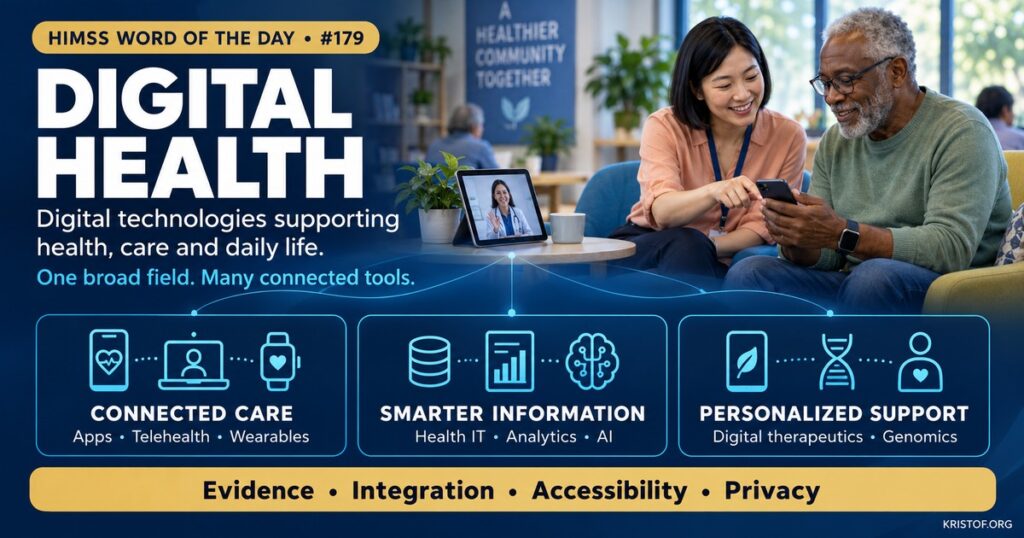
Digital health is the broad field of using digital technologies, such as mobile devices, sensors, software, networks, data analytics, artificial intelligence, and genomic information, to support health, prevent disease, deliver care, and improve health systems.
The HIMSS Dictionary draws on Paul Sonnier’s description of digital health as the coming together of digital and genomic advances with health, healthcare, daily living, and society. Its building blocks, in that description, range from wireless devices, sensors, and microchips to the internet, social and mobile networks, health IT, and personal genetic information.
| Digital Health Area | What It Includes | Example |
|---|---|---|
| mHealth | Mobile apps and devices | A medication reminder app |
| Telehealth | Remote care delivery | Video visits and remote consultations |
| Remote Monitoring and Wearables | Sensors collecting health data | Connected blood pressure cuffs and activity trackers |
| Digital Therapeutics | Evidence-based software treatments | An FDA-authorized app for a behavioral condition |
| Health IT and Data | EHRs, interoperability, analytics | Patient portals and FHIR-based apps |
| AI and Advanced Analytics | Algorithms that interpret data | Image analysis and predictive models |
| Genomics and Precision Health | Genetic data used in care | Pharmacogenomic testing guiding medication choice |
⚠️ Exam Alert: Digital health is the umbrella; mHealth, telehealth, digital therapeutics, and health IT are components. Some digital health products are regulated medical devices and many are not. Digital health literacy is the ability to find, understand, and use digital health tools and information.
🌐 Why It Matters: Real-World Healthcare IT Context
Digital health is reshaping how people manage their health and how care is delivered. Patients use apps and wearables to track symptoms and activity, attend video visits, view results in portals, and share data with clinicians. Health systems use digital tools for remote monitoring, virtual nursing, AI-supported decisions, and population health.
Regulators have adapted. The FDA established its Digital Health Center of Excellence to coordinate oversight of digital health technologies, including software as a medical device, AI-enabled devices, wearables, and cybersecurity. Many wellness and low-risk tools are not actively regulated, while products that diagnose or treat disease may require FDA clearance or approval.
Global health organizations promote digital health strategically. The World Health Organization adopted a global strategy on digital health for 2020 to 2025 to encourage countries to develop national digital health strategies, interoperable systems, and governance that protect people’s rights.
Evidence matters. Thousands of digital health products exist, but evidence of clinical benefit varies widely. Some, such as certain digital therapeutics and remote monitoring programs, have supporting studies, while many apps have little rigorous evaluation. Health systems increasingly require evidence, security reviews, and workflow analysis before adopting tools.
Integration determines usefulness. Data from apps and devices only helps care when it reaches clinicians in a usable form, with clear responsibility for reviewing it. Standards such as FHIR and patient access APIs make integration more feasible, but workflows must be designed thoughtfully to avoid overwhelming clinicians.
Equity is a central concern. Digital divides in broadband access, devices, digital literacy, language, and disability can leave some patients behind. Designing for accessibility, offering alternatives, and supporting digital health literacy help ensure benefits reach everyone.
Privacy and trust are essential. Many consumer tools fall outside HIPAA, and data may be shared with third parties. Clear privacy practices, security, and transparency build trust in digital health.
Workforce readiness is another factor. Clinicians need training not only in using specific tools but in interpreting patient-generated data, explaining AI outputs, and judging when digital care is appropriate versus when an in-person visit is needed. Many nursing and medical education programs are adding digital health competencies to their curricula, and organizations are creating roles such as virtual care nurses and digital navigators.
Payment shapes adoption. Coverage for telehealth, remote monitoring, digital mental health treatment, and other services influences which tools are sustainable in practice.
Sustainability depends on governance. Health systems that adopt many tools without a strategy can end up with overlapping apps, duplicated data, and confused patients. A digital health governance process that reviews requests, retires unused tools, and coordinates patient-facing technology keeps the portfolio manageable.
Common digital health challenges:
- Limited evidence for many products
- Poor integration with EHRs and workflows
- Data overload for clinicians
- Digital divides and accessibility barriers
- Privacy gaps for non-HIPAA tools
- Uncertain or changing reimbursement
What supports effective digital health:
- Evidence review before adoption
- Integration through standards and clear workflows
- Patient support and digital literacy resources
- Accessible design and non-digital alternatives
- Strong privacy and security practices
- Measurement of outcomes and engagement
🏥 The Nurse’s Perspective: Clinical, Bedside, & Workflow
Nurses help patients adopt digital tools and help organizations use them safely.
At the Bedside
Patients often ask nurses about apps, wearables, or online information. Nurses can help evaluate credibility, encourage use of organization-approved tools, and explain how information will be shared with the care team.
Teaching patients to use portals, video visits, and home monitoring devices is an increasingly common nursing task. Teach-back and simple written instructions improve success.
Patients sharing self-tracked data at visits benefit when nurses ask what they track and why, connecting digital habits to care goals.
In Clinical Workflow
Remote monitoring and virtual care programs often rely on nurses to review incoming data, contact patients, and escalate concerns. Clear protocols define which readings require action and how quickly.
Assessing digital health literacy, such as whether a patient has a smartphone, reliable internet, and comfort with technology, helps nurses tailor education and offer alternatives when needed.
Nurse informaticists evaluate digital tools for usability, workflow fit, and patient safety, and help integrate them into clinical systems.
Digital navigators, sometimes nurses or trained staff, help patients set up and troubleshoot tools, freeing clinicians to focus on clinical questions.
In EHR Implementation (Go-Live Perspective)
During an Epic Go-Live, patient portal activation, video visit integration, and device data connections are often launched or rebuilt. Nurses frequently help patients sign up for portals during visits.
At-the-elbow support analysts help nurses navigate new digital workflows, such as reviewing patient-submitted questionnaires or device readings.
🎓 CAHIMS / CPHIMS & HIMSS Perspective
CAHIMS Exam Domain Mapping
Digital health appears in technology trend and patient engagement questions:
| CAHIMS Domain | How Digital Health Appears |
|---|---|
| Healthcare & Technology Environments | Digital health trends; FDA and WHO approaches; reimbursement |
| Clinical Informatics | Patient engagement, remote monitoring workflows, digital literacy |
| Healthcare Information & Systems Management | Integration, APIs, device data, security |
| Management & Leadership | Digital strategy, evidence review, equity, vendor evaluation |
Key Terms to Know Alongside Digital Health
- mHealth — health care supported by mobile devices
- Telehealth — delivery of health services at a distance
- Digital Therapeutics — evidence-based software interventions that treat or manage conditions
- Software as a Medical Device (SaMD) — software intended for medical purposes without being part of hardware
- Digital Health Literacy — the ability to find, understand, and use digital health tools
- Digital Divide — gaps in access to technology and connectivity
HIMSS Organizational Position
HIMSS promotes digital health transformation through its education, research, maturity models, and global community, emphasizing interoperability, equity, and measurable outcomes. Members can find related education and research through the HIMSS Resource Center.
🔗 Explore Further: External References
- FDA — Digital Health Center of Excellence https://www.fda.gov/medical-devices/digital-health-center-excellence
- World Health Organization — Global Strategy on Digital Health 2020–2025 https://www.who.int/publications/i/item/9789240020924
- World Health Organization — Digital Health https://www.who.int/health-topics/digital-health
- FDA — Policy for Device Software Functions and Mobile Medical Applications https://www.fda.gov/regulatory-information/search-fda-guidance-documents/policy-device-software-functions-and-mobile-medical-applications
- AMA — Digital Health Implementation Playbook Series https://www.ama-assn.org/practice-management/digital-health/digital-health-implementation-playbook-series
- HIMSS — Virtual Care Community https://www.himss.org/networking/communities/virtual-care/
Term source: HIMSS Dictionary of Health Information and Technology Terms, Acronyms, and Organizations, 6th Edition (2025). All definitions in this series are paraphrased for editorial purposes. Readers are encouraged to consult the primary source for exact language.
Eric Andrew Kristof, RN, CAHIMS is a Healthcare IT professional and HIMSS Arkansas Chapter member based in Hot Springs Village, AR, with hands-on Epic Go-Live experience and a diverse healthcare and IT background. He writes at kristof.org at the intersection of clinical care and healthcare technology.
Leave a Reply