By Eric Andrew Kristof, RN, CAHIMS | Healthcare IT Professional | HIMSS Arkansas Chapter Member
About This Series: The HIMSS Word of the Day is a running blog series drawing from the HIMSS Dictionary of Health Information and Technology Terms, Acronyms, and Organizations, 6th Edition (2025) — the authoritative reference for healthcare IT professionals and the primary study resource for CAHIMS and CPHIMS certification. Each post paraphrases the term in plain language, grounds it in real-world healthcare IT context, and adds a bedside nursing perspective you won’t find in a textbook.
📖 The Term: Value-Based Insurance Design (VBID)
Source: HIMSS Dictionary of Health Information and Technology Terms, Acronyms, and Organizations, 6th Edition (2025)
🔍 Plain-Language Definition
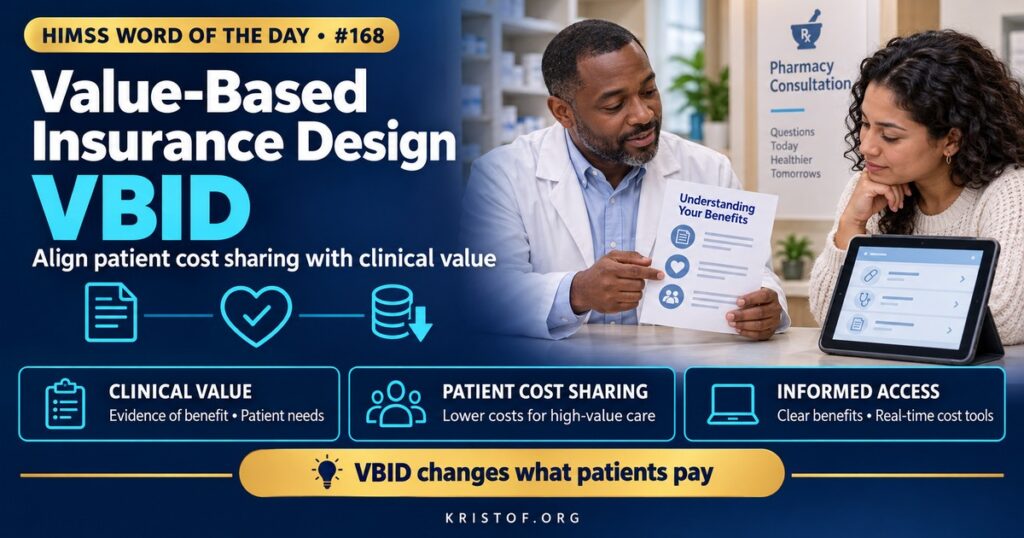
Value-based insurance design (VBID) is an approach to health benefit design that sets patients’ cost sharing, such as copays, coinsurance, and deductibles, according to the clinical value of services rather than their price alone.
The HIMSS Dictionary describes VBID as encouraging patients to use high-value care by adjusting the cost sharing they pay for different options. It explains that high-value treatments may have reduced or no cost sharing so they remain affordable, while plans may sometimes charge more for services that add little clinical benefit relative to their cost.
| VBID Feature | How It Works | Example |
|---|---|---|
| Reduced Cost Sharing for High-Value Care | Lower or no copays for proven services | No copay for insulin or blood pressure medications |
| Targeting by Condition | Benefits for people with specific diagnoses | Lower costs for diabetes supplies for members with diabetes |
| Higher Cost Sharing for Low-Value Care | Discourage services with little benefit | Higher cost for imaging without clear indication |
| Provider-Based Incentives | Lower costs for high-performing providers | Reduced copays at designated centers of excellence |
| Program Participation Incentives | Lower costs for engaging in programs | Reduced copays for completing care management |
⚠️ Exam Alert: VBID changes what patients pay based on clinical value. Value-based payment changes how providers are paid. Underuse means failing to receive beneficial care, which VBID aims to reduce. One-size-fits-all cost sharing can discourage needed care for people with chronic conditions.
🌐 Why It Matters: Real-World Healthcare IT Context
Cost sharing affects behavior. Research has long shown that higher out-of-pocket costs reduce use of both needed and unneeded care. When patients with chronic conditions skip medications or follow-up visits because of cost, complications and preventable hospitalizations can follow, raising total costs.
VBID tries to make cost sharing smarter. The concept was developed in large part by researchers at the University of Michigan, whose Center for Value-Based Insurance Design promotes clinically nuanced benefit design. Employers, public programs, and health plans have adopted elements such as lower copays for chronic disease medications and preventive services.
Federal policy has incorporated related ideas. The Affordable Care Act requires most private plans to cover many recommended preventive services without cost sharing. IRS guidance has allowed high-deductible health plans paired with health savings accounts to cover certain preventive care for chronic conditions before the deductible is met.
CMS tested VBID in Medicare Advantage. The CMS Innovation Center’s Medicare Advantage Value-Based Insurance Design Model allowed participating plans to offer targeted supplemental benefits and reduced cost sharing for enrollees with chronic conditions or low incomes, and later included a hospice benefit component. CMS ended the model at the end of 2025, citing evaluation findings, including concerns about increased risk score growth, and stated that it would build on lessons learned.
Data is essential to VBID. Plans need claims, pharmacy, and clinical data to identify members with qualifying conditions, determine which services are high value, and measure effects on adherence, outcomes, and costs. Evidence on which services are high or low value comes from clinical research and guideline bodies.
Communication challenges are significant. Benefit designs can be complex, and patients and clinicians may not know which services carry reduced costs. Real-time benefit tools that show patient cost at the point of prescribing can help clinicians choose affordable options.
Low-value care is the harder side. Identifying services that offer little benefit, such as imaging for uncomplicated low back pain or certain routine tests, is well supported by initiatives that catalog low-value services, but raising patients’ costs for them is controversial and less common than reducing costs for high-value care. Many organizations address low-value care through clinician education and decision support instead.
Evidence on outcomes is mixed but suggests benefits in specific areas. Studies of reduced medication copays have often found improved adherence, while effects on total spending vary depending on design and population.
Common VBID challenges:
- Identifying which services are truly high or low value
- Complex benefit designs that confuse patients
- Data needed to target eligible members
- Uncertain effects on total cost
- Administrative complexity for plans and providers
- Ensuring benefits reach people who need them most
What supports effective VBID:
- Evidence-based definitions of high- and low-value care
- Accurate data to identify eligible members
- Clear communication to patients and clinicians
- Real-time benefit information in clinical workflow
- Evaluation of adherence, outcomes, and costs
- Attention to equity in benefit design
🏥 The Nurse’s Perspective: Clinical, Bedside, & Workflow
Nurses frequently see the effects of cost sharing on patients’ ability to follow care plans.
At the Bedside
Patients may admit they cannot afford medications or supplies, or nurses may discover missed doses during medication reconciliation. Asking about cost barriers respectfully helps identify patients who might benefit from lower-cost options or benefit programs.
Discharge planning can include checking whether prescribed medications are affordable under the patient’s plan, preventing gaps in therapy after discharge.
In Clinical Workflow
Care managers and ambulatory nurses can help patients understand benefits such as reduced copays for chronic disease medications or preventive services. Connecting patients with pharmacists, social workers, or assistance programs supports adherence.
Real-time prescription benefit tools in the EHR may show patient-specific costs and alternatives. Nurses involved in medication management can use this information to support conversations about affordable options.
Adherence monitoring, such as pharmacy refill data, can reveal patients who may be struggling with costs, prompting outreach.
Nurses also hear when benefit changes surprise patients, such as a new copay at the start of a plan year, and can route patients to financial counselors.
In EHR Implementation (Go-Live Perspective)
During an Epic Go-Live, organizations may enable real-time benefit checks and connect to pharmacy benefit information. Testing confirms that cost information displays accurately for different plans.
At-the-elbow support analysts can show clinicians and nurses where to find benefit information when prescribing or reconciling medications.
🎓 CAHIMS / CPHIMS & HIMSS Perspective
CAHIMS Exam Domain Mapping
VBID appears in payment and policy questions:
| CAHIMS Domain | How VBID Appears |
|---|---|
| Healthcare & Technology Environments | Benefit design; CMS Innovation Center models; preventive services coverage |
| Clinical Informatics | Medication adherence, real-time benefit tools, discharge planning |
| Healthcare Information & Systems Management | Claims and pharmacy data, member targeting, evaluation analytics |
| Management & Leadership | Plan strategy, value-based care alignment, equity |
Key Terms to Know Alongside VBID
- Cost Sharing — the portion of costs patients pay, such as copays and deductibles
- High-Value Care — services with strong evidence of benefit relative to cost
- Low-Value Care — services that provide little or no benefit for their cost or risk
- Medication Adherence — taking medications as prescribed
- Real-Time Benefit Tool — technology showing patient-specific drug costs at prescribing
- Underuse — failure to provide beneficial care
HIMSS Organizational Position
HIMSS supports value-based care through education on data, analytics, and interoperability, including the information flows that connect benefits, pharmacies, and clinical care. Members can find related education and research through the HIMSS Resource Center.
🔗 Explore Further: External References
- CMS — Medicare Advantage Value-Based Insurance Design Model https://www.cms.gov/priorities/innovation/innovation-models/vbid
- University of Michigan — Center for Value-Based Insurance Design https://vbidcenter.org/
- HealthCare.gov — Preventive Care Benefits https://www.healthcare.gov/coverage/preventive-care-benefits/
- IRS — Notice 2019-45, Additional Preventive Care Benefits for HSA-Eligible Plans https://www.irs.gov/pub/irs-drop/n-19-45.pdf
- CMS — About the CMS Innovation Center https://www.cms.gov/priorities/innovation/about
- HIMSS — Public Policy & Advocacy https://www.himss.org/public-policy-advocacy-overview
Term source: HIMSS Dictionary of Health Information and Technology Terms, Acronyms, and Organizations, 6th Edition (2025). All definitions in this series are paraphrased for editorial purposes. Readers are encouraged to consult the primary source for exact language.
Eric Andrew Kristof, RN, CAHIMS is a Healthcare IT professional and HIMSS Arkansas Chapter member based in Hot Springs Village, AR, with hands-on Epic Go-Live experience and a diverse healthcare and IT background. He writes at kristof.org at the intersection of clinical care and healthcare technology.
Leave a Reply