By Eric Andrew Kristof, RN, CAHIMS | Healthcare IT Professional | HIMSS Arkansas Chapter Member
About This Series: The HIMSS Word of the Day is a running blog series drawing from the HIMSS Dictionary of Health Information and Technology Terms, Acronyms, and Organizations, 6th Edition (2025) — the authoritative reference for healthcare IT professionals and the primary study resource for CAHIMS and CPHIMS certification. Each post paraphrases the term in plain language, grounds it in real-world healthcare IT context, and adds a bedside nursing perspective you won’t find in a textbook.
📖 The Term: Managed Care
Source: HIMSS Dictionary of Health Information and Technology Terms, Acronyms, and Organizations, 6th Edition (2025)
🔍 Plain-Language Definition
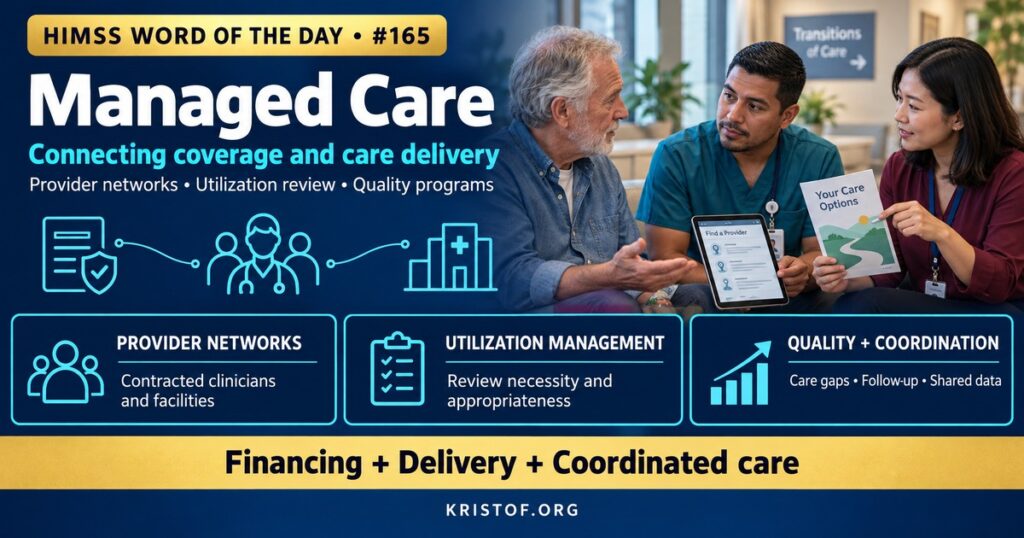
Managed care is an approach to health coverage that integrates the financing of care with its delivery, using contracted provider networks, utilization management, quality programs, and financial incentives to manage cost and appropriateness of care for members.
The HIMSS Dictionary describes managed care as an insurance approach that joins the paying for care with the providing of care and related services, aiming to keep purchaser costs down while providing what is appropriate for a patient or population. It notes that definitions have evolved over decades, and that common features include a limited network of credentialed, contracted providers, utilization management, quality management, incentives for patients to use network providers, and some financial incentives or risk-sharing for providers.
| Managed Care Model | Key Features | Example |
|---|---|---|
| HMO (Health Maintenance Organization) | Network required; often a primary care gatekeeper | Referrals needed for specialists |
| PPO (Preferred Provider Organization) | Lower costs in network; some out-of-network coverage | Higher cost sharing for out-of-network care |
| POS (Point of Service) | Combines HMO and PPO features | Primary care referral with some out-of-network options |
| Medicare Advantage | Private plans providing Medicare benefits | A Medicare HMO or PPO with added benefits |
| Medicaid Managed Care | States contract with plans to serve Medicaid enrollees | Managed care organizations coordinating Medicaid benefits |
⚠️ Exam Alert: Managed care combines financing and delivery. Capitation is a common payment method within managed care. Utilization management reviews necessity and appropriateness of services. Medicare Advantage plans are paid on a capitated, risk-adjusted basis, unlike Original Medicare fee-for-service.
🌐 Why It Matters: Real-World Healthcare IT Context
Managed care grew rapidly in the United States after the HMO Act of 1973 encouraged the development of health maintenance organizations, and it became the dominant model in employer coverage in later decades. Today it is central to public programs as well.
Medicare Advantage has expanded steadily. KFF’s 2026 analysis found that Medicare Advantage plans covered about 55 percent of eligible Medicare beneficiaries. Most Medicaid enrollees also receive care through managed care arrangements, as states contract with plans to coordinate benefits and manage costs.
Managed care relies on several tools. Provider networks with negotiated rates and credentialing set where members can receive covered care. Utilization management, including prior authorization and concurrent review, evaluates whether services are necessary and appropriate. Care management programs target high-risk members. Quality programs measure performance using tools such as HEDIS, and Medicare Advantage plans receive Star Ratings that affect payments.
Payment arrangements vary. Plans may pay providers fee-for-service, use capitation, or share risk through value-based contracts. Medicare Advantage plans receive risk-adjusted payments, which makes accurate diagnosis documentation and coding financially significant.
Data and health IT are essential. Plans depend on claims, enrollment, pharmacy, and increasingly clinical data from providers. Electronic prior authorization, payer data exchange APIs, and HEDIS supplemental data feeds connect plans and providers. Federal interoperability rules require many plans to support patient access, provider access, and payer-to-payer data exchange through FHIR APIs.
Managed care faces criticism. Prior authorization delays, narrow networks, inaccurate provider directories, and denials frustrate patients and clinicians. Oversight bodies have raised concerns about inappropriate denials and risk adjustment practices in Medicare Advantage. Supporters point to care coordination, added benefits, and lower cost growth.
Supplemental benefits are a distinctive feature of Medicare Advantage. Many plans offer dental, vision, hearing, fitness, transportation, or meal benefits not covered by Original Medicare, and special needs plans focus on people with chronic conditions, institutional needs, or dual Medicare and Medicaid eligibility. Coordinating these benefits with clinical care requires information sharing between plans and providers.
For providers, managed care means managing many plans with different rules. Health IT that consolidates eligibility, authorization requirements, and care gap information into the workflow reduces burden.
Policy continues to evolve. CMS has adopted rules to streamline prior authorization, require faster decisions, and improve transparency, and it adjusts Medicare Advantage payment and Star Rating methods through annual rulemaking.
Common managed care challenges:
- Prior authorization delays and administrative burden
- Narrow or inaccurate provider networks
- Variation in rules across many plans
- Disputes over denials and medical necessity
- Risk adjustment documentation pressures
- Fragmented data between plans and providers
What supports effective managed care relationships:
- Electronic eligibility and prior authorization tools
- Data sharing for care gaps and quality measures
- Coordinated care management between plans and providers
- Accurate provider directories
- Clear contracts with quality and value incentives
- Transparent appeals and grievance processes
🏥 The Nurse’s Perspective: Clinical, Bedside, & Workflow
Nurses work throughout managed care, in health plans, care management programs, and provider organizations.
At the Bedside
Patients’ coverage affects their care paths, such as which specialists and post-acute providers are in network. Hospital nurses and case managers often help patients understand network limitations during discharge planning.
Accurate documentation of diagnoses, severity, and functional status supports both appropriate authorization decisions and accurate risk adjustment.
Transitions between plans, such as when patients change Medicare Advantage plans during enrollment periods, can disrupt authorizations and networks. Checking coverage at each admission prevents surprises.
In Clinical Workflow
Many health plans employ nurses as utilization reviewers and care managers. Plan care managers contact members with chronic conditions, coordinate services, and connect them with community resources.
In hospitals and clinics, nurses handle prior authorizations, communicate with plan reviewers, and coordinate follow-up for members identified as high risk. Shared information reduces duplicate outreach.
Care gap reports from plans, often based on HEDIS measures, guide outreach in primary care. Nurses who document completed care accurately help close gaps and ensure that plans see the care delivered.
Patients often need help navigating appeals when services are denied. Nurses can explain the process and connect patients with case management or financial counseling teams.
In EHR Implementation (Go-Live Perspective)
During an Epic Go-Live, organizations configure payer information, eligibility checks, authorization workflows, and plan-specific requirements. Errors in payer setup can lead to denials and delays.
At-the-elbow support analysts help staff find coverage and authorization information in the new system. Escalating payer configuration issues quickly prevents downstream financial and access problems.
🎓 CAHIMS / CPHIMS & HIMSS Perspective
CAHIMS Exam Domain Mapping
Managed care appears in payment, policy, and data exchange questions:
| CAHIMS Domain | How Managed Care Appears |
|---|---|
| Healthcare & Technology Environments | Medicare Advantage; Medicaid managed care; plan types |
| Clinical Informatics | Authorization workflows, care management, documentation for risk adjustment |
| Healthcare Information & Systems Management | Claims, eligibility, payer APIs, quality data exchange |
| Management & Leadership | Payer contracting, value-based arrangements, network strategy |
Key Terms to Know Alongside Managed Care
- Health Maintenance Organization (HMO) — a managed care plan requiring use of network providers
- Preferred Provider Organization (PPO) — a plan with lower costs for network providers and some out-of-network coverage
- Medicare Advantage — private plans that provide Medicare benefits
- Capitation — a fixed payment per member per period
- Utilization Management — review of the necessity and appropriateness of services
- Risk Adjustment — payment adjustments based on members’ expected health costs
HIMSS Organizational Position
HIMSS supports payer-provider interoperability and administrative simplification, including electronic prior authorization, through its public policy work and education. Members can find related education and research through the HIMSS Resource Center.
🔗 Explore Further: External References
- KFF — Medicare Advantage in 2026: Enrollment Update and Key Trends https://www.kff.org/medicare/medicare-advantage-in-2026-enrollment-update-and-key-trends/
- MACPAC — Managed Care https://www.macpac.gov/topic/managed-care/
- CMS — Medicare Advantage/Part D Contract and Enrollment Data https://www.cms.gov/data-research/statistics-trends-and-reports/medicare-advantagepart-d-contract-and-enrollment-data
- CMS — Interoperability and Prior Authorization Final Rule (CMS-0057-F) https://www.cms.gov/initiatives/burden-reduction/overview/interoperability/policies-regulations/cms-interoperability-prior-authorization-final-rule-cms-0057-f
- NCQA — HEDIS https://www.ncqa.org/hedis/
- HIMSS — Public Policy & Advocacy https://www.himss.org/public-policy-advocacy-overview
Term source: HIMSS Dictionary of Health Information and Technology Terms, Acronyms, and Organizations, 6th Edition (2025). All definitions in this series are paraphrased for editorial purposes. Readers are encouraged to consult the primary source for exact language.
Eric Andrew Kristof, RN, CAHIMS is a Healthcare IT professional and HIMSS Arkansas Chapter member based in Hot Springs Village, AR, with hands-on Epic Go-Live experience and a diverse healthcare and IT background. He writes at kristof.org at the intersection of clinical care and healthcare technology.
Leave a Reply