By Eric Andrew Kristof, RN, CAHIMS | Healthcare IT Professional | HIMSS Arkansas Chapter Member
About This Series: The HIMSS Word of the Day is a running blog series drawing from the HIMSS Dictionary of Health Information and Technology Terms, Acronyms, and Organizations, 6th Edition (2025) — the authoritative reference for healthcare IT professionals and the primary study resource for CAHIMS and CPHIMS certification. Each post paraphrases the term in plain language, grounds it in real-world healthcare IT context, and adds a bedside nursing perspective you won’t find in a textbook.
📖 The Term: Merit-based Incentive Payment System (MIPS)
Source: HIMSS Dictionary of Health Information and Technology Terms, Acronyms, and Organizations, 6th Edition (2025)
🔍 Plain-Language Definition
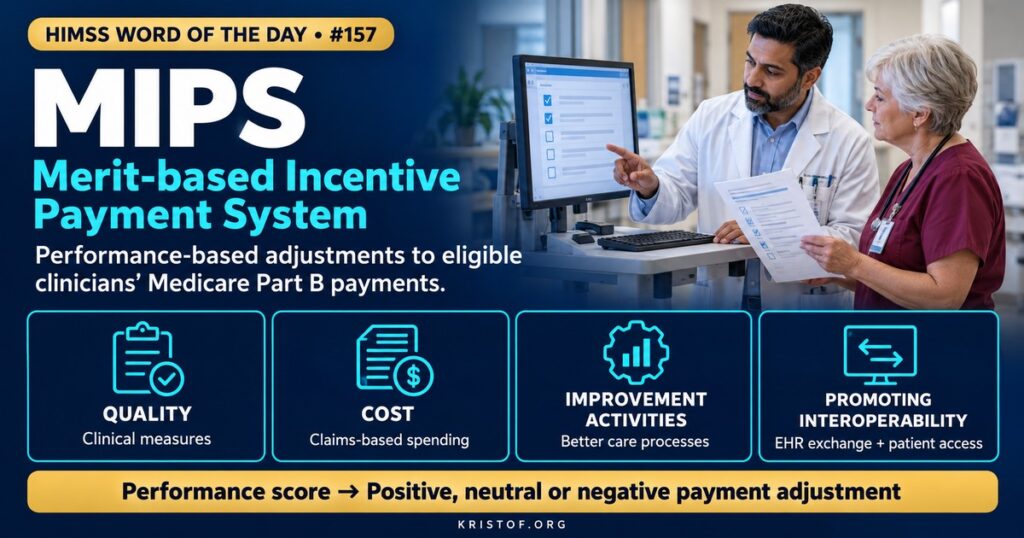
The Merit-based Incentive Payment System (MIPS) is one of the two tracks of Medicare’s Quality Payment Program. It adjusts Medicare Part B payments to eligible clinicians, positively, negatively, or not at all, based on their performance across several categories.
The HIMSS Dictionary describes MIPS as a program created under MACRA in 2015 that brought together earlier quality and incentive programs, including the Physician Quality Reporting System, the Value-based Payment Modifier, and the Medicare EHR Incentive Program, often called Medicare’s meaningful use. It explains that clinicians are scored in four areas: quality, cost, improvement activities, and Promoting Interoperability.
| MIPS Performance Category | What It Measures | Example |
|---|---|---|
| Quality | Performance on selected clinical quality measures | Blood pressure control, cancer screening, diabetes care |
| Cost | Medicare spending for attributed patients, calculated from claims | Total per capita cost; episode-based cost measures |
| Improvement Activities | Activities that improve care processes and patient engagement | Expanded access, care coordination, patient safety work |
| Promoting Interoperability | Use of certified EHR technology for exchange and patient access | E-prescribing, health information exchange, patient electronic access |
⚠️ Exam Alert: The Quality Payment Program has two tracks: MIPS and Advanced APMs. MIPS adjusts fee-for-service payments based on a composite score. Promoting Interoperability replaced the meaningful use component for clinicians. Payment adjustments apply two years after the performance year. MIPS Value Pathways (MVPs) organize reporting around specialties or conditions.
🌐 Why It Matters: Real-World Healthcare IT Context
MIPS is one of the main ways Medicare links clinician payment to performance. It applies to many physicians, nurse practitioners, physician assistants, clinical nurse specialists, certified registered nurse anesthetists, and other eligible clinicians who bill Medicare Part B, unless they are exempt or qualify through an Advanced APM.
Clinicians receive a final score based on their performance in the four categories. Scores above a performance threshold earn positive adjustments, scores below it lead to negative adjustments, and the adjustments apply to Medicare payments in a later payment year. CMS updates measures, weights, and thresholds through annual rulemaking, so practices must track changes each year.
CMS has added MIPS Value Pathways, or MVPs, to make reporting more meaningful. MVPs group measures and activities related to a specialty or condition so clinicians report on a more cohesive set, alongside population health measures calculated by CMS. Traditional MIPS remains available, and CMS has signaled an intention to move more reporting toward MVPs over time.
Health IT is central to MIPS. The Promoting Interoperability category requires use of certified EHR technology for activities such as e-prescribing, health information exchange, and providing patients electronic access to their information. Many quality measures can be reported as electronic clinical quality measures from the EHR, through qualified registries, or through other approved methods.
Data quality drives scores. Quality measures depend on structured documentation of screenings, results, and exclusions. Missing or inconsistent documentation can make good care look poor on paper. Cost measures depend on claims and attribution, which clinicians cannot always see in real time.
Reporting creates burden. Practices must choose measures, collect data, validate results, and submit by deadlines. Smaller practices often rely on EHR vendors, registries, or consultants. Critics, including some policy advisors, have questioned whether MIPS meaningfully distinguishes performance relative to the effort required, which partly motivated MVPs.
Group and virtual group options affect strategy. Clinicians can participate individually, as a group under a shared tax identification number, or in some cases as part of a virtual group, and the choice affects which measures are reported and how scores are calculated. Organizations often analyze which option will best reflect their performance and minimize reporting effort.
MIPS connects to broader payment reform. It is designed as a bridge, encouraging clinicians to build quality and data capabilities that support participation in alternative payment models, which offer a separate path under the Quality Payment Program.
Common MIPS challenges:
- Annual changes in measures, thresholds, and rules
- Documentation that does not capture completed care
- Limited visibility into cost measures during the year
- Reporting burden for small practices
- Dependence on vendor updates for certified EHR technology
- Measures that may not fit every specialty
What supports MIPS success:
- Selecting measures aligned with clinical priorities
- Structured documentation built into workflow
- Regular performance monitoring during the year
- Use of certified EHR features for Promoting Interoperability
- Registry or vendor support for submission
- Team-based processes for closing care gaps
🏥 The Nurse’s Perspective: Clinical, Bedside, & Workflow
Nurses play important roles in MIPS performance, both as eligible clinicians and as members of care teams.
At the Bedside
Many MIPS quality measures depend on work nurses do: screening for depression, falls risk, or tobacco use, documenting blood pressure, giving immunizations, and reconciling medications. Recording this work in structured fields allows it to count toward quality scores.
Advanced practice registered nurses who bill Medicare, such as nurse practitioners, clinical nurse specialists, and certified registered nurse anesthetists, may be MIPS eligible clinicians whose own payments are affected by their scores.
In Clinical Workflow
Pre-visit planning by nurses can identify care gaps related to MIPS measures and address them during the visit through standing orders and protocols.
Care coordination and patient engagement activities led by nurses, such as follow-up after hospital discharge or chronic care management, can support improvement activities and quality outcomes.
Quality nurses and informaticists often monitor MIPS dashboards, validate data, and work with clinicians to correct documentation patterns that cause measures to fail.
Promoting Interoperability activities, such as sending summaries of care and engaging patients through the portal, often involve nursing workflows.
Patient engagement through portals, such as timely access to results and secure messaging, also contributes to Promoting Interoperability and to patient experience.
In EHR Implementation (Go-Live Perspective)
During an Epic Go-Live in ambulatory settings, organizations configure quality measure reporting, health maintenance tools, and Promoting Interoperability workflows. Mid-year transitions require careful planning to combine data from old and new systems for a full performance year.
At-the-elbow support analysts help nurses find where to document measure-related information, such as screenings and patient education, so it is captured correctly from the start.
🎓 CAHIMS / CPHIMS & HIMSS Perspective
CAHIMS Exam Domain Mapping
MIPS appears in policy, quality reporting, and EHR certification questions:
| CAHIMS Domain | How MIPS Appears |
|---|---|
| Healthcare & Technology Environments | MACRA; Quality Payment Program; CMS rulemaking |
| Clinical Informatics | Measure documentation, care gaps, nursing contributions to quality |
| Healthcare Information & Systems Management | Certified EHR technology, eCQMs, registries, data submission |
| Management & Leadership | Payment strategy, performance monitoring, reporting burden |
Key Terms to Know Alongside MIPS
- MACRA — the 2015 law that created the Quality Payment Program
- Quality Payment Program (QPP) — the CMS program with MIPS and Advanced APM tracks
- MIPS Value Pathways (MVPs) — specialty- or condition-focused reporting options within MIPS
- Promoting Interoperability — the MIPS category focused on certified EHR use and data exchange
- Electronic Clinical Quality Measure (eCQM) — a quality measure calculated from EHR data
- Advanced APM — an alternative payment model that offers a separate QPP path
HIMSS Organizational Position
HIMSS engages on MIPS and Promoting Interoperability policy through comments on CMS rules and supports clinicians with education on quality reporting and interoperability. Members can find related education and research through the HIMSS Resource Center.
🔗 Explore Further: External References
- CMS — Quality Payment Program: About QPP https://qpp.cms.gov/get-started/what-is-qpp/about-qpp
- CMS — Traditional MIPS https://qpp.cms.gov/reporting-requirements/ways-to-report/traditional-mips
- CMS — MIPS Value Pathways https://qpp.cms.gov/reporting-requirements/measures-activities/explore-mvps
- eCQI Resource Center — Digital Quality Measures https://ecqi.healthit.gov/dqm/about-dqms
- MedPAC — Medicare Payment Advisory Commission https://www.medpac.gov/
- HIMSS — Public Policy & Advocacy https://www.himss.org/public-policy-advocacy-overview
Term source: HIMSS Dictionary of Health Information and Technology Terms, Acronyms, and Organizations, 6th Edition (2025). All definitions in this series are paraphrased for editorial purposes. Readers are encouraged to consult the primary source for exact language.
Eric Andrew Kristof, RN, CAHIMS is a Healthcare IT professional and HIMSS Arkansas Chapter member based in Hot Springs Village, AR, with hands-on Epic Go-Live experience and a diverse healthcare and IT background. He writes at kristof.org at the intersection of clinical care and healthcare technology.
Leave a Reply