By Eric Andrew Kristof, RN, CAHIMS | Healthcare IT Professional | HIMSS Arkansas Chapter Member
About This Series: The HIMSS Word of the Day is a running blog series drawing from the HIMSS Dictionary of Health Information and Technology Terms, Acronyms, and Organizations, 6th Edition (2025) — the authoritative reference for healthcare IT professionals and the primary study resource for CAHIMS and CPHIMS certification. Each post paraphrases the term in plain language, grounds it in real-world healthcare IT context, and adds a bedside nursing perspective you won’t find in a textbook.
📖 The Term: Patient-Centered Medical Home (PCMH)
Source: HIMSS Dictionary of Health Information and Technology Terms, Acronyms, and Organizations, 6th Edition (2025)
🔍 Plain-Language Definition
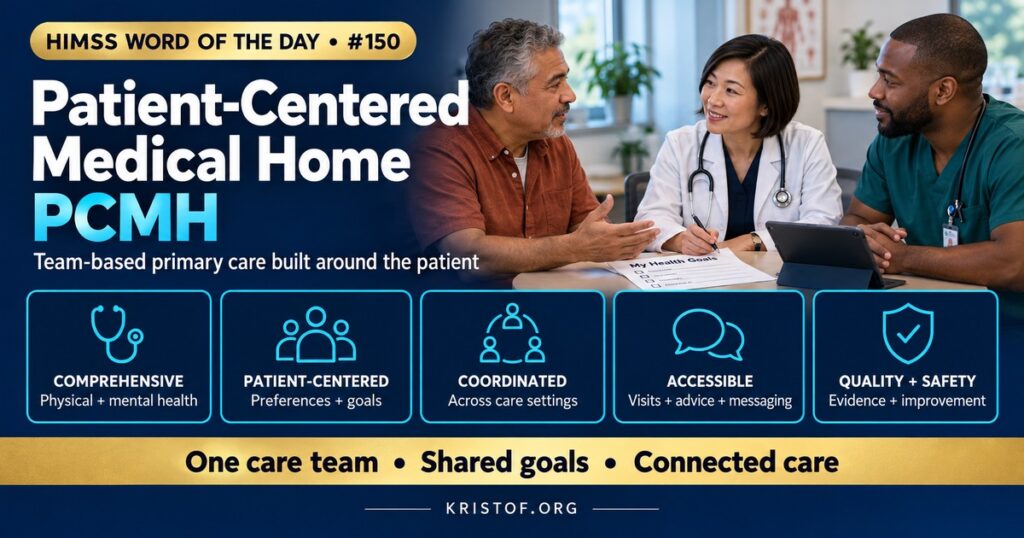
A patient-centered medical home (PCMH) is a model for organizing primary care so that a team of clinicians takes responsibility for a patient’s overall health needs, coordinates care across settings, and makes care accessible, comprehensive, and centered on the patient’s preferences.
The HIMSS Dictionary describes the PCMH as a way of organizing primary care practices to deliver the core functions of primary healthcare. It identifies five functions: comprehensive care, patient-centered care, coordinated care, accessible services, and a focus on quality and safety.
| PCMH Function | What It Means | Example |
|---|---|---|
| Comprehensive Care | A team meets most physical and mental health needs | Integrated behavioral health in the primary care office |
| Patient-Centered | Care reflects patient preferences, culture, and goals | Shared decision-making and self-management support |
| Coordinated Care | Care is organized across specialists, hospitals, and community services | Follow-up calls after an emergency department visit |
| Accessible Services | Patients can reach the team when needed | Same-day appointments, after-hours advice, portal messaging |
| Quality and Safety | Evidence-based care and continuous improvement | Registries that track preventive and chronic care |
⚠️ Exam Alert: A PCMH is a model of primary care delivery, not a payment method or a building. Recognition programs, such as NCQA’s, assess whether practices meet medical home standards. An ACO is an organization accountable for the cost and quality of care for a population, and it may include medical home practices. Capitation and care management fees are payment approaches that can support medical homes.
🌐 Why It Matters: Real-World Healthcare IT Context
Traditional primary care often struggled with short visits, limited access, and little coordination after patients left the office. The medical home model emerged to strengthen primary care so it could serve as the foundation of the health system, managing chronic disease, preventing illness, and guiding patients through complex care.
The concept gained national momentum in 2007, when major primary care physician organizations released joint principles describing the patient-centered medical home. Since then, the model has influenced practice transformation programs, payer initiatives, and federal policy.
Recognition programs translate the model into measurable standards. NCQA’s PCMH Recognition program is among the most widely used, evaluating practices on concepts such as team-based care, knowing and managing patients, patient-centered access, care management, care coordination and transitions, and performance measurement and quality improvement.
Payment support matters. Fee-for-service visits alone do not pay for care coordination, outreach, or after-hours access, so many payers add care management fees, performance bonuses, or population-based payments for medical homes. CMS tested enhanced primary care payment through models such as Comprehensive Primary Care Plus, which combined care management fees with performance-based incentives.
Evidence on outcomes is mixed but informative. AHRQ has supported research and resources on the medical home, and evaluations have found improvements in some processes of care and patient experience, with more variable effects on cost and utilization. Results often depend on how fully practices implement the model and how payment supports it.
Health IT is essential to the medical home. Registries identify patients who need preventive or chronic care. Care management tools track high-risk patients. Patient portals and secure messaging improve access. Health information exchange and admission, discharge, and transfer notifications let practices know when patients visit hospitals. Quality dashboards show performance and guide improvement.
Data quality determines how well these tools work. Accurate problem lists, structured documentation of screenings, and up-to-date contact information allow registries and outreach to target the right patients.
Team-based care is the operating model. Medical homes rely on nurses, medical assistants, care coordinators, behavioral health specialists, pharmacists, and community health workers working at the top of their training, which requires clear roles, standing orders, and shared workflows in the EHR.
Common PCMH challenges:
- Insufficient payment for coordination and access work
- Documentation burden for recognition and reporting
- Limited data from hospitals and specialists
- Staff turnover disrupting team roles
- Registries built on incomplete problem lists
- Difficulty sustaining transformation after initial recognition
What helps medical homes succeed:
- Payment that supports team-based care and care management
- Registries and population health tools in daily workflow
- Timely notifications of hospital and emergency visits
- Standing orders and clear team roles
- Patient portals and flexible access options
- Regular review of quality and patient experience data
🏥 The Nurse’s Perspective: Clinical, Bedside, & Workflow
Nurses are central to the medical home model, often leading care management, coordination, and patient education.
At the Bedside
In primary care, registered nurses and licensed practical nurses provide education, medication review, immunizations, chronic disease monitoring, and triage. In a medical home, these roles expand to include proactive outreach and long-term relationships with patients.
Nurses often lead self-management support, helping patients with diabetes, heart failure, or hypertension understand their conditions, set goals, and use tools such as home monitoring devices and portals.
In Clinical Workflow
Care management nurses use registries and risk stratification to identify high-risk patients, coordinate with specialists and community resources, and follow patients across transitions. A follow-up call within days of hospital discharge can catch medication problems before they lead to readmission.
Standing orders allow nurses to close care gaps, such as ordering overdue screenings or giving vaccines, without waiting for individual orders. Documenting this work in structured fields supports both care and quality reporting.
Telephone and portal triage are key access functions. Nurses who manage triage protocols help patients receive the right level of care quickly, often preventing unnecessary emergency visits.
Huddles at the start of the day bring the team together to review scheduled patients, identify care gaps, and plan who will address each need.
In EHR Implementation (Go-Live Perspective)
During an Epic Go-Live in ambulatory settings, medical home practices configure registries, care management tools, health maintenance reminders, and outreach work queues. Converting historical screening data accurately prevents patients from appearing overdue for care they already received.
At-the-elbow support analysts help nurses find outreach lists, document care management activities, and use portal messaging tools. Quick fixes to registry logic keep outreach work on track after Go-Live.
🎓 CAHIMS / CPHIMS & HIMSS Perspective
CAHIMS Exam Domain Mapping
The PCMH appears in value-based care and care delivery questions:
| CAHIMS Domain | How the PCMH Appears |
|---|---|
| Healthcare & Technology Environments | Primary care transformation; recognition programs; payment models |
| Clinical Informatics | Team-based workflows, standing orders, care management documentation |
| Healthcare Information & Systems Management | Registries, portals, notifications, quality dashboards |
| Management & Leadership | Practice transformation, payment strategy, performance improvement |
Key Terms to Know Alongside PCMH
- Care Management — coordinated activities that help patients manage health conditions, often led by nurses
- Registry — a list of patients with specific conditions used to track and manage care
- Team-Based Care — care delivered by a coordinated group of professionals working at the top of their training
- Care Gap — recommended care that a patient has not received
- Accountable Care Organization (ACO) — a group of providers accountable for the cost and quality of care for a population
- Population Health — managing health outcomes for a defined group of patients
HIMSS Organizational Position
HIMSS supports primary care transformation and value-based care through education on population health tools, interoperability, and data-driven care management. Members can find related education and research through the HIMSS Resource Center.
🔗 Explore Further: External References
- NCQA — Patient-Centered Medical Home (PCMH) Recognition https://www.ncqa.org/programs/health-care-providers-practices/patient-centered-medical-home-pcmh/
- AHRQ — Patient Centered Medical Home https://www.ahrq.gov/ncepcr/research/care-coordination/pcmh/index.html
- AHRQ — National Center for Excellence in Primary Care Research https://www.ahrq.gov/ncepcr/index.html
- CMS — Comprehensive Primary Care Plus https://www.cms.gov/priorities/innovation/innovation-models/comprehensive-primary-care-plus
- CMS — Care Management Services https://www.cms.gov/medicare/payment/fee-schedules/physician/care-management
- HIMSS — Nursing Informatics Community https://www.himss.org/networking/communities/nursing-informatics/
Term source: HIMSS Dictionary of Health Information and Technology Terms, Acronyms, and Organizations, 6th Edition (2025). All definitions in this series are paraphrased for editorial purposes. Readers are encouraged to consult the primary source for exact language.
Eric Andrew Kristof, RN, CAHIMS is a Healthcare IT professional and HIMSS Arkansas Chapter member based in Hot Springs Village, AR, with hands-on Epic Go-Live experience and a diverse healthcare and IT background. He writes at kristof.org at the intersection of clinical care and healthcare technology.
Leave a Reply