By Eric Andrew Kristof, RN, CAHIMS | Healthcare IT Professional | HIMSS Arkansas Chapter Member
About This Series: The HIMSS Word of the Day is a running blog series drawing from the HIMSS Dictionary of Health Information and Technology Terms, Acronyms, and Organizations, 6th Edition (2025) — the authoritative reference for healthcare IT professionals and the primary study resource for CAHIMS and CPHIMS certification. Each post paraphrases the term in plain language, grounds it in real-world healthcare IT context, and adds a bedside nursing perspective you won’t find in a textbook.
📖 The Term: CCD (Continuity of Care Document)
Source: HIMSS Dictionary of Health Information and Technology Terms, Acronyms, and Organizations, 6th Edition (2025)
🔍 Plain-Language Definition
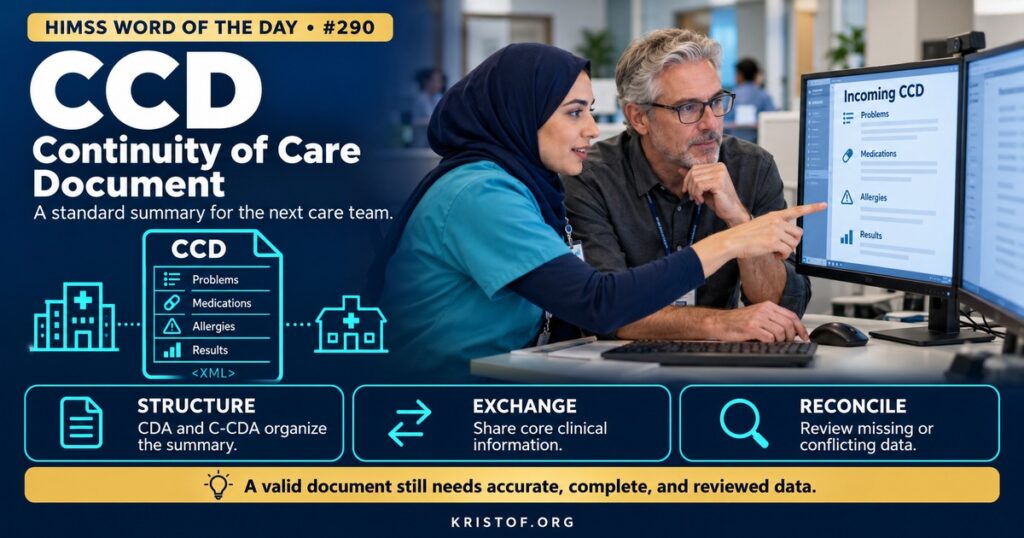
A Continuity of Care Document (CCD) is a standard patient summary document that health information systems use to exchange core clinical data. According to the HIMSS Dictionary, it is an implementation guide that takes the content model of the Continuity of Care Record (CCR) and expresses it in HL7’s Clinical Document Architecture, Release 2 (CDA R2), part of the HL7 Version 3 family. The result is an XML-based format that fixes the encoding, structure, and meaning of a summary record. The CCD defines templates for the typical sections, such as vital signs, family history, and plan of care, and those templates can be reused in other CDA document types.
Today the CCD is usually discussed together with C-CDA (Consolidated CDA), an HL7 implementation guide that gathers templates for a family of clinical documents, including the CCD, discharge summary, progress note, and others, in one set. When a clinic says it can send a “CCD,” it often means a C-CDA summary document. HL7 publishes both the CDA standard and the C-CDA guide.
| Layer | What It Defines | Example |
|---|---|---|
| HL7 CDA R2 | Document structure and rules | Header, body, sections, entries |
| C-CDA | US templates for many document types | CCD, discharge summary, consult note |
| CCD | A patient summary document | Problems, medications, allergies, results |
| Vocabulary | Codes inside entries | SNOMED CT, RxNorm, LOINC |
⚠️ Exam Alert: The CCD is a document exchanged as a unit; FHIR exchanges resources through APIs. The CCR is the earlier ASTM content standard, and the CCD expresses its content in CDA. A document can be valid XML and still hold poor-quality data.
🌐 Why It Matters: Real-World Healthcare IT Context
When a patient moves between organizations, the receiving clinician needs a concise summary of problems, medications, allergies, and recent results. The CCD gave the industry a common format for that summary long before modern APIs existed, and C-CDA documents remain widely used. The federal health IT certification rules still reference the standard: 45 CFR 170.205(a) lists C-CDA implementation guide versions, including a Release 2.1 guide and a Release 4.1 companion guide, as standards incorporated by reference, and notes that the adoption of one companion guide expired on January 1, 2026.
Using a standard format does not guarantee useful data. A 2018 study in the AMIA Annual Symposium proceedings examined the primary standard for clinical document exchange in the United States, C-CDA. It analyzed example documents from 52 certified health information technologies using automated tools and manual inspection, cataloging both interoperability progress and remaining barriers. The authors concluded that programs need to evaluate data quality beyond schematron conformance, meaning beyond whether a document passes technical rules, in order to support safe and high-quality exchange.
A 2024 study in Studies in Health Technology and Informatics looked at real-world documents. Using 1,054 randomly selected patients from a large US health system, the authors generated C-CDA documents from a regional health information exchange network and from an EHR vendor-based network. Overall, 778 patients (74 percent) had at least one document from either source, and two-thirds of those had information in only one source. All documents contained demographics, but fewer than half of patients had data in clinical domains, and the data from the two networks were not concordant. The authors concluded that networks hold different, likely complementary information for the same patient and that integration and deduplication need work. It is one health system’s experience, but it illustrates why a “received CCD” is not necessarily a complete record.
Implementation choices determine whether a CCD helps. Senders decide what goes into the document, and codes may be mapped imperfectly. Receivers must decide how to display, parse, and reconcile the incoming data: whether medications from the document are shown for review, merged into the medication list, or only attached as a file. Poor handling produces duplicate allergies, outdated problem lists, and clinicians who ignore the document because it is long and cluttered. Teams that manage exchange test with real documents from partners, review how incoming data appear to users, and track which sections are populated.
CCD and C-CDA are document-based, and the industry is also adopting API-based exchange using HL7 FHIR. The two coexist: many organizations still exchange C-CDA documents through health information exchanges and direct messaging, while using FHIR for specific data access. Knowing the document model remains part of informatics literacy.
Common CCD challenges:
- Documents that are valid but missing key sections
- Different systems placing the same information in different sections
- Mapping errors in codes for problems, medications, and results
- Long documents with little usable summary
- Duplicate or conflicting data after import
- Unclear policy on which incoming data are reconciled
What supports good CCD exchange:
- Testing with real partner documents, not only sample files
- Quality checks beyond conformance
- Clinician review of how incoming data display
- Reconciliation workflows for medications, allergies, and problems
- Monitoring of which sections are populated
- A plan for FHIR-based exchange alongside documents
🏥 The Nurse’s Perspective: Clinical, Bedside, & Workflow
Nurses are frequent recipients and reviewers of the data that CCDs carry, especially around admissions and transfers.
At the Bedside
On admission, nurses compare what patients report with outside records, and a summary document may offer an allergy list or a medication list that differs from the patient’s account. Nurses document differences and escalate them. A summary from another organization is a starting point, not a final truth.
In Clinical Workflow
Transition nurses and care managers use received summaries to prepare for visits and to follow up after discharge. Nurse managers decide who is responsible for reviewing and reconciling incoming outside data, and which discrepancies go to a pharmacist or physician.
Nurse informaticists help test how exchanged documents appear in the chart, check that nursing-relevant content such as allergies and functional status is included, and work with interface analysts to correct mappings.
In EHR Implementation (Go-Live Perspective)
An Epic Go-Live turns on document exchange with outside organizations, so new outside data begin arriving on units. At-the-elbow support analysts hear when incoming information is confusing or duplicated, and those observations lead to display and reconciliation changes.
🎓 CAHIMS / CPHIMS & HIMSS Perspective
CAHIMS Exam Domain Mapping
The CCD appears in standards and interoperability questions:
| CAHIMS Domain | How the CCD Appears |
|---|---|
| Healthcare & Technology Environments | Standards organizations, certification rules, exchange policy |
| Clinical Informatics | Patient summaries, reconciliation, transitions of care |
| Healthcare Information & Systems Management | HL7 CDA, C-CDA, interfaces, data quality |
| Management & Leadership | Interoperability strategy, partner testing, governance |
Key Terms to Know Alongside CCD
- HL7 CDA (Clinical Document Architecture) — HL7 standard for the structure of clinical documents
- C-CDA (Consolidated CDA) — implementation guide with US templates for many clinical documents
- CCR (Continuity of Care Record) — earlier standard for a patient summary dataset
- Schematron — rule language used to check whether a document meets conformance rules
- Health Information Exchange (HIE) — organization or network that supports sharing health information
- FHIR — HL7 standard for exchanging health data as resources through APIs
HIMSS Organizational Position
HIMSS supports interoperability and standards-based information exchange through its public policy work, research, and education. Members can find related resources through the HIMSS Resource Center.
🔗 Explore Further: External References
- HL7 International — CDA R2 Product Brief https://www.hl7.org/implement/standards/product_brief.cfm?product_id=7
- HL7 International — C-CDA Product Brief https://www.hl7.org/implement/standards/product_brief.cfm?product_id=492
- eCFR — 45 CFR 170.205, Content Exchange Standards and Implementation Specifications https://www.ecfr.gov/current/title-45/subtitle-A/subchapter-D/part-170/subpart-B/section-170.205
- D’Amore et al. (2018), AMIA Annual Symposium Proceedings — Interoperability Progress and Remaining Data Quality Barriers of Certified Health Information Technologies https://pubmed.ncbi.nlm.nih.gov/30815075/
- Dixon et al. (2024), Studies in Health Technology and Informatics — Interoperability in the Wild: Comparison of Real-World Electronic C-CDA Documents from Two Sources https://pubmed.ncbi.nlm.nih.gov/38269762/
Term source: HIMSS Dictionary of Health Information and Technology Terms, Acronyms, and Organizations, 6th Edition (2025). All definitions in this series are paraphrased for editorial purposes. Readers are encouraged to consult the primary source for exact language.
Eric Andrew Kristof, RN, CAHIMS is a Healthcare IT professional and HIMSS Arkansas Chapter member based in Hot Springs Village, AR, with hands-on Epic Go-Live experience and a diverse healthcare and IT background. He writes at kristof.org at the intersection of clinical care and healthcare technology.
Leave a Reply