By Eric Andrew Kristof, RN, CAHIMS | Healthcare IT Professional | HIMSS Arkansas Chapter Member
About This Series: The HIMSS Word of the Day is a running blog series drawing from the HIMSS Dictionary of Health Information and Technology Terms, Acronyms, and Organizations, 6th Edition (2025) — the authoritative reference for healthcare IT professionals and the primary study resource for CAHIMS and CPHIMS certification. Each post paraphrases the term in plain language, grounds it in real-world healthcare IT context, and adds a bedside nursing perspective you won’t find in a textbook.
📖 The Term: Activity Tracker
Source: HIMSS Dictionary of Health Information and Technology Terms, Acronyms, and Organizations, 6th Edition (2025)
🔍 Plain-Language Definition
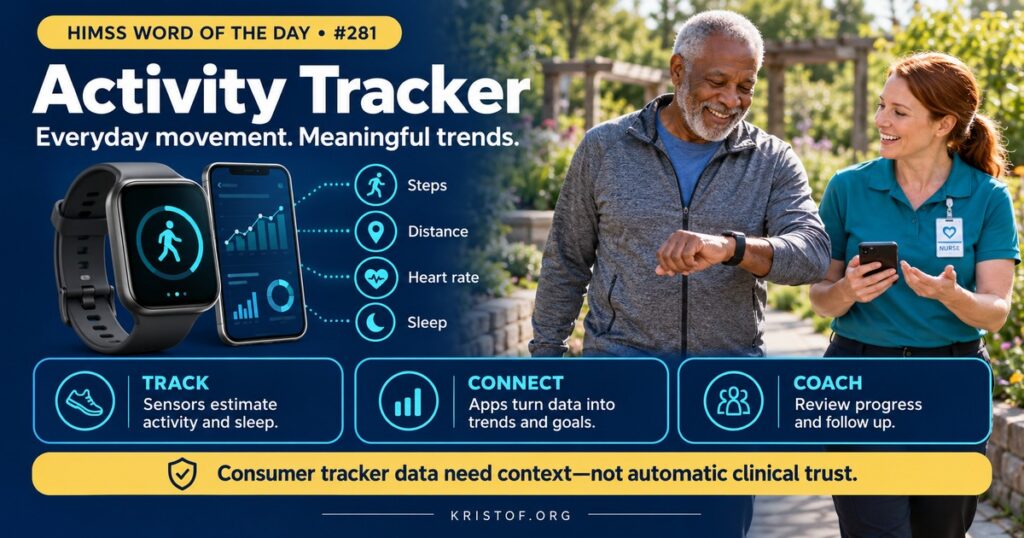
An activity tracker is a device or application that monitors fitness-related measures such as distance walked or run, calories used, heart rate, and quality of sleep. The HIMSS Dictionary notes that the term most often refers to dedicated electronic monitors that sync with a computer or smartphone so data can be followed over a long period, and points readers to wearable technology. Today the same functions appear in smartwatches, rings, patches, and phone apps.
Trackers combine sensors, such as accelerometers and optical heart rate sensors, with software that turns raw signals into metrics, trends, goals, and feedback. Most are consumer products, not medical devices, which affects how accurate the data are, how they are validated, and who owns and protects them.
| Element | What It Does | Example |
|---|---|---|
| Sensor | Detects motion, pulse, or other signals | Accelerometer, optical heart rate sensor |
| Algorithm | Converts signals into metrics | Step count, sleep stage estimate |
| App and cloud | Stores data and shows feedback | Daily summary, weekly trend |
| Behavior change features | Prompt action | Goals, reminders, rewards |
| Data sharing | Moves data to others | Export to a health record or a clinic portal |
⚠️ Exam Alert: An activity tracker is typically a consumer device; a remote patient monitoring device is prescribed and managed as part of care and may be a regulated medical device. Data a patient generates on a personal device are patient-generated health data. The HIPAA Privacy Rule generally applies when data are held by a covered entity or its business associate, not to the consumer’s own app.
🌐 Why It Matters: Real-World Healthcare IT Context
Activity trackers matter to health care for two reasons: they might change behavior, and they generate data that clinicians might use. The evidence on the first is more developed than on the second.
A 2026 umbrella review in Physiological Reviews synthesized systematic reviews of interventions that used feedback from wrist-worn wearables. After screening 9,487 citations, the authors identified 39 systematic reviews covering 98 original studies, almost all randomized controlled trials. Fitbit devices were used in 40.2 percent of the original studies. Over 80 percent of the trials were complex behavioral interventions with wearable-based feedback, and most of the systematic reviews were rated low confidence because of problems such as inadequate attention to risk of bias and heterogeneity. The review concluded that interventions incorporating wrist-worn activity trackers increased physical activity in diverse populations, while effects on cardiometabolic risk markers, quality of life, depression and anxiety, and pain were limited and inconsistent. The authors cautioned that findings rely on reviews of varying quality and may miss recent evidence.
A 2026 systematic review of randomized trials focused on older adults. It included 18 trials with 2,841 participants who were not recruited for a specific disease and used a tracker for at least two weeks. Most trials reported positive effects on physical activity, particularly steps per day and intensity-related outcomes, in the short and medium term. For sedentary behavior, some trials showed reductions in self-reported time but none showed improvement in objectively measured sedentary time. Interventions that combined trackers with behavior change techniques, most often goal setting, self-monitoring, and feedback, more consistently showed benefit. The authors concluded that trackers can promote activity in older adults, especially with behavioral strategies, but their effect on objectively measured sedentary behavior and on long-term outcomes remains unclear. For a clinic, the practical message is that the device alone is rarely the intervention. Coaching, goals, and follow-up matter.
Who actually uses trackers affects equity. A 2024 survey in the Journal of the American Heart Association linked responses from patients at Mass General Brigham to electronic health records. Of 214,992 people receiving longitudinal primary or cardiovascular care with an active portal, 11,121 responded, a 5.2 percent response rate. Most respondents, 55.8 percent, used a wearable, and 95.3 percent of nonusers would use one if provided at no cost. Among users, 70.2 percent had not shared device data with their doctor, though most thought sharing would be very or moderately important. Older age, male sex, and heart failure were associated with lower odds of use, while higher income and care in a cardiovascular clinic were associated with higher odds. Because the response rate was low, the results describe respondents and not the whole population, but they point to a digital divide: the people most likely to benefit from monitoring may be least likely to own the device.
Data handling is the informatics challenge. Trackers use different metrics and proprietary algorithms, accuracy varies by device and activity, and the data arrive as streams, not as clinical observations. World Sleep Society recommendations published in 2025 illustrate the issue for sleep trackers: they advocate standardized fundamental sleep measures across manufacturers, distinguish them from proprietary exploratory metrics, and discuss the challenges of integrating heterogeneous sleep data into clinical health records. Organizations deciding whether to accept patient-generated data need clear policies on which data they will review, who is responsible for responding to alerts, how data enter the chart, and what happens outside clinic hours. A common mistake is to accept a feed that no one is assigned to watch, creating an expectation of monitoring that the clinic cannot meet.
Privacy needs attention. Consumer app data may be governed by the company’s terms and by consumer protection law rather than HIPAA, depending on who holds them. Patients should understand where their data go. Clinics that connect devices to their systems should apply security review, consent, and data minimization.
Common activity tracker problems:
- Treating step counts as clinical measurements without validation
- Data feeds that no clinician is assigned to review
- Differences in metrics and algorithms across brands
- Lower use among older, lower-income, and sicker patients
- Abandonment after the first weeks
- Unclear privacy rules for consumer app data
What supports effective use:
- Pairing devices with goals, coaching, and follow-up
- A written policy on which wearable data the clinic reviews
- Standard formats and clear paths into the record
- Loaner or subsidized devices to reduce the digital divide
- Patient education about data sharing and privacy
- Evaluation of whether the program changes outcomes
🏥 The Nurse’s Perspective: Clinical, Bedside, & Workflow
Nurses are often the first to hear what patients do with their devices, and the first to be asked what the numbers mean.
At the Bedside
A patient may arrive with a smartwatch showing a heart rate or sleep graph and ask whether it is normal. Nurses can acknowledge the interest, explain that consumer devices can be inaccurate, and take their own measurements for clinical decisions. For patients recovering at home, a tracker can support goals such as walking more each day, reviewed at follow-up calls.
In Clinical Workflow
Cardiac rehabilitation, diabetes education, and oncology survivorship nurses often use trackers to set and review activity goals. Nurse managers decide who reviews incoming data, how often, and how patients are told what to expect. Telephone triage nurses need a protocol for patients who report an alarming reading from a personal device.
Nurse informaticists help decide how patient-generated data enter the record, such as a flowsheet row for patient-reported activity, and they design workflows so that data do not create unmanaged alerts. They also advise on patient education materials about devices and privacy.
In EHR Implementation (Go-Live Perspective)
An Epic Go-Live that includes patient-generated data features must define who can see device data and who responds to it. At-the-elbow support analysts hear clinicians ask where wearable data appear and what they are supposed to do with them, and those questions shape the review workflow. Clear patient-facing instructions on what the clinic does and does not monitor help prevent a false sense of safety.
🎓 CAHIMS / CPHIMS & HIMSS Perspective
CAHIMS Exam Domain Mapping
Activity trackers appear in connected health, data, and privacy questions:
| CAHIMS Domain | How Activity Trackers Appear |
|---|---|
| Healthcare & Technology Environments | Consumer health technology, privacy law, digital health equity |
| Clinical Informatics | Patient-generated data, behavior change, workflow integration |
| Healthcare Information & Systems Management | Device data integration, APIs, standards, security |
| Management & Leadership | Program evaluation, policy on monitoring, vendor selection |
Key Terms to Know Alongside Activity Tracker
- Wearable Technology — electronic devices worn on the body to collect data
- Patient-Generated Health Data — health data created and recorded by patients outside the clinic
- Remote Patient Monitoring — clinically managed collection of patient data from home
- Behavior Change Technique — specific strategy, such as goal setting, to change behavior
- Digital Divide — gap between people who do and do not have access to technology
- Interoperability — ability of systems to exchange and use data
HIMSS Organizational Position
HIMSS supports connected health and the responsible use of consumer-generated data through its research, education, and community work. Members can find related resources through the HIMSS Resource Center.
🔗 Explore Further: External References
- Glisic et al. (2026), Physiological Reviews — An Umbrella Review of Systematic Reviews of the Impact of Wrist-Worn Wearables on Health Outcomes https://pubmed.ncbi.nlm.nih.gov/41460208/
- Estorff et al. (2026), European Review of Aging and Physical Activity — Efficacy of Activity Tracker-Based Interventions and Their Behavioral Components in Promoting Physical Activity and Reducing Sedentary Behavior in Older Adults https://pubmed.ncbi.nlm.nih.gov/41526810/
- Venn et al. (2024), Journal of the American Heart Association — Characteristics and Attitudes of Wearable Device Users and Nonusers in a Large Health Care System https://pubmed.ncbi.nlm.nih.gov/38156452/
- Chee et al. (2025), Sleep Medicine — World Sleep Society Recommendations for the Use of Wearable Consumer Health Trackers That Monitor Sleep https://pubmed.ncbi.nlm.nih.gov/40300398/
- HealthIT.gov — Health IT Playbook https://playbook.healthit.gov/
Term source: HIMSS Dictionary of Health Information and Technology Terms, Acronyms, and Organizations, 6th Edition (2025). All definitions in this series are paraphrased for editorial purposes. Readers are encouraged to consult the primary source for exact language.
Eric Andrew Kristof, RN, CAHIMS is a Healthcare IT professional and HIMSS Arkansas Chapter member based in Hot Springs Village, AR, with hands-on Epic Go-Live experience and a diverse healthcare and IT background. He writes at kristof.org at the intersection of clinical care and healthcare technology.
Leave a Reply