By Eric Andrew Kristof, RN, CAHIMS | Healthcare IT Professional | HIMSS Arkansas Chapter Member
About This Series: The HIMSS Word of the Day is a running blog series drawing from the HIMSS Dictionary of Health Information and Technology Terms, Acronyms, and Organizations, 6th Edition (2025) — the authoritative reference for healthcare IT professionals and the primary study resource for CAHIMS and CPHIMS certification. Each post paraphrases the term in plain language, grounds it in real-world healthcare IT context, and adds a bedside nursing perspective you won’t find in a textbook.
📖 The Term: IHE Profile
Source: HIMSS Dictionary of Health Information and Technology Terms, Acronyms, and Organizations, 6th Edition (2025)
🔍 Plain-Language Definition
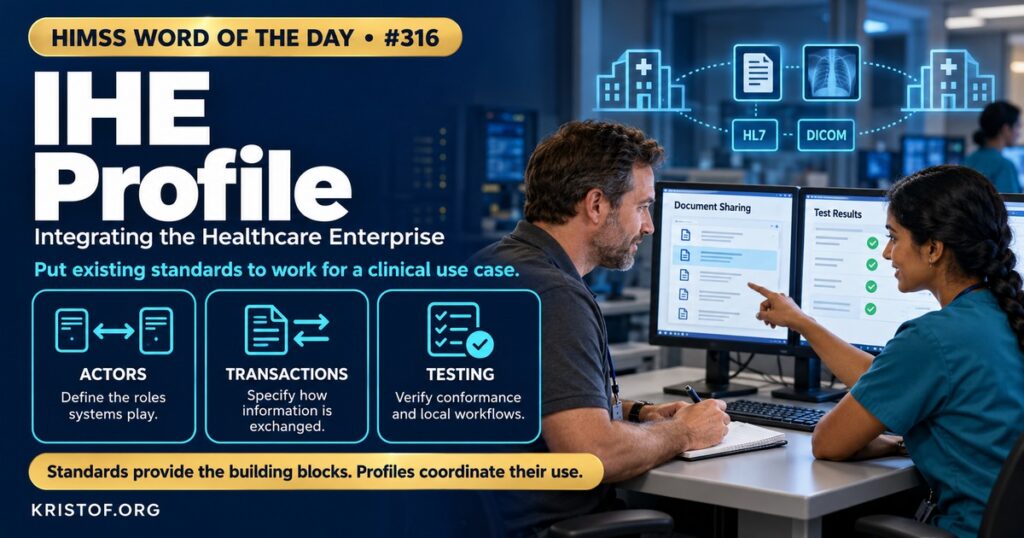
An IHE profile is a specification from Integrating the Healthcare Enterprise (IHE) that describes how existing standards should be combined to solve a defined integration problem. The HIMSS Dictionary frames profiles as a shared vocabulary that lets buyers and vendors discuss what a health care site needs and what a product can do. The IHE website adds that profiles organize the integration capabilities achievable through coordinated use of standards such as DICOM and HL7 FHIR, giving precise definitions of how those standards can be implemented to meet specific clinical needs.
A profile differs from a standard in a practical way. A standard such as HL7 CDA defines the format of a document, while a profile such as Cross-Enterprise Document Sharing (XDS) says which systems play which roles, what transactions they exchange, and what metadata must accompany a document so that another organization can find it. Profiles therefore reduce the number of local choices that two systems must agree on before they can exchange data.
IHE publishes profiles by domain, such as radiology, IT infrastructure, laboratory, pharmacy, and patient care coordination. Each profile goes through a lifecycle. It is first published for public comment, then republished for trial implementation, when it is used in IHE testing. If testing criteria are met, it is published as final text in the domain’s Technical Framework. IHE also holds testing events known as Connectathons and keeps a product registry.
| Element | Purpose | Example |
|---|---|---|
| Actors | Define the roles systems play | Document source, registry, consumer |
| Transactions | Define the messages actors exchange | Submit, query, retrieve |
| Standards used | Specify which existing standards apply | HL7 CDA documents, DICOM images |
| Options | Allow optional capabilities | Additional document types |
| Testing | Verify that products conform | Connectathon |
⚠️ Exam Alert: A standard defines format or messaging; an IHE profile defines how standards are combined for a use case. IHE is an initiative and a set of profiles, not a standards development organization. XDS shares documents across enterprises; XDS-I extends the idea to medical images. Connectathons are testing events for conformance.
🌐 Why It Matters: Real-World Healthcare IT Context
Profiles matter because interoperability fails in the details. Two systems can both claim to support HL7, yet exchange nothing useful if they differ on which fields, codes, and workflows to use. Profiles narrow those choices. Two studies show how one profile worked at scale.
The first is Taiwan’s national electronic medical record exchange. A 2015 article in Computer Methods and Programs in Biomedicine described the country’s National Electronic Medical Record Exchange Center (EEC). At the time of writing, Taiwan had 501 hospitals and about 20,000 clinics, and the single-payer National Health Insurance program covered 99.9 percent of its 23 million people. To improve continuity of care and reduce duplicate tests and prescriptions, the government planned an exchange in which a patient with a health insurance IC card could allow other participating hospitals to retrieve key records from the previous six months. Each hospital connects through a gateway that converts its records into standardized files. The EEC indexes those files and supports search and retrieval for four document types: imaging reports, laboratory reports, discharge summaries, and outpatient records. The design adopted HL7 CDA for the documents and the IHE XDS profile for the communication infrastructure. By December 2014, 321 hospitals offered the exchange, and those not yet participating were all smaller hospitals with fewer than 100 beds. The authors noted that implementation faced many challenges and offered their experience as a reference for others. The article is a descriptive account from the builders, not an outcome evaluation, so it shows feasibility and design choices more than clinical benefit.
A follow-up study tested a modern design. A 2017 article in the International Journal of Medical Informatics implemented a prototype of a cloud-based EMR exchange system on the Microsoft Azure platform, based on the IHE XDS profile and the existing Taiwan exchange. The prototype used RESTful services, and the researchers tested it in four scenarios. It completed exchange in all four, and its response times were better than those of the existing system, which used the Simple Object Access Protocol (SOAP) approach. The result is from a prototype in a test environment, so production performance may differ, but it shows that a profile can outlast the technology underneath it: the roles and transactions stay the same while the implementation changes.
The second example is imaging. A 2015 article in the Journal of Medical Imaging examined three pilot studies based on the IHE XDS-I profile for cross-enterprise medical image sharing: federated sharing between two Shanghai hospitals, a patient-controlled image sharing project by the Radiological Society of North America in the United States, and collaborative imaging diagnosis connected to health records in two Shanghai districts. To support the pilots, the teams developed new image access methods, components, and data models, including a hybrid retrieval method and extensions to metadata definitions. They identified several practical issues that affect implementation and concluded that XDS-I is a theoretically good architecture and a useful foundation for sharing images across regional providers. The authors noted that few clinical implementations of the profile had been reported, so the pilots filled a gap, and that the profile required extensions to work in practice.
Taken together, the studies suggest how to use profiles. When buying or building a system, ask which IHE profiles and actors it supports, and ask for evidence of conformance testing. When planning an exchange, use a profile as the starting point but expect local decisions: which document types, which identity matching method, which consent model, and which extensions. When evaluating a vendor claim of interoperability, ask which transactions will actually run between which systems and how they were tested.
Common IHE profile problems:
- Treating a profile name as a guarantee of interoperability
- Skipping the options and local decisions a profile leaves open
- Weak patient identity matching between enterprises
- Metadata that is incomplete or inconsistent between sources
- Performance problems with older messaging approaches
- No testing between the specific systems that must connect
What supports effective use of profiles:
- Contract language that names the profiles and actors required
- Evidence of conformance from IHE testing
- Agreed document types, metadata, and identity methods
- Gateways that convert local data into standard files
- Performance testing under realistic load
- Governance that maintains the exchange after launch
🏥 The Nurse’s Perspective: Clinical, Bedside, & Workflow
Nurses rarely see a profile name, but they feel the results when records from another organization appear in the chart or fail to.
At the Bedside
A patient arriving from another hospital with no records is a daily frustration. When document exchange works, the nurse can open a summary from the other organization and confirm medications, allergies, and recent results. When it does not work, nurses fall back on phone calls, faxes, and patient recall.
In Clinical Workflow
Case managers and nurse managers see the effects of exchange in transitions of care: whether discharge summaries arrive, whether images are viewable, and whether duplicate tests can be avoided. They report gaps to informatics teams, such as a document type that does not appear.
Nurse informaticists help decide what clinicians need from outside documents, how they should be displayed, and how to reconcile outside information with the local record. They test exchange with real patient scenarios and give feedback on whether the information is complete enough to use.
In EHR Implementation (Go-Live Perspective)
An Epic Go-Live often includes connecting to regional or national exchange networks. At-the-elbow support analysts hear when outside records are hard to find or confusing, and these observations help interface and interoperability teams adjust the display and the workflows.
🎓 CAHIMS / CPHIMS & HIMSS Perspective
CAHIMS Exam Domain Mapping
IHE profiles appear in interoperability and standards questions:
| CAHIMS Domain | How IHE Profiles Appear |
|---|---|
| Healthcare & Technology Environments | Standards organizations, national exchange programs |
| Clinical Informatics | Continuity of care, document sharing, image access |
| Healthcare Information & Systems Management | Actors, transactions, gateways, conformance testing |
| Management & Leadership | Procurement, vendor claims, exchange governance |
Key Terms to Know Alongside IHE Profile
- Integrating the Healthcare Enterprise (IHE) — initiative that develops profiles for using standards together
- XDS (Cross-Enterprise Document Sharing) — profile for registering and retrieving documents across organizations
- XDS-I — profile that applies the document sharing model to medical images
- Actor — role a system plays in a profile
- Technical Framework — published collection of profiles for a domain
- Connectathon — IHE testing event where vendors test interoperability
HIMSS Organizational Position
HIMSS supports interoperability and standards-based exchange through its research, education, and community work. Members can find related resources through the HIMSS Resource Center.
🔗 Explore Further: External References
- IHE International — Profiles https://www.ihe.net/resources/profiles/
- IHE International https://www.ihe.net/
- Li et al. (2015), Computer Methods and Programs in Biomedicine — Building a National Electronic Medical Record Exchange System: Experiences in Taiwan https://pubmed.ncbi.nlm.nih.gov/26001420/
- Wu et al. (2017), International Journal of Medical Informatics — Implementation of a Cloud-Based Electronic Medical Record Exchange System in Compliance with the Integrating Healthcare Enterprise’s Cross-Enterprise Document Sharing Integration Profile https://pubmed.ncbi.nlm.nih.gov/29029689/
- Zhang et al. (2015), Journal of Medical Imaging — Implementation Methods of Medical Image Sharing for Collaborative Health Care Based on IHE XDS-I Profile https://pubmed.ncbi.nlm.nih.gov/26835497/
Term source: HIMSS Dictionary of Health Information and Technology Terms, Acronyms, and Organizations, 6th Edition (2025). All definitions in this series are paraphrased for editorial purposes. Readers are encouraged to consult the primary source for exact language.
Eric Andrew Kristof, RN, CAHIMS is a Healthcare IT professional and HIMSS Arkansas Chapter member based in Hot Springs Village, AR, with hands-on Epic Go-Live experience and a diverse healthcare and IT background. He writes at kristof.org at the intersection of clinical care and healthcare technology.
Leave a Reply