By Eric Andrew Kristof, RN, CAHIMS | Healthcare IT Professional | HIMSS Arkansas Chapter Member
About This Series: The HIMSS Word of the Day is a running blog series drawing from the HIMSS Dictionary of Health Information and Technology Terms, Acronyms, and Organizations, 6th Edition (2025) — the authoritative reference for healthcare IT professionals and the primary study resource for CAHIMS and CPHIMS certification. Each post paraphrases the term in plain language, grounds it in real-world healthcare IT context, and adds a bedside nursing perspective you won’t find in a textbook.
📖 The Term: NEDSS (National Electronic Disease Surveillance System)
Source: HIMSS Dictionary of Health Information and Technology Terms, Acronyms, and Organizations, 6th Edition (2025)
🔍 Plain-Language Definition
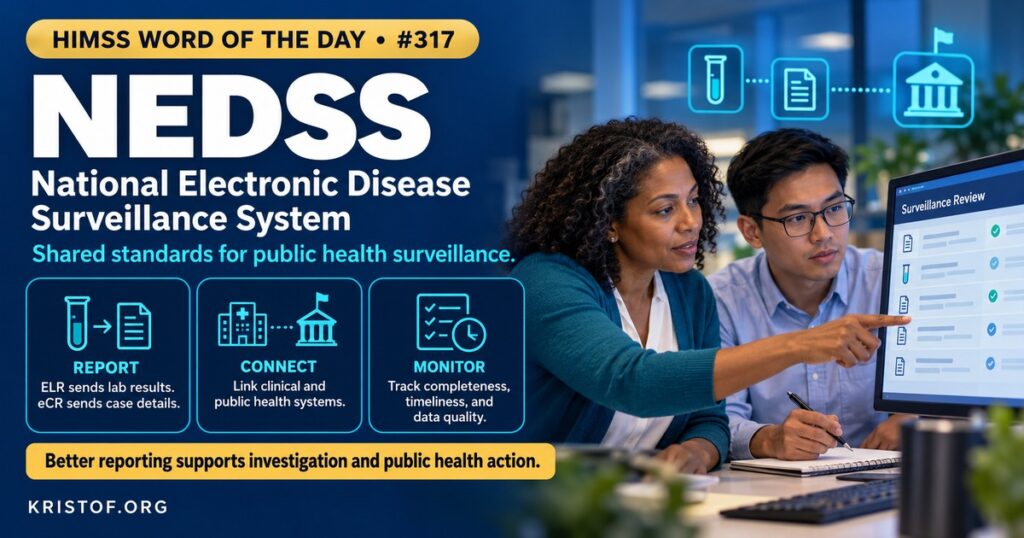
NEDSS (National Electronic Disease Surveillance System) is, in the HIMSS Dictionary’s words, an initiative that pushes federal, state, and local agencies toward common data and system standards, so that their surveillance systems work efficiently, fit together, and can exchange information. The Dictionary also places NEDSS within the Public Health Information Network (PHIN) as one of its principal parts. A 2011 CDC report in the Morbidity and Mortality Weekly Report describes NEDSS as a web-based infrastructure for exchanging public health surveillance data between CDC and the 50 states.
Disease surveillance is the ongoing collection and analysis of data on conditions that public health agencies track, such as notifiable infectious diseases. Clinicians and laboratories report cases to the health department. The health department classifies them, investigates as needed, and shares information with other jurisdictions and with CDC. Electronic surveillance systems are meant to make that flow faster and more complete than paper forms, faxes, and phone calls.
In practice, a state health department may run a software platform known as the NEDSS Base System (NBS), a system CDC supports, or a different commercial or locally built system that follows the same goals. Reports arrive through several channels.
| Reporting Channel | What It Carries | Typical Limitation |
|---|---|---|
| Electronic laboratory reporting (ELR) | Laboratory test results | Only information available to the laboratory |
| Electronic case reporting (eCR) | Case details generated from the EHR | Depends on EHR triggers and mapping |
| Web-based entry | Manual reports by clinicians or staff | Staff time and delays |
| Fax or phone | Urgent or paper-based reports | Slow, error-prone, hard to analyze |
| Sentinel or registry feeds | Selected conditions from participating sites | Limited coverage by design |
⚠️ Exam Alert: NEDSS is an initiative and set of standards for surveillance systems; PHIN is the broader public health information network it belongs to. ELR sends laboratory results; eCR sends case information from the EHR. Both complement manual reporting, and reportable conditions are set by state law.
🌐 Why It Matters: Real-World Healthcare IT Context
For clinicians and hospitals, public health reporting is a legal duty that is also a data exchange problem. Four studies show how the technology has developed.
The first looks at state capacity. A 2011 MMWR report summarized assessments by the Council of State and Territorial Epidemiologists (CSTE) in 2007 and 2010. The number of states with fully operational electronic surveillance systems for general communicable diseases rose from 40 to 47, the number with interoperable systems rose from 13 to 39, the number with integrated systems rose from 23 to 34, and the number able to receive electronic laboratory reports rose to 42. The report linked these goals to the federal meaningful use rules, which encourage data exchange between EHRs and public health agencies, and said variation among surveillance systems should decrease while functionality increases. The data are from 2010, so they describe a much earlier stage of development, but they show the trend that informatics staff still work within: more states can receive electronic data, and the quality of the connection matters.
The second looks at what electronic case reporting adds. A 2023 pilot in JMIR Public Health and Surveillance implemented standards-based eCR for chlamydia and gonorrhea in eight Chicago clinics sharing a central EHR over a 52-day study period. Messages used the HL7 electronic initial case report standard, and the Illinois Department of Public Health received 183 eCRs for 135 unique patients. The eCR approach reported 95 percent of chlamydia cases (113) and 97 percent of gonorrhea cases (70) reported from the sites. It found 14 gonorrhea cases (19 percent) that were not reported by ELR, although ELR reported six chlamydia and two gonorrhea cases that eCR missed. ELR captured all chlamydia cases but only 81 percent of gonorrhea cases. Patient and provider names were complete in both channels, but eCR also carried clinical data such as the history of present illness, reason for visit, symptoms, diagnosis, and medications. The authors concluded that eCR gave a more complete case report and could reduce provider reporting burden. The study covered a short period, two conditions, and clinics on a single EHR, so the results may not apply to other settings.
The third looks at modernization. A 2026 implementation report in JMIR Medical Informatics described how the US Virgin Islands Department of Health moved its NBS instance from a vendor-managed environment to a jurisdiction-managed cloud platform and upgraded to NBS 7. The team used a phased plan covering cost-benefit assessment, deployment, database migration, validation, and staged re-onboarding of reporting facilities. It went live in May 2025 and was the first US jurisdiction to run NBS 7 on Amazon Web Services, according to the report. The authors reported nearly 90 percent cost savings, with a preliminary estimate of 80 percent, along with more bandwidth, real-time data ingestion, and more autonomy over data. They re-onboarded 106 of 109 (97 percent) of connected electronic reporting facilities and added one new reporting laboratory. This is one small jurisdiction’s account of its own project, so costs and results will vary elsewhere.
A fourth study evaluated a national sentinel system outside the United States. A 2026 mixed methods evaluation in JMIR Public Health and Surveillance examined South Korea’s electronic sentinel surveillance system for bacterial gastroenteritis, which has operated since 2000. Of 211 sentinel hospitals, 180 (85.3 percent) responded to a survey, and 90 percent of respondents rated reporting as simple or adequate. Delayed reporting fell from 2.4 percent of reports in 2021 to 1.1 percent in 2023, and submission completeness was 99.9 percent and then 100 percent. The authors noted that comparison with insurance claims showed strong parallel trends but could not establish sensitivity, because the two sources use different case definitions, and they recommended clearer communication of goals, standardized operator training, and validation with patient-level data linked to laboratory results. The system is not NEDSS, but the evaluation shows what to measure in any surveillance system: timeliness, completeness, and user experience.
Together the studies show where hospitals and clinics feel the effect. Reporting depends on accurate mapping of local codes and triggers, on keeping interfaces running when the EHR is upgraded, and on staff who know what is reportable and when. Hospital infection prevention and laboratory teams often manage reporting, but clinicians’ documentation supplies the data. When a state changes its platform or reporting rules, hospitals must test and re-onboard their feeds. The general direction, from manual entry toward automated, standards-based exchange, reduces effort but increases dependence on well-built interfaces.
Common surveillance reporting problems:
- Reliance on manual reports that arrive late or incomplete
- Laboratory reports that lack clinical details
- EHR triggers that miss some reportable cases
- Interface changes that interrupt feeds without notice
- Different reporting rules and systems in each state
- Limited staff time for investigating and following up
What supports effective electronic surveillance:
- Standards-based messages such as HL7 case reports
- Automated triggers tuned to reportable conditions
- Both ELR and eCR so that they complement each other
- Testing and monitoring of feeds after system changes
- Clear ownership of reporting within the organization
- Ongoing collaboration between hospitals and health departments
🏥 The Nurse’s Perspective: Clinical, Bedside, & Workflow
Nurses, especially in infection prevention and public health roles, are central to disease reporting.
At the Bedside
Bedside nurses document symptoms, exposures, travel, vaccination, and lab collection that determine whether a case is reportable. Complete documentation helps infection prevention staff and health departments do their jobs, and nurses may be asked follow-up questions about patients with a reportable condition.
In Clinical Workflow
Infection preventionists and public health nurses track reportable conditions, confirm that cases reach the health department, and coordinate contact investigation and follow-up. Nurse managers support these workflows by making sure the unit documents key facts consistently and by communicating when reporting rules change.
Nurse informaticists help build and test triggers and reporting rules in the EHR, review whether the information in a case report matches what clinicians record, and coordinate with laboratory and public health teams when the state changes its system.
In EHR Implementation (Go-Live Perspective)
An Epic Go-Live can change the data that feed electronic case reports, such as new flowsheet rows or diagnosis lists. At-the-elbow support analysts and infection prevention staff report unexpected gaps, such as a field clinicians skip, so that reporting teams can correct the workflow before it affects surveillance.
🎓 CAHIMS / CPHIMS & HIMSS Perspective
CAHIMS Exam Domain Mapping
NEDSS appears in public health and standards questions:
| CAHIMS Domain | How NEDSS Appears |
|---|---|
| Healthcare & Technology Environments | Public health agencies, reporting laws, national networks |
| Clinical Informatics | Reportable conditions, clinical triggers, documentation |
| Healthcare Information & Systems Management | Interfaces, HL7 messages, ELR and eCR, system migration |
| Management & Leadership | Compliance, vendor and agency coordination, cost |
Key Terms to Know Alongside NEDSS
- Public Health Information Network (PHIN) — national initiative for public health information exchange
- Electronic Laboratory Reporting (ELR) — automated transmission of laboratory results to public health
- Electronic Case Reporting (eCR) — automated generation and transmission of case reports from the EHR
- Notifiable Disease — condition that must be reported to public health authorities
- Sentinel Surveillance — monitoring through selected reporting sites
- Syndromic Surveillance — monitoring of symptom-based data to detect outbreaks early
HIMSS Organizational Position
HIMSS supports the use of health information technology to improve population health through its research, education, and community work. Members can find related resources through the HIMSS Resource Center.
🔗 Explore Further: External References
- CDC (2011), MMWR Morbidity and Mortality Weekly Report — State Electronic Disease Surveillance Systems: United States, 2007 and 2010 https://pubmed.ncbi.nlm.nih.gov/22012115/
- Mishra et al. (2023), JMIR Public Health and Surveillance — Automating Case Reporting of Chlamydia and Gonorrhea to Public Health Authorities in Illinois Clinics: Implementation and Evaluation of Findings https://pubmed.ncbi.nlm.nih.gov/36917153/
- Cranford et al. (2026), JMIR Medical Informatics — US Virgin Islands Launches Modernized NBS 7 Disease Surveillance System to Transform Public Health: Implementation Report https://pubmed.ncbi.nlm.nih.gov/42335364/
- Song et al. (2026), JMIR Public Health and Surveillance — Performance of an Electronic Sentinel Surveillance System for Bacterial Gastroenteritis: Mixed Methods Evaluation Study https://pubmed.ncbi.nlm.nih.gov/42684393/
- HealthIT.gov — Public Health https://healthit.gov/public-health/
Term source: HIMSS Dictionary of Health Information and Technology Terms, Acronyms, and Organizations, 6th Edition (2025). All definitions in this series are paraphrased for editorial purposes. Readers are encouraged to consult the primary source for exact language.
Eric Andrew Kristof, RN, CAHIMS is a Healthcare IT professional and HIMSS Arkansas Chapter member based in Hot Springs Village, AR, with hands-on Epic Go-Live experience and a diverse healthcare and IT background. He writes at kristof.org at the intersection of clinical care and healthcare technology.
Leave a Reply