By Eric Andrew Kristof, RN, CAHIMS | Healthcare IT Professional | HIMSS Arkansas Chapter Member
About This Series: The HIMSS Word of the Day is a running blog series drawing from the HIMSS Dictionary of Health Information and Technology Terms, Acronyms, and Organizations, 6th Edition (2025) — the authoritative reference for healthcare IT professionals and the primary study resource for CAHIMS and CPHIMS certification. Each post paraphrases the term in plain language, grounds it in real-world healthcare IT context, and adds a bedside nursing perspective you won’t find in a textbook.
📖 The Term: CDW (Clinical Data Warehouse)
Source: HIMSS Dictionary of Health Information and Technology Terms, Acronyms, and Organizations, 6th Edition (2025)
🔍 Plain-Language Definition
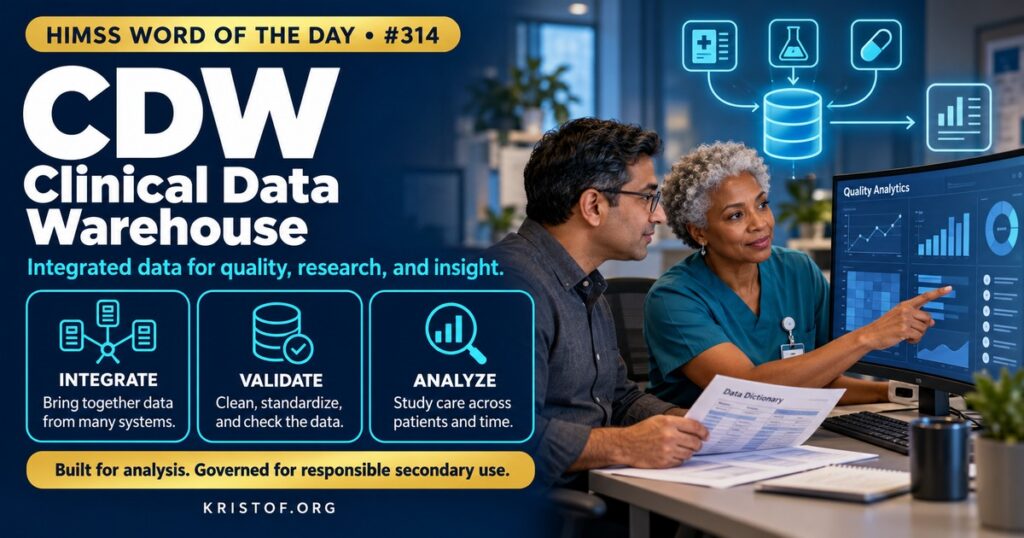
A clinical data warehouse (CDW) is a collection of data, often from many different sources, that a data management system makes available for analysis in order to answer questions about how a health system functions. The HIMSS Dictionary emphasizes the purpose: secondary data analysis that helps an organization understand, maintain, and improve its care delivery. The words “secondary” and “warehouse” matter. The EHR is built for transactions at the point of care, such as entering an order or reading a result. The CDW is built for questions that span many patients and time periods, such as how long it takes patients with stroke symptoms to reach imaging.
A CDW typically receives copies of data from the EHR, laboratory and imaging systems, pharmacy, registration and billing, and sometimes registries or devices. The data are cleaned, standardized as far as possible, linked, and stored in structures designed for queries. Many organizations also remove or replace direct identifiers, a process called pseudonymization, before researchers see the data.
| CDW Element | Role | Example |
|---|---|---|
| Source feeds | Bring in data from operational systems | EHR, laboratory, imaging, billing |
| Transformation | Clean, map, and standardize | Codes mapped to a common terminology |
| Storage structure | Organize data for analysis | Tables designed for population queries |
| Governance | Decide who may use which data and for what | Approval committee, access rules |
| Access layer | Provide queries, extracts, and dashboards | Self-service tool, curated datasets |
⚠️ Exam Alert: An EHR supports transactions for individual patients; a CDW supports analysis across many patients. A data warehouse stores integrated, historical data; an operational system holds the current record. Secondary use means using data for purposes other than the original care, such as quality or research, and it requires governance.
🌐 Why It Matters: Real-World Healthcare IT Context
A CDW matters because most of the data a health system generates never reach a report unless someone builds a path for them. Three recent French studies show what that path can achieve and what it demands.
Automating quality measurement is one use. A 2026 pilot in Scientific Reports at the Greater Paris University Hospitals (AP-HP) tested whether French national quality and safety indicators could be calculated automatically from a CDW instead of by manual chart review. The team focused on door-to-imaging time in stroke care, the interval between arrival at the hospital and the first diagnostic imaging, and computed it for more than 6,000 medical records of patients hospitalized for acute stroke in 2022. They then compared the results with the manual chart review done for the 2022 national audit. The two methods agreed on the overall indicator but differed case by case, mainly because of human variability in both how records were completed and how reviewers read them. The authors concluded that automation is promising when professional time is limited, but that it requires structured and validated data, interoperability when patients are treated at more than one institution, and indicators that can actually be measured from the data. The lesson is that a CDW does not remove the need for good documentation. It exposes how well documentation was done.
Building a specialized warehouse is another. A 2026 report in JMIR Medical Informatics described FREDD, the French Rare Eye Disease Database, a national warehouse created under the oversight of the French National Institute of Health and Medical Research (INSERM). The report notes that French health data warehouses are strictly regulated by national data protection authorities. FREDD uses a three-layer design covering data collection, processing, and a research reuse environment, extends the national minimum rare disease dataset with ophthalmology variables, and uses a custom parsing tool to prefill data from an existing national registry. It also runs a pseudonymization and human-verified validation process for retinal images. Regulatory authorization was obtained in April 2024 and data collection began in March 2025 in five pilot expert centers. Within a year it integrated data on 1,649 patients, about 20.3 percent of all retinitis pigmentosa cases in the national registry, with more than 10,000 images and a data inconsistency rate of roughly 7 percent. The authors credited regulatory planning, formal governance, and technical flexibility, and noted that long-term sustainability would need a structured cost-recovery model because the early work depended on grants. This is a single project in a particular country, so its figures are not benchmarks, but the pattern of governance first and technology second is widely applicable.
Data quality is a third issue. A 2026 study in the Journal of Medical Systems examined sickle cell disease patients in five expert centers of the same Paris hospital group. Researchers built a regular-expression algorithm to classify disease subtypes from unstructured clinical reports and compared it with manual review of a sample of 1,510 patients. The algorithm processed 561,924 reports from 10,868 patients in five minutes and had a positive predictive value of 94.0 percent. Strategies that relied only on ICD-10 codes had positive predictive values between 58.1 and 88.3 percent, depending on how many codes were required. The study did not describe itself as a warehouse project, but it illustrates a common warehouse problem: billing codes alone can misclassify patients, while the text in reports often holds the detail. The authors cautioned that results may reflect the specific documentation practices of their setting.
For informatics staff, the practical work is in the unglamorous layers. Someone must map local codes to standards, decide how often feeds refresh, document what each field means, and monitor for gaps when an upstream system changes. Governance bodies define who can request data, how requests are reviewed, and what must be removed or masked. Clinical stakeholders define the indicator or question precisely enough that a query can answer it. Without those steps, a warehouse produces numbers that no one trusts.
Common CDW problems:
- Source data entered inconsistently or only as free text
- Codes that do not capture clinical detail
- No shared definitions for indicators across sites
- Unclear approval paths for data requests
- Warehouse feeds that break silently when a source system changes
- Funding that covers the build but not long-term support
What supports a useful CDW:
- Early agreement on governance, privacy, and regulatory requirements
- Documented definitions and data dictionaries
- Mapping to standard terminologies
- Validation against manual review for key indicators
- Monitoring dashboards for data completeness and consistency
- A funding plan for maintenance as well as construction
🏥 The Nurse’s Perspective: Clinical, Bedside, & Workflow
Nurses contribute much of what flows into a CDW, so their documentation shapes what analysts can learn.
At the Bedside
Every timed assessment, medication administration, and intervention entered by a nurse becomes a data point. Entering values in the structured fields, with accurate times, makes later analysis possible, whereas notes that hold key facts only in free text are harder to use. Nurses see the effects when a quality report is built from their documentation.
In Clinical Workflow
Nurse managers use warehouse-based reports to review indicators such as falls, pressure injuries, and time to treatment. They read the reports with an understanding of how the data were captured, which helps them spot a documentation gap that looks like a clinical problem.
Nurse informaticists help define quality indicators in terms of fields the EHR actually captures, validate query results against chart review, and advise on which flowsheet rows should be standardized. They also take part in governance discussions about who can see unit-level and patient-level data.
In EHR Implementation (Go-Live Perspective)
An Epic Go-Live sets the data structures that the warehouse will receive for years. At-the-elbow support analysts hear about fields that clinicians skip or misuse, and these reports let analytics teams adjust workflows and reports early rather than discovering problems months later in a dashboard.
🎓 CAHIMS / CPHIMS & HIMSS Perspective
CAHIMS Exam Domain Mapping
CDWs appear in data, analytics, and governance questions:
| CAHIMS Domain | How CDWs Appear |
|---|---|
| Healthcare & Technology Environments | Privacy regulation, secondary use, research and quality programs |
| Clinical Informatics | Quality indicators, documentation quality, clinical definitions |
| Healthcare Information & Systems Management | Data integration, mapping, storage design, access control |
| Management & Leadership | Data governance, funding, stakeholder prioritization |
Key Terms to Know Alongside CDW
- Secondary Use of Data — using data collected for care for other purposes, such as quality or research
- Data Governance — policies and roles that control how data are managed and used
- Pseudonymization — replacing direct identifiers with codes while keeping a link under controlled conditions
- Data Dictionary — documentation describing each data element and its meaning
- Quality Indicator — a measure used to assess care processes or outcomes
- ETL (Extract, Transform, Load) — the process of moving data from sources into a warehouse
HIMSS Organizational Position
HIMSS supports effective, responsible use of health data through its research, education, and community work. Members can find related resources through the HIMSS Resource Center.
🔗 Explore Further: External References
- Hassanaly et al. (2026), Scientific Reports — Automating the Assessment of Quality Indicators Using a Clinical Data Warehouse: A Pilot Study on Door-to-Imaging Time in Stroke Management https://pubmed.ncbi.nlm.nih.gov/41781503/
- Beluffi Marin et al. (2026), JMIR Medical Informatics — Building a National Interoperable Rare Eye Disease Data Warehouse: Methodological Framework and Implementation Report From the French Rare Eye Disease Database (FREDD) Initiative https://pubmed.ncbi.nlm.nih.gov/42642992/
- Azoyan et al. (2026), Journal of Medical Systems — Classifying Sickle Cell Disease Subtypes from Clinical Reports: Algorithm Validation and ICD-10 Accuracy Assessment in Five French Hospitals https://pubmed.ncbi.nlm.nih.gov/42773269/
- HealthIT.gov — Privacy and Security https://healthit.gov/privacy-security/
- HIMSS — Nursing Informatics Community https://www.himss.org/networking/communities/nursing-informatics/
Term source: HIMSS Dictionary of Health Information and Technology Terms, Acronyms, and Organizations, 6th Edition (2025). All definitions in this series are paraphrased for editorial purposes. Readers are encouraged to consult the primary source for exact language.
Eric Andrew Kristof, RN, CAHIMS is a Healthcare IT professional and HIMSS Arkansas Chapter member based in Hot Springs Village, AR, with hands-on Epic Go-Live experience and a diverse healthcare and IT background. He writes at kristof.org at the intersection of clinical care and healthcare technology.
Leave a Reply