By Eric Andrew Kristof, RN, CAHIMS | Healthcare IT Professional | HIMSS Arkansas Chapter Member
About This Series: The HIMSS Word of the Day is a running blog series drawing from the HIMSS Dictionary of Health Information and Technology Terms, Acronyms, and Organizations, 6th Edition (2025) — the authoritative reference for healthcare IT professionals and the primary study resource for CAHIMS and CPHIMS certification. Each post paraphrases the term in plain language, grounds it in real-world healthcare IT context, and adds a bedside nursing perspective you won’t find in a textbook.
📖 The Term: Medical Home
Source: HIMSS Dictionary of Health Information and Technology Terms, Acronyms, and Organizations, 6th Edition (2025)
🔍 Plain-Language Definition
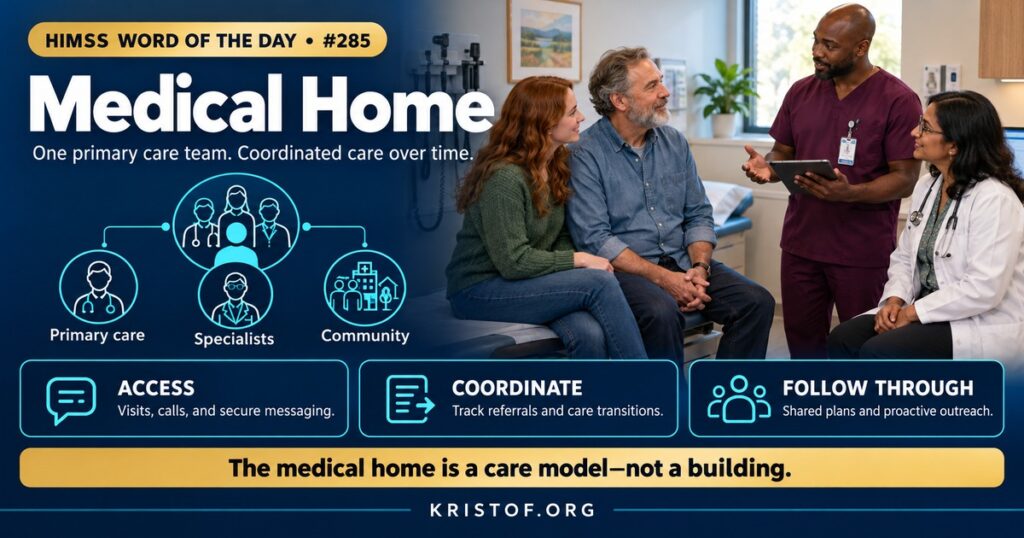
A medical home is a model of primary care delivery. The HIMSS Dictionary describes care meant to be easy to reach, ongoing, broad in scope, family-centered, coordinated, caring, and responsive to culture. In the model, clinicians and allied professionals in primary care deliver routine diagnosis and treatment and also coordinate the care for patients who need services that primary care cannot provide. The goal is a broad range of preventive and curative care over time, with one team coordinating everything the patient receives. The term is usually written patient-centered medical home (PCMH), and the “home” is a relationship and a care team, not a place.
Typical features include a personal clinician and care team for each patient, team-based care with each member working at the top of their training, same-day or extended access, care management for patients with complex needs, coordination with specialists and hospitals, use of data to manage a panel of patients, and a commitment to quality improvement. Many practices pursue formal recognition. NCQA, whose PCMH program it describes as the most widely adopted in the country, states that more than 10,000 practices with over 50,000 clinicians hold its recognition.
| Medical Home Feature | What It Looks Like | Informatics Support |
|---|---|---|
| Personal clinician and team | Patient knows who is responsible | Attribution and panel lists |
| Access | Same-day visits, phone and portal contact | Scheduling, portal, secure messaging |
| Care coordination | Referrals and transitions tracked | Referral tracking, discharge notifications |
| Care management | Outreach to patients at high risk | Risk stratification, registries |
| Quality improvement | Data reviewed and acted on | Dashboards, quality reports |
| Comprehensive care | Preventive, chronic, and behavioral health | Care gap alerts, integrated records |
⚠️ Exam Alert: The medical home is a care delivery model; an accountable care organization (ACO) is a payment and organizational model that may include medical homes. PCMH recognition programs, such as NCQA’s, evaluate practices against standards. Care coordination and population health management are core functions that depend on health information technology.
🌐 Why It Matters: Real-World Healthcare IT Context
Primary care is where chronic disease, prevention, and many acute needs are managed, and coordination across the health system is often weakest there. The medical home aims to fix that by organizing primary care around a team and a panel of patients. It is closely tied to value-based care: payers and accountable care organizations often support medical homes because better primary care is expected to reduce avoidable emergency visits and hospitalizations.
The evidence is mixed, and the best studies explain why. A 2021 study in Medical Care examined PCMH adoption in 5,943 practices across 14 states between 2011 and 2015, using 5,314,284 patient-year observations from a commercial claims database and a difference-in-differences design. PCMH adoption, defined by NCQA recognition, was associated with a reduction of more than 8 percent in total expenditures, with significant reductions in emergency department use, outpatient care, laboratory services, and imaging. Practices differed in capabilities, and when the authors grouped them using clustering, the reduction in emergency department use was driven entirely by one group of practices with enhanced electronic communications. The authors concluded that the model has significant effects when variation in implementation is accounted for. It is an observational study, so it shows association, but the finding about electronic communication is a useful signal for informatics teams.
A cluster randomized trial, the TOPMED study, tested a different question: whether focusing on high-value elements extracted from successful primary care transformation models would reduce cost and use compared with a focus on PCMH quality improvement goals. Eight clinics took part and 16,099 patients met inclusion criteria. All practices received equal financial incentives, health information technology support, and in-person practice facilitation. The results were mixed: a trend toward fewer hospitalizations in the intervention arm, an increase in emergency department visits relative to control, and no difference in costs. It illustrates how hard it is to demonstrate savings in a short trial with few sites.
Chronic disease provides another lens. A 2021 systematic review in Current Diabetes Reviews included 24 of 596 articles on PCMH and diabetes. Care management led to more screening and better preventive care, pharmacy-led interventions and technology were associated with positive clinical outcomes, lower use, and savings, and most studies reported fewer emergency visits and admissions. But the quality and strength of the outcomes were largely inconclusive about overall effectiveness, and the authors found that definitions of the PCMH varied across studies, making comparison difficult. They called for research on which components, such as care bundles, team-based care, and coordination, contribute to improvement.
For informatics, the medical home is demanding. It needs patient attribution so that teams know whose care they are responsible for, registries and risk stratification to find patients who need outreach, tools to track referrals and results, notification when patients are admitted or discharged, portals and messaging for access, and dashboards that show performance. It also needs workflow design so that data tasks are shared across the team and do not fall on the physician alone. Interoperability matters because the home must coordinate with hospitals, specialists, and community services outside its own record system.
Common medical home implementation problems:
- Recognition pursued as paperwork without changing workflow
- No reliable list of attributed patients
- Care management programs without enough staff or data
- Poor links to hospital and specialty information
- Quality measures that burden the team without guiding action
- Savings expected faster than the evidence supports
What supports an effective medical home:
- Defined team roles with nurses and others working at the top of their licenses
- Electronic communication, portal access, and referral tracking
- Registries, risk stratification, and care gap reporting
- Notifications of emergency visits and admissions
- Care managers with manageable panels
- Regular review of data and a culture of improvement
🏥 The Nurse’s Perspective: Clinical, Bedside, & Workflow
Nurses are central to the medical home, often as care coordinators, care managers, and clinic leaders.
At the Bedside
In the clinic, nurses room patients, review medications, screen for needs, teach self-management, and follow up after visits. Knowing that a patient belongs to a team with a personal clinician changes the conversation: the nurse can say who will call, when, and about what, and can arrange the next step before the patient leaves.
In Clinical Workflow
Registered nurse care managers contact patients after hospital discharge, manage chronic disease panels, and connect patients with community resources. Clinic nurse managers organize standing orders and protocols so that routine tasks, such as vaccines, screenings, and refill requests, are handled by the team. Triage nurses use portal and phone protocols to give timely access.
Nurse informaticists help build registries, outreach lists, and templates for care plans, and measure whether the work reduces gaps and avoidable visits. They also ensure that documentation supports quality reporting without adding unnecessary clicks.
In EHR Implementation (Go-Live Perspective)
An Epic Go-Live in primary care must support the team’s workflow: pre-visit planning, rooming, standing orders, and care management tools. At-the-elbow support analysts spend clinic days with nurses and medical assistants, noting where tasks fall to the wrong person or where registry lists do not match the team’s panel. Those findings guide adjustments after go-live.
🎓 CAHIMS / CPHIMS & HIMSS Perspective
CAHIMS Exam Domain Mapping
The medical home appears in care delivery, population health, and payment questions:
| CAHIMS Domain | How the Medical Home Appears |
|---|---|
| Healthcare & Technology Environments | Care delivery models, value-based payment, recognition programs |
| Clinical Informatics | Care coordination, registries, team workflows, decision support |
| Healthcare Information & Systems Management | Attribution, portals, referral tracking, interoperability |
| Management & Leadership | Practice transformation, performance measurement, change management |
Key Terms to Know Alongside Medical Home
- Patient-Centered Medical Home (PCMH) — team-based primary care model that coordinates a patient’s care
- Care Coordination — deliberate organization of care activities across providers and settings
- Panel — group of patients for whom a clinician or team is responsible
- Risk Stratification — grouping patients by likelihood of future need or harm
- NCQA Recognition — external evaluation of a practice against PCMH standards
- Accountable Care Organization (ACO) — group of providers accountable for the cost and quality of care for a population
HIMSS Organizational Position
HIMSS supports value-based care and team-based, data-driven primary care through its research, education, and community work. Members can find related resources through the HIMSS Resource Center.
🔗 Explore Further: External References
- Saynisch et al. (2021), Medical Care — Model Homes: Evaluating Approaches to Patient-Centered Medical Home Implementation https://pubmed.ncbi.nlm.nih.gov/33480657/
- Colasurdo et al. (2022), Medical Care — The Transforming Outcomes for Patients Through Medical Home Evaluation and reDesign (TOPMED) Cluster Randomized Controlled Trial: Cost and Utilization Results https://pubmed.ncbi.nlm.nih.gov/35030564/
- McManus et al. (2021), Current Diabetes Reviews — The Patient-Centered Medical Home as an Intervention Strategy for Diabetes Mellitus: A Systematic Review of the Literature https://pubmed.ncbi.nlm.nih.gov/33231158/
- NCQA — Patient-Centered Medical Home (PCMH) Recognition https://www.ncqa.org/programs/health-care-providers-practices/patient-centered-medical-home-pcmh/
- CMS — Value-Based Programs https://www.cms.gov/medicare/quality/value-based-programs
Term source: HIMSS Dictionary of Health Information and Technology Terms, Acronyms, and Organizations, 6th Edition (2025). All definitions in this series are paraphrased for editorial purposes. Readers are encouraged to consult the primary source for exact language.
Eric Andrew Kristof, RN, CAHIMS is a Healthcare IT professional and HIMSS Arkansas Chapter member based in Hot Springs Village, AR, with hands-on Epic Go-Live experience and a diverse healthcare and IT background. He writes at kristof.org at the intersection of clinical care and healthcare technology.
Leave a Reply