By Eric Andrew Kristof, RN, CAHIMS | Healthcare IT Professional | HIMSS Arkansas Chapter Member
About This Series: The HIMSS Word of the Day is a running blog series drawing from the HIMSS Dictionary of Health Information and Technology Terms, Acronyms, and Organizations, 6th Edition (2025) — the authoritative reference for healthcare IT professionals and the primary study resource for CAHIMS and CPHIMS certification. Each post paraphrases the term in plain language, grounds it in real-world healthcare IT context, and adds a bedside nursing perspective you won’t find in a textbook.
📖 The Term: CCM (Chronic Care Management)
Source: HIMSS Dictionary of Health Information and Technology Terms, Acronyms, and Organizations, 6th Edition (2025)
🔍 Plain-Language Definition
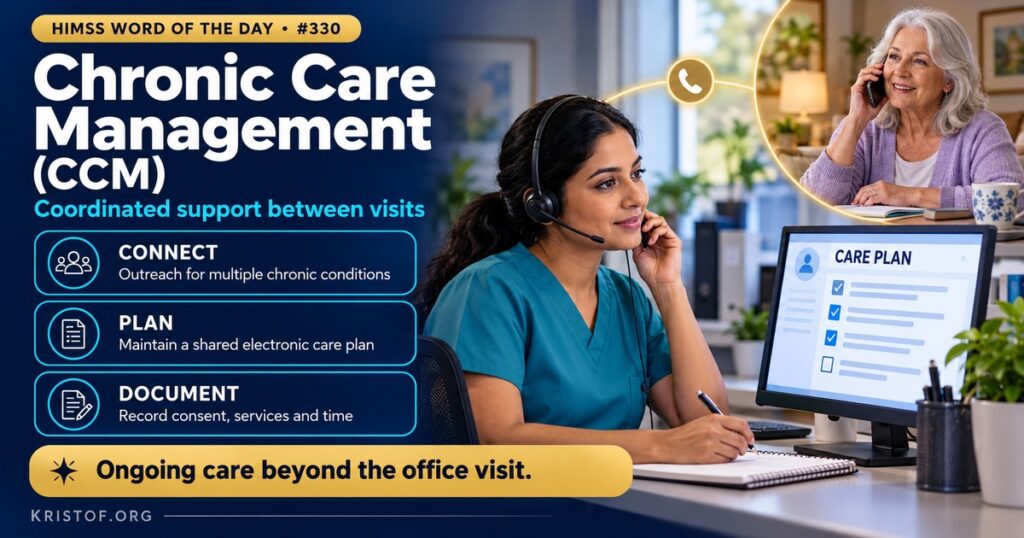
Chronic care management (CCM) is, in the HIMSS Dictionary’s words, a set of non-face-to-face services for Medicare beneficiaries who have two or more significant chronic conditions. The CMS booklet on CCM (MLN909188, June 2025) adds detail. CCM is the management of multiple chronic conditions expected to last at least 12 months, or until death, that place the patient at significant risk of death, acute exacerbation or decompensation, or functional decline. CMS pays for CCM under the Physician Fee Schedule and calls it a critical primary care service.
Several requirements shape the informatics work. An initiating visit is required for new patients or those not seen within the previous year. The practice must get the patient’s written or verbal consent, document it, and tell the patient about cost sharing, that only one practitioner can bill CCM in a calendar month, and that the patient can stop at any time. The practice must record demographics, problems, medications, and medication allergies in certified EHR technology. It must create, revise, and monitor an electronic comprehensive care plan covering assessments and goals, and make that plan available promptly within and outside the practice. It must provide 24/7 access to a clinician or qualified staff, name a care team member for continuity, offer asynchronous communication such as secure messaging or a portal, manage care transitions, and share continuity-of-care documents.
CMS distinguishes standard from complex CCM. Standard CCM codes are based on monthly time, with clinical staff time starting at 20 minutes for code 99490 and the practitioner’s own time starting at 30 minutes for 99491. Complex CCM, code 99487 and its add-on, requires 60 minutes of clinical staff time and moderate to high complexity medical decision making. CMS also describes related services: principal care management for a single high-risk condition, transitional care management, and advanced primary care management (APCM), a bundled monthly payment that combines elements of several care management services without requiring practices to count minutes.
| Service | Focus | Key Feature |
|---|---|---|
| Chronic care management | Two or more chronic conditions | Monthly time-based, non-face-to-face |
| Complex CCM | Higher complexity needs | Longer monthly time, higher-level decisions |
| Principal care management | One high-risk condition | Condition-specific plan |
| Transitional care management | Move from inpatient to community | 30-day period after discharge |
| Advanced primary care management | Bundled primary care services | Monthly bundle without minute counting |
⚠️ Exam Alert: CCM serves patients with two or more chronic conditions and consists mainly of non-face-to-face services. It requires an initiating visit, patient consent, a comprehensive electronic care plan, and use of certified EHR technology. Only one practitioner can bill CCM per patient per month. Complex CCM and standard CCM cannot be billed for the same patient in the same month.
🌐 Why It Matters: Real-World Healthcare IT Context
CCM turns care coordination into a billable, documented service, which makes it an informatics project as much as a clinical program. Three studies show how it works in practice.
Financial sustainability is one question. A 2020 study in the American Journal of Health-System Pharmacy examined pharmacist-led CCM in an academic multiclinic practice over 12 months, from May 2018 through April 2019, billing under the CPT codes added to the Medicare Physician Fee Schedule in 2017. Sixty-five patients were enrolled, and pharmacists delivered 236 encounters, including 31 enrollment visits, over 102 hours of clinical time. Gross revenue was $7,433.91 against expenses of $6,430.36, a return on investment of 15.6 percent. Of 158 claims, 131 (83 percent) were paid and 27 (17 percent) were unpaid or still being adjudicated. The authors called the return modest and suggested combining CCM with other reimbursement programs. The study is a single-site retrospective analysis with small numbers, so it shows feasibility, not what a typical practice would earn.
Scale is another question. A 2020 article in Population Health Management described a technology and clinical staff platform built to deliver CCM at scale. It noted that a CMS-commissioned study had shown CCM to be effective in increasing advance care planning and decreasing overall costs, but that the program remained underutilized. In 2018 the platform supported CCM for 26,500 patients, flagged risks such as falls, mortality, hospitalization, and polypharmacy through structured data elements, and used regression to identify risk factors for hospitalization. The cohort had 2,679 hospitalizations. Among patients living outside nursing homes, higher mortality risk scores were associated with a much greater chance of hospitalization, and nursing home residence was also a predictor. The authors concluded that the model was a scalable method of supporting care management and could help identify risk factors. The article describes the developers’ own platform, so readers should interpret its outcomes with that in mind.
Monitoring tools are a third. A 2025 study in JMIR Cardio evaluated an EHR-integrated, team-based remote patient monitoring program at UC San Diego Health for patients with hypertension, alone or with ischemic heart disease, type 2 diabetes, or both. Patients referred by primary care received a Bluetooth blood pressure cuff and ongoing support from a team including nurse care managers and a pharmacist. In an event-study design comparing before and after referral, systolic blood pressure fell by an average of 9.70 mm Hg in the hypertension-only group at one year, and by 6.61 and 6.60 mm Hg in the groups with one or both coexisting conditions. Among active participants, the average reductions were 16.83, 13.22, and 16.01 mm Hg. The program used existing EHR workflows for referral and monitoring. The design has no randomized control group, so unmeasured factors may contribute. The study did not evaluate CCM billing itself, but it illustrates the kind of between-visit support that CCM is meant to fund. CMS notes that remote physiologic monitoring and remote therapeutic monitoring can be billed with CCM, but not both of them at the same time.
For informatics teams, the main tasks follow from the requirements. They build registries or reports that identify eligible patients, document consent in a way that can be reported, and create a care plan template that clinicians and outside parties can view. They track monthly time by staff member so that billing matches the work, and they flag patients who are enrolled with another practitioner. They also build outreach lists, task queues, and messaging workflows so that nurse care managers can reach patients efficiently. Because CMS updates the codes and rules, compliance staff need to monitor changes, and CMS now describes bundled alternatives such as APCM that may suit some practices better than counting minutes.
Common CCM problems:
- No reliable way to identify eligible patients
- Consent not documented or not reportable
- Care plans that are not shared outside the practice
- Time tracking that is manual or inconsistent
- Patients enrolled with more than one practitioner
- Monthly work that does not meet minimum time thresholds
What supports effective CCM:
- Registry reports that find eligible patients
- Structured consent and care plan documentation
- Shared care plans available to outside providers
- Time tracking built into care manager workflow
- Outreach lists and task queues for nurse care managers
- Ongoing review of CMS rules and alternative bundles
🏥 The Nurse’s Perspective: Clinical, Bedside, & Workflow
Nurse care managers do much of the work that CCM funds, which is the contact, coordination, and teaching between visits.
At the Bedside
For patients who have just left the hospital or clinic, a call from a nurse care manager can catch a medication problem or a worsening symptom early. Nurses teach patients and caregivers what to monitor and when to call, and they document the conversation in the care plan.
In Clinical Workflow
Care managers keep call lists, track monthly time, and update the shared care plan. Nurse leaders decide caseload sizes, supervise clinical staff who work under a billing practitioner’s general supervision, and review whether the time spent meets the program’s standards.
Nurse informaticists build the registries, templates, and task queues the work depends on, and test whether outside providers can read the care plan. They also help decide how monitoring data from devices reach the care manager.
In EHR Implementation (Go-Live Perspective)
An Epic Go-Live that includes care management modules changes how patients are identified and tracked. At-the-elbow support analysts hear when a care manager cannot find a patient’s consent or when time entries do not roll up correctly, and these reports help correct the build before billing is affected.
🎓 CAHIMS / CPHIMS & HIMSS Perspective
CAHIMS Exam Domain Mapping
CCM appears in value-based care, reimbursement, and care coordination questions:
| CAHIMS Domain | How CCM Appears |
|---|---|
| Healthcare & Technology Environments | Medicare payment, fee schedule, certified EHR requirements |
| Clinical Informatics | Care plans, care coordination, patient monitoring |
| Healthcare Information & Systems Management | Registries, task queues, time tracking, data sharing |
| Management & Leadership | Program design, billing compliance, staffing |
Key Terms to Know Alongside CCM
- Comprehensive Care Plan — patient-centered plan covering goals, assessments, and interventions
- Complex CCM — higher-intensity care management with more time and decision making
- Advanced Primary Care Management (APCM) — monthly bundled payment for primary care services
- Transitional Care Management (TCM) — services during the 30 days after an inpatient discharge
- Remote Patient Monitoring (RPM) — collection of patient data outside the clinic for care decisions
- General Supervision — oversight that does not require the practitioner to be physically present
HIMSS Organizational Position
HIMSS supports value-based care and effective use of health information technology through its public policy work, research, and education. Members can find related resources through the HIMSS Resource Center.
🔗 Explore Further: External References
- CMS — Chronic Care Management Services (MLN909188) https://www.cms.gov/files/document/chroniccaremanagement.pdf
- CMS — Physician Fee Schedule https://www.cms.gov/medicare/payment/fee-schedules/physician
- Martin et al. (2020), American Journal of Health-System Pharmacy — Financial Performance and Reimbursement of Pharmacist-Led Chronic Care Management https://pubmed.ncbi.nlm.nih.gov/32995845/
- Mills et al. (2020), Population Health Management — A Platform and Clinical Model to Enable Medicare’s Chronic Care Management Program https://pubmed.ncbi.nlm.nih.gov/31216255/
- Graham et al. (2025), JMIR Cardio — Outcomes of Team-Based Digital Monitoring of Patients With Multiple Chronic Conditions: Semiparametric Event Study https://pubmed.ncbi.nlm.nih.gov/41359921/
Term source: HIMSS Dictionary of Health Information and Technology Terms, Acronyms, and Organizations, 6th Edition (2025). All definitions in this series are paraphrased for editorial purposes. Readers are encouraged to consult the primary source for exact language.
Eric Andrew Kristof, RN, CAHIMS is a Healthcare IT professional and HIMSS Arkansas Chapter member based in Hot Springs Village, AR, with hands-on Epic Go-Live experience and a diverse healthcare and IT background. He writes at kristof.org at the intersection of clinical care and healthcare technology.
Leave a Reply