By Eric Andrew Kristof, RN, CAHIMS | Healthcare IT Professional | HIMSS Arkansas Chapter Member
About This Series: The HIMSS Word of the Day is a running blog series drawing from the HIMSS Dictionary of Health Information and Technology Terms, Acronyms, and Organizations, 6th Edition (2025) — the authoritative reference for healthcare IT professionals and the primary study resource for CAHIMS and CPHIMS certification. Each post paraphrases the term in plain language, grounds it in real-world healthcare IT context, and adds a bedside nursing perspective you won’t find in a textbook.
📖 The Term: SOP (Standard Operating Procedure)
Source: HIMSS Dictionary of Health Information and Technology Terms, Acronyms, and Organizations, 6th Edition (2025)
🔍 Plain-Language Definition
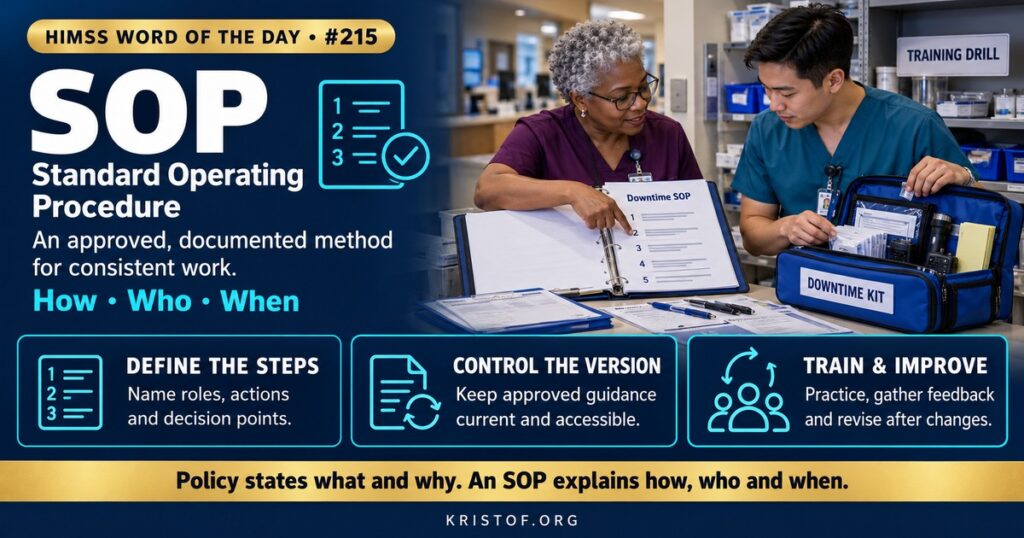
A standard operating procedure (SOP) is a documented, approved method for carrying out a task or handling a recurring situation the same way each time. The HIMSS Dictionary describes SOPs as established or prescribed methods followed for operations or situations. In health care they cover everything from specimen handling to account provisioning to what staff do when a system fails.
SOPs sit in a hierarchy of governing documents. A policy states what the organization requires and why. A procedure or SOP states who does what, in what order. A guideline offers recommended practice with room for judgment. A work instruction or checklist gives task-level detail.
| Document | Purpose | Example |
|---|---|---|
| Policy | States the rule and its rationale | All workforce access to PHI must be authorized |
| Standard Operating Procedure | Gives the required steps and roles | Steps to request, approve, and grant EHR access |
| Guideline | Recommends good practice | Suggested approach to unit-specific access templates |
| Checklist or Work Instruction | Task-level prompts | Daily downtime kit check |
| Protocol | Clinical care pathway or research method | Order set for a specific condition |
⚠️ Exam Alert: A policy says what and why; an SOP says how, who, and when. An SOP is meant to be followed consistently, so it must be specific enough to audit. A guideline is advisory, not mandatory.
🌐 Why It Matters: Real-World Healthcare IT Context
SOPs reduce variation. When two shifts or two sites do the same task differently, errors, delays, and audit findings follow. Written procedures also protect new staff, who would otherwise learn by watching whoever happens to be nearby, and they let organizations show regulators and accreditors that practice matches policy.
Some written procedures are legally required. The HIPAA Security Rule at 45 CFR 164.316 directs covered entities and business associates to implement reasonable and appropriate policies and procedures, to maintain them in written form, which may be electronic, and to keep a written record of any action or assessment the rule requires to be documented. Documentation must be retained for six years from creation or from the date it was last in effect, whichever is later, must be available to the people who carry out the procedures, and must be reviewed and updated periodically in response to changes that affect the security of electronic protected health information.
Clinical laboratories offer another model. Under CLIA at 42 CFR 493.1251, a laboratory must have a written procedure manual for all tests, assays, and examinations it performs, and that manual must be available to and followed by laboratory personnel. Textbooks may supplement but cannot replace the laboratory’s own written procedures. The manual must cover items such as specimen collection and acceptability, step-by-step performance and interpretation, calibration and control procedures, corrective action when controls fail, limitations of the method, reference intervals, and critical or panic values. The regulation shows what a well-built SOP includes: scope, steps, quality checks, and what to do when something goes wrong.
Health IT depends on SOPs in the same way. Examples include procedures for granting and removing access, applying patches, restoring from backup, responding to security incidents, validating interfaces after an upgrade, and operating during downtime. The HIPAA contingency planning provisions call for a data backup plan, a disaster recovery plan, and an emergency mode operation plan, which are most useful when broken into executable procedures.
Downtime is the proving ground. A 2025 retrospective study of a hospital’s adverse event reports identified 204 EHR downtime events over several years, 96.1 percent of them unplanned, and most reported events disrupted patient care. Another 2025 study described the problem of losing access to order sets during a downtime and noted that downtimes affect 96 percent of health care organizations, and that paper-based protocols are often impractical and hard to maintain. Those findings argue for downtime SOPs that are tested, current, and easy to reach when the primary system is unavailable.
Writing a useful SOP takes discipline. Strong procedures have a clear purpose and scope, named roles, numbered steps in plain language, decision points, references to forms or tools, an owner, an effective date, and a revision history. Version control matters, because an outdated SOP can be worse than none. Review on a set schedule, and after any incident or system change, keeps procedures aligned with reality.
Common SOP problems:
- Procedures written to satisfy an auditor but never used
- Several versions in circulation, some outdated
- Steps too vague to follow or too long to read under pressure
- No owner responsible for review
- Staff never trained or tested on the procedure
- Procedures stored only in the system that may be down
What supports usable SOPs:
- A single controlled repository with version history
- Plain language and numbered steps
- Named owners and a review calendar
- Drills and simulations for high-risk procedures
- Printed or offline copies for downtime
- Feedback loops so frontline staff can flag problems
🏥 The Nurse’s Perspective: Clinical, Bedside, & Workflow
Nurses follow SOPs every shift, even when they are called unit procedures, policies, or checklists.
At the Bedside
Hand hygiene, specimen labeling, medication administration, and patient identification all rest on written procedures. When the EHR is unavailable, the downtime SOP tells nurses how to document, how to order, and how to reconcile entries afterward. Knowing where the downtime kit is and having practiced with it makes a difference when minutes matter.
When a procedure does not match what is practical on the unit, nurses are best placed to report it. Procedures that are routinely bypassed signal a problem with the procedure, the tools, or the staffing.
In Clinical Workflow
Nurse leaders and educators often own clinical SOPs. They update them after practice changes, new devices, or safety events, and they make sure staff are trained. Nurse informaticists help ensure that the EHR workflow and the written procedure agree, so that the SOP does not describe a screen that no longer exists.
After a downtime, the recovery SOP governs back-entry of paper records. Clear steps for who enters what, how late entries are marked, and how conflicts are resolved protect the integrity of the record.
In EHR Implementation (Go-Live Perspective)
An Epic Go-Live generates many new procedures: downtime workflows, escalation paths for issues, and unit-specific job aids. At-the-elbow support analysts rely on these documents and often discover the gaps, such as a step that assumes access a user does not have. They pass those findings back so SOPs are corrected while the go-live team is still on site.
🎓 CAHIMS / CPHIMS & HIMSS Perspective
CAHIMS Exam Domain Mapping
SOPs appear in compliance, operations, and quality questions:
| CAHIMS Domain | How SOPs Appear |
|---|---|
| Healthcare & Technology Environments | HIPAA documentation requirements, CLIA, accreditation expectations |
| Clinical Informatics | Clinical workflow documentation, downtime and recovery procedures |
| Healthcare Information & Systems Management | IT operations, change management, backup and restore, access procedures |
| Management & Leadership | Governance, training, audits, continuous improvement |
Key Terms to Know Alongside SOPs
- Policy — formal statement of what an organization requires
- Procedure — the steps and roles for carrying out a policy
- Downtime Procedure — instructions for continuing operations when a system is unavailable
- Version Control — tracking approved versions and revisions of a document
- Documentation Retention — required period for keeping compliance records
- Corrective Action — step taken when a process does not meet expectations
HIMSS Organizational Position
HIMSS supports quality, safety, and operational readiness through its education, research, and communities. Members can find related resources through the HIMSS Resource Center.
🔗 Explore Further: External References
- eCFR — 45 CFR 164.316, Policies and Procedures and Documentation Requirements https://www.ecfr.gov/current/title-45/subtitle-A/subchapter-C/part-164/subpart-C/section-164.316
- eCFR — 45 CFR 164.308, Administrative Safeguards (Contingency Plan) https://www.ecfr.gov/current/title-45/subtitle-A/subchapter-C/part-164/subpart-C/section-164.308
- eCFR — 42 CFR 493.1251, Standard: Procedure Manual (CLIA) https://www.ecfr.gov/current/title-42/chapter-IV/subchapter-G/part-493/subpart-K/section-493.1251
- Fang et al. (2025), Applied Clinical Informatics — Electronic Health Record Downtime Events of a Hospital: A Retrospective Analysis from Adverse Event Reports https://pubmed.ncbi.nlm.nih.gov/41135583/
- Proctor et al. (2025), Applied Clinical Informatics — Development and Evaluation of Offsite Repository for Clinical Assets, a Resilient Solution for Order Set Access during EHR Downtimes https://pubmed.ncbi.nlm.nih.gov/40419254/
- ONC — SAFER Guides https://healthit.gov/clinical-quality-and-safety/safer-guides/
Term source: HIMSS Dictionary of Health Information and Technology Terms, Acronyms, and Organizations, 6th Edition (2025). All definitions in this series are paraphrased for editorial purposes. Readers are encouraged to consult the primary source for exact language.
Eric Andrew Kristof, RN, CAHIMS is a Healthcare IT professional and HIMSS Arkansas Chapter member based in Hot Springs Village, AR, with hands-on Epic Go-Live experience and a diverse healthcare and IT background. He writes at kristof.org at the intersection of clinical care and healthcare technology.
Leave a Reply