By Eric Andrew Kristof, RN, CAHIMS | Healthcare IT Professional | HIMSS Arkansas Chapter Member
About This Series: The HIMSS Word of the Day is a running blog series drawing from the HIMSS Dictionary of Health Information and Technology Terms, Acronyms, and Organizations, 6th Edition (2025) — the authoritative reference for healthcare IT professionals and the primary study resource for CAHIMS and CPHIMS certification. Each post paraphrases the term in plain language, grounds it in real-world healthcare IT context, and adds a bedside nursing perspective you won’t find in a textbook.
📖 The Term: NCPDP SCRIPT Standard
Source: HIMSS Dictionary of Health Information and Technology Terms, Acronyms, and Organizations, 6th Edition (2025)
🔍 Plain-Language Definition
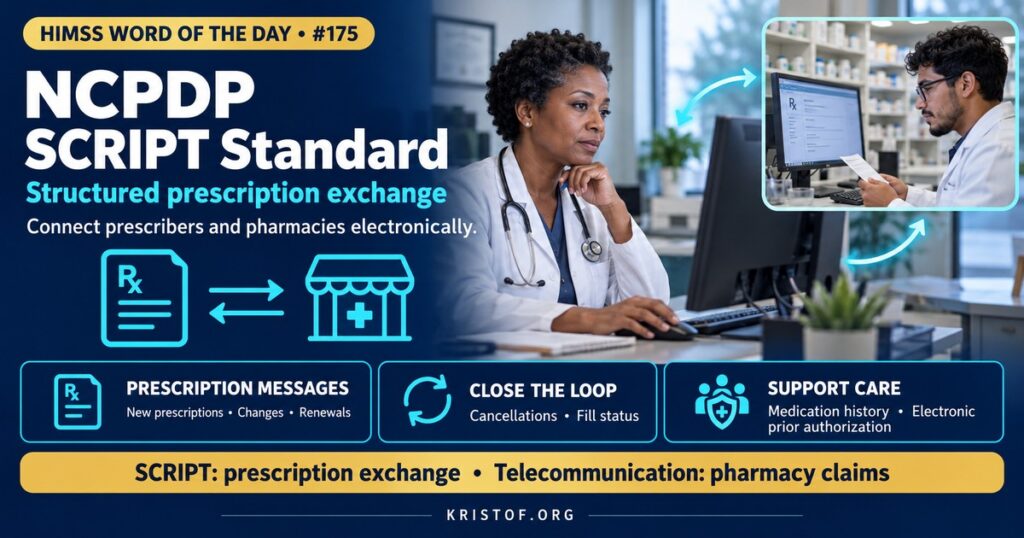
The NCPDP SCRIPT standard is the National Council for Prescription Drug Programs standard for electronically exchanging prescription and prescription-related information among prescribers, pharmacies, intermediaries, long-term care facilities, and payers.
The HIMSS Dictionary describes SCRIPT as a standard published by NCPDP to support moving prescription data among pharmacies, prescribers, intermediaries, facilities, and payers. Its examples include sending new prescriptions, requesting changes or refills, reporting whether a prescription was filled, canceling orders, sharing medication history, supporting long-term care workflows, and exchanging prior authorization information.
| SCRIPT Transaction | Purpose | Example |
|---|---|---|
| New Prescription (NewRx) | Sends a new prescription to a pharmacy | A discharge prescription for an antibiotic |
| Change Request and Response | Pharmacy requests a change; prescriber responds | Substituting a covered alternative |
| Renewal Request and Response | Requests and approves refills | Renewal of a chronic medication |
| Cancel Prescription | Cancels a previously sent prescription | Discontinuing a medication after a dose change |
| Fill Status | Reports whether a prescription was dispensed | Notifying the prescriber that a prescription was picked up |
| Medication History | Retrieves dispensing history | Supporting medication reconciliation at admission |
| Electronic Prior Authorization | Exchanges prior authorization questions and responses | Approval for a specialty medication |
⚠️ Exam Alert: SCRIPT is the standard for prescriber-to-pharmacy e-prescribing. NCPDP Telecommunication standards handle pharmacy claims. NDC identifies drug products; RxNorm provides normalized clinical drug names used in prescriptions. EPCS adds identity proofing and two-factor authentication for controlled substances.
🌐 Why It Matters: Real-World Healthcare IT Context
E-prescribing has largely replaced handwritten and faxed prescriptions, improving legibility, reducing transcription errors, and enabling decision support. SCRIPT is what makes this possible across thousands of EHRs and pharmacy systems from different vendors.
Federal rules drive adoption of specific versions. For Medicare Part D, CMS requires use of the SCRIPT standard adopted by HHS. A CMS final rule moved Part D e-prescribing from SCRIPT version 2017071 to version 2023011, with a transition period that began in July 2024. Beginning January 1, 2028, entities must use SCRIPT version 2023011 exclusively for Part D e-prescribing. CMS also adopted updated formulary and benefit and real-time prescription benefit standards to help prescribers see coverage and costs.
The ONC Health IT Certification Program includes e-prescribing criteria tied to SCRIPT, so certified EHRs support the required transactions. Version upgrades require coordinated work among EHR vendors, pharmacy systems, and intermediary networks.
Newer SCRIPT versions add capabilities. Improvements include better support for structured dosing instructions, long-term care workflows, compounded medications, and electronic prior authorization, along with refinements based on industry experience.
Change and cancel transactions matter for safety. When a prescriber discontinues a medication, sending an electronic cancellation helps prevent the pharmacy from dispensing it. Organizations that fail to send or process cancellations risk patients receiving discontinued drugs.
Electronic prescribing of controlled substances adds security. DEA rules require identity proofing and two-factor authentication for prescribers using EPCS, and federal law requires most Medicare Part D controlled substance prescriptions to be sent electronically, with exceptions. Prescription drug monitoring programs complement EPCS by providing dispensing history for controlled substances.
Pharmacy workflow benefits as well. When prescriptions arrive in structured form, pharmacists spend less time deciphering handwriting and calling prescribers, and they can use change requests to propose formulary alternatives or clarify doses electronically, creating a documented exchange instead of a phone tag.
Medication history supports reconciliation. Dispensing history retrieved through SCRIPT transactions helps clinicians build accurate medication lists at admission, though it may miss cash purchases, samples, and over-the-counter drugs.
Long-term care settings have particular needs. Nursing facilities manage frequent medication changes, administration schedules, and pharmacy deliveries for many residents, and SCRIPT includes transactions designed for communication among facilities, prescribers, and long-term care pharmacies. Electronic exchange in these settings reduces faxed orders and transcription errors.
Data quality still matters. Free-text sig instructions, mismatched drug identifiers, and incomplete patient information can lead to pharmacy callbacks or errors. Structured sigs and consistent use of RxNorm and NDC codes improve accuracy.
Patients increasingly see prescription status in portals and pharmacy apps. Fill status and cancellation messages help keep what patients see consistent with what the care team intends.
Common e-prescribing problems:
- Unsent or unprocessed cancellations
- Free-text instructions that confuse pharmacies
- Wrong pharmacy selected for the patient
- Mismatched drug codes between systems
- Change requests that go unanswered
- Version differences during transitions
Practices that support safe e-prescribing:
- Using structured sig and standard drug codes
- Sending cancel transactions when discontinuing therapy
- Verifying pharmacy selection with patients
- Responding promptly to change and renewal requests
- Monitoring transaction failures
- Planning upgrades to SCRIPT 2023011 before 2028
🏥 The Nurse’s Perspective: Clinical, Bedside, & Workflow
Nurses interact with e-prescribing every day, especially at discharge and in ambulatory care.
At the Bedside
At discharge, nurses review prescriptions with patients, confirm the correct pharmacy, and explain new, changed, and discontinued medications. Confirming that discontinued medications have been canceled helps prevent patients from receiving outdated prescriptions.
Medication history pulled from pharmacy data assists nurses in admission medication reconciliation, but patient interviews remain essential to capture what patients actually take.
In Clinical Workflow
In clinics, nurses often manage renewal requests and pharmacy change requests under protocols, routing them to prescribers or approving refills when authorized. Prompt handling prevents gaps in therapy.
Pharmacy callbacks about unclear instructions or coverage issues frequently reach nurses. Understanding SCRIPT capabilities, such as electronic change requests and prior authorization, helps resolve issues efficiently.
Advanced practice nurses who prescribe controlled substances complete identity proofing and use two-factor authentication for EPCS. Protecting tokens and credentials preserves security and accountability.
Prior authorization requests for medications can now often be completed electronically within the EHR, and nurses who manage these requests benefit from knowing where to find payer questions and responses.
In EHR Implementation (Go-Live Perspective)
During an Epic Go-Live, e-prescribing connections, pharmacy directories, and medication history services are configured and tested. Prescribers and nurses verify that prescriptions route correctly and that renewals and change requests appear in the right work queues.
At-the-elbow support analysts help nurses manage incoming pharmacy messages and resolve failed transmissions in the first days after Go-Live.
🎓 CAHIMS / CPHIMS & HIMSS Perspective
CAHIMS Exam Domain Mapping
The SCRIPT standard appears in standards and medication questions:
| CAHIMS Domain | How SCRIPT Appears |
|---|---|
| Healthcare & Technology Environments | NCPDP; CMS Part D e-prescribing requirements; EPCS rules |
| Clinical Informatics | Discharge prescriptions, renewals, cancellations, medication reconciliation |
| Healthcare Information & Systems Management | Transactions, version upgrades, intermediary networks, drug codes |
| Management & Leadership | Compliance deadlines, vendor coordination, medication safety programs |
Key Terms to Know Alongside SCRIPT
- NCPDP — the standards development organization for pharmacy transactions
- E-Prescribing — electronic transmission of prescriptions from prescriber to pharmacy
- EPCS — electronic prescribing of controlled substances with added security requirements
- Structured Sig — standardized coding of prescription instructions
- Real-Time Prescription Benefit — a standard for showing patient-specific drug cost and coverage
- Medication History — dispensing records used to support reconciliation
HIMSS Organizational Position
HIMSS supports standards-based e-prescribing and medication safety through its interoperability education and policy engagement on CMS and ONC rules. Members can find related education and research through the HIMSS Resource Center.
🔗 Explore Further: External References
- CMS — E-Prescribing https://www.cms.gov/medicare/regulations-guidance/electronic-prescribing
- NCPDP — National Council for Prescription Drug Programs https://www.ncpdp.org/
- ONC — Interoperability Standards Platform https://isp.healthit.gov/
- National Library of Medicine — RxNorm https://www.nlm.nih.gov/research/umls/rxnorm/index.html
- FDA — National Drug Code Directory https://www.fda.gov/drugs/drug-approvals-and-databases/national-drug-code-directory
- HIMSS — Public Policy & Advocacy https://www.himss.org/public-policy-advocacy-overview
Term source: HIMSS Dictionary of Health Information and Technology Terms, Acronyms, and Organizations, 6th Edition (2025). All definitions in this series are paraphrased for editorial purposes. Readers are encouraged to consult the primary source for exact language.
Eric Andrew Kristof, RN, CAHIMS is a Healthcare IT professional and HIMSS Arkansas Chapter member based in Hot Springs Village, AR, with hands-on Epic Go-Live experience and a diverse healthcare and IT background. He writes at kristof.org at the intersection of clinical care and healthcare technology.
Leave a Reply