By Eric Andrew Kristof, RN, CAHIMS | Healthcare IT Professional | HIMSS Arkansas Chapter Member
About This Series: The HIMSS Word of the Day is a running blog series drawing from the HIMSS Dictionary of Health Information and Technology Terms, Acronyms, and Organizations, 6th Edition (2025) — the authoritative reference for healthcare IT professionals and the primary study resource for CAHIMS and CPHIMS certification. Each post paraphrases the term in plain language, grounds it in real-world healthcare IT context, and adds a bedside nursing perspective you won’t find in a textbook.
📖 The Term: HIPAA Privacy Rule
Source: HIMSS Dictionary of Health Information and Technology Terms, Acronyms, and Organizations, 6th Edition (2025)
🔍 Plain-Language Definition
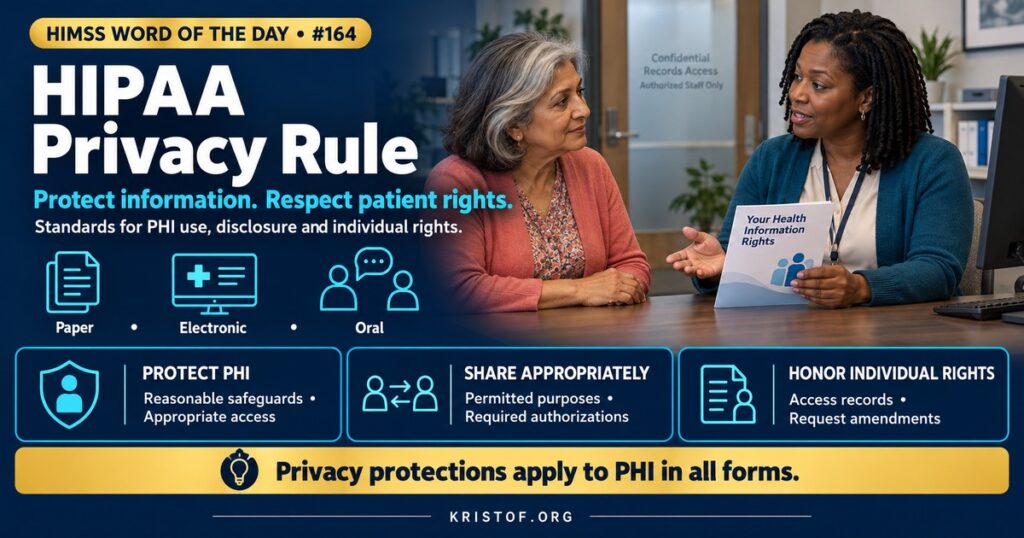
The HIPAA Privacy Rule is the federal regulation that sets national standards for protecting individually identifiable health information held by covered entities and their business associates, limits how that information may be used and disclosed, and gives individuals rights over their health information.
The HIMSS Dictionary describes the Privacy Rule as establishing national standards to protect medical records and other personal health information. It notes that the rule applies to health plans, clearinghouses, and providers that conduct certain transactions electronically, requires safeguards for privacy, limits uses and disclosures made without authorization, and gives patients rights, including examining and getting copies of their records and requesting corrections. It locates the rule in Part 160 and in Subparts A and E of Part 164 of Title 45 of the Code of Federal Regulations.
| Privacy Rule Element | What It Means | Example |
|---|---|---|
| Treatment, Payment, and Operations | Uses and disclosures generally permitted without authorization | Sharing records with a consulting specialist |
| Authorization | Written permission required for other uses | Releasing records to an employer or for marketing |
| Minimum Necessary | Use or disclose only what is needed for the purpose | Billing staff seeing only data needed for claims |
| Individual Rights | Access, amendment, accounting of disclosures, restrictions, confidential communications | A patient requesting a copy of records |
| Notice of Privacy Practices | Explains how information may be used and patients’ rights | A notice given at a first visit |
| Public Interest Disclosures | Permitted disclosures such as public health reporting | Reporting a communicable disease to the health department |
⚠️ Exam Alert: The Privacy Rule covers PHI in all forms; the Security Rule covers electronic PHI only. Minimum necessary does not apply to disclosures for treatment. Patients have a right to access their records, generally within 30 days. 42 CFR Part 2 adds extra protections for certain substance use disorder treatment records.
🌐 Why It Matters: Real-World Healthcare IT Context
The Privacy Rule, with compliance required for most covered entities beginning in 2003, created the first national standards for health information privacy in the United States. It balances two goals: protecting patients’ privacy and allowing information to flow as needed for care, payment, and public health.
Permitted uses and disclosures are central. Covered entities may use and disclose PHI for treatment, payment, and health care operations without authorization, and the rule permits disclosures for certain public interest purposes, such as public health activities, health oversight, law enforcement under specific conditions, and research under defined safeguards. Most other uses, such as marketing or sale of PHI, require written authorization.
Individual rights give patients control and transparency. Patients can access and obtain copies of their records, request amendments, receive an accounting of certain disclosures, request restrictions, and ask for confidential communications. HHS’s Office for Civil Rights has emphasized the right of access through enforcement actions against organizations that failed to provide timely access.
The minimum necessary standard requires covered entities to limit uses and disclosures to the minimum information needed for the purpose, with exceptions for treatment and some other situations. Role-based access controls in EHRs help put this standard into practice.
The rule interacts with other laws. State laws that provide greater privacy protection generally remain in effect. 42 CFR Part 2 adds protections for certain substance use disorder treatment records, and HHS revised Part 2 in 2024 to align it more closely with HIPAA. Information blocking regulations encourage sharing electronic health information, and organizations must reconcile these expectations with privacy requirements.
Privacy rules continue to evolve through rulemaking and courts. For example, a 2024 HHS rule adding protections for reproductive health information was vacated by a federal court in 2025, illustrating how privacy requirements can change and why organizations monitor developments closely.
Outside HIPAA, many health data uses are not covered, such as many consumer apps and wearables. Patients often assume HIPAA protects all health information, but other laws, including Federal Trade Commission rules and state privacy laws, may apply instead. Other countries’ laws, such as Europe’s General Data Protection Regulation, take broader approaches.
Technology shapes privacy practice. Audit logs, access controls, break-the-glass features, secure messaging, and portal release rules all help organizations meet Privacy Rule requirements, while snooping in records remains a common privacy violation.
Common Privacy Rule violations:
- Accessing records without a work-related reason
- Discussing patients where others can overhear
- Sending PHI to the wrong recipient
- Failing to provide timely patient access
- Disclosing more than the minimum necessary
- Posting patient information on social media
Practices that support privacy compliance:
- Role-based access and audit monitoring
- Clear policies for disclosures and verification
- Timely processes for patient access requests
- Privacy training tailored to roles
- Prompt reporting and investigation of incidents
- Patient-facing notices that explain rights clearly
🏥 The Nurse’s Perspective: Clinical, Bedside, & Workflow
Nurses protect patient privacy in nearly every interaction, from conversations to charting.
At the Bedside
Speaking quietly, closing curtains or doors, and choosing locations carefully for sensitive conversations reduce incidental disclosures. The Privacy Rule recognizes that some incidental disclosures happen, but expects reasonable safeguards.
Sharing information with family members involved in a patient’s care is often permitted, but nurses should respect the patient’s wishes. When a patient can agree or object, asking first is the best practice; when the patient is incapacitated, professional judgment guides what to share.
In Clinical Workflow
Accessing only the records needed for one’s role is essential. Looking up a neighbor, coworker, or public figure without a work-related reason is a violation, and audit logs make such access detectable.
Phone requests for information require verification of the caller’s identity and authority. Requests from attorneys, employers, or law enforcement should be routed to the appropriate office.
Patients may ask how to get copies of their records or how to request a correction. Nurses can point them to the patient portal and health information management processes.
Social media posts, even without names, can identify patients through details, photos, or timing. Nurses should avoid sharing any patient-related content outside approved channels.
In EHR Implementation (Go-Live Perspective)
During an Epic Go-Live, organizations configure access roles, break-the-glass settings, sensitive record flags, and portal release rules that implement Privacy Rule requirements. Training reinforces appropriate access in the new system.
At-the-elbow support analysts should avoid viewing more patient information than needed to help users, and should report any privacy concerns observed during support.
🎓 CAHIMS / CPHIMS & HIMSS Perspective
CAHIMS Exam Domain Mapping
The HIPAA Privacy Rule appears in privacy, policy, and compliance questions:
| CAHIMS Domain | How the Privacy Rule Appears |
|---|---|
| Healthcare & Technology Environments | HIPAA regulations; OCR enforcement; interaction with state and federal laws |
| Clinical Informatics | Family communication, appropriate access, patient education about rights |
| Healthcare Information & Systems Management | Access controls, audit logs, portal release rules, sensitive data flags |
| Management & Leadership | Privacy programs, policies, training, incident response |
Key Terms to Know Alongside HIPAA Privacy Rule
- Protected Health Information (PHI) — individually identifiable health information held by covered entities and business associates
- Treatment, Payment, and Operations (TPO) — purposes for which PHI may generally be used without authorization
- Authorization — a patient’s written permission for uses and disclosures not otherwise permitted
- Minimum Necessary — limiting PHI use and disclosure to what is needed
- Notice of Privacy Practices — a document explaining uses of PHI and patients’ rights
- Right of Access — an individual’s right to inspect and obtain copies of PHI
HIMSS Organizational Position
HIMSS engages on health privacy policy, including HIPAA modernization and protections for health data outside HIPAA, through its public policy work and education. Members can find related education and research through the HIMSS Resource Center.
🔗 Explore Further: External References
- HHS — The HIPAA Privacy Rule https://www.hhs.gov/hipaa/for-professionals/privacy/index.html
- HHS — Summary of the HIPAA Privacy Rule https://www.hhs.gov/hipaa/for-professionals/privacy/laws-regulations/index.html
- eCFR — 45 CFR Part 164 Subpart E, Privacy of Individually Identifiable Health Information https://www.ecfr.gov/current/title-45/subtitle-A/subchapter-C/part-164/subpart-E
- HHS — Minimum Necessary Requirement https://www.hhs.gov/hipaa/for-professionals/privacy/guidance/minimum-necessary-requirement/index.html
- HHS — Fact Sheet: 42 CFR Part 2 Final Rule https://www.hhs.gov/hipaa/for-professionals/regulatory-initiatives/fact-sheet-42-cfr-part-2-final-rule/index.html
- HIMSS — Public Policy & Advocacy https://www.himss.org/public-policy-advocacy-overview
Term source: HIMSS Dictionary of Health Information and Technology Terms, Acronyms, and Organizations, 6th Edition (2025). All definitions in this series are paraphrased for editorial purposes. Readers are encouraged to consult the primary source for exact language.
Eric Andrew Kristof, RN, CAHIMS is a Healthcare IT professional and HIMSS Arkansas Chapter member based in Hot Springs Village, AR, with hands-on Epic Go-Live experience and a diverse healthcare and IT background. He writes at kristof.org at the intersection of clinical care and healthcare technology.
Leave a Reply