By Eric Andrew Kristof, RN, CAHIMS | Healthcare IT Professional | HIMSS Arkansas Chapter Member
About This Series: The HIMSS Word of the Day is a running blog series drawing from the HIMSS Dictionary of Health Information and Technology Terms, Acronyms, and Organizations, 6th Edition (2025) — the authoritative reference for healthcare IT professionals and the primary study resource for CAHIMS and CPHIMS certification. Each post paraphrases the term in plain language, grounds it in real-world healthcare IT context, and adds a bedside nursing perspective you won’t find in a textbook.
📖 The Term: Virtual Hospital (Hospital at Home)
Source: HIMSS Dictionary of Health Information and Technology Terms, Acronyms, and Organizations, 6th Edition (2025)
🔍 Plain-Language Definition
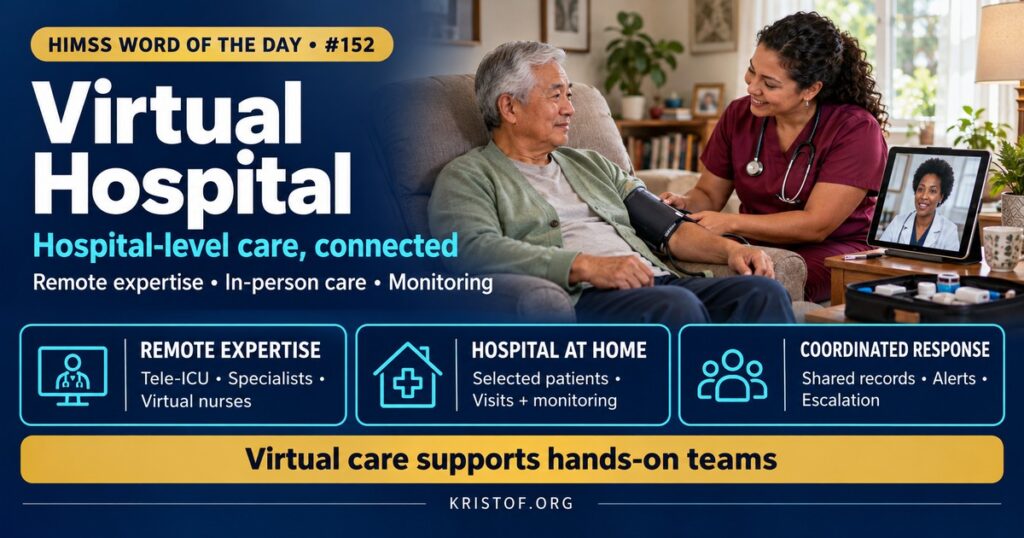
A virtual hospital is a care model that uses telehealth, remote monitoring, and communication technology to deliver hospital-level expertise or care to patients wherever they are, whether in a smaller hospital, a nursing facility, or their own home.
The HIMSS Dictionary describes two related meanings: a centralized hub that uses telemedicine and advanced communication devices to connect with a regional hospital offering broader expertise, and a model that lets caregivers provide care regardless of the patient’s location.
| Virtual Hospital Model | How It Works | Example |
|---|---|---|
| Tele-ICU | Remote critical care teams monitor ICU patients across sites | Intensivists and nurses watching vital signs and alerts from a hub |
| Virtual Nursing | Remote nurses support bedside teams by video | Admission histories, discharge education, and mentoring |
| Hospital at Home | Acute inpatient-level care delivered in the home | A patient with pneumonia treated at home with daily visits and monitoring |
| Virtual Care Center | A central hub providing multiple telehealth services | Remote monitoring, specialist consults, and care coordination |
| Tele-Specialty Support | Specialists consult remotely for smaller hospitals | Telestroke assessments in rural emergency departments |
⚠️ Exam Alert: Telehealth is the broad category of remote care. A virtual hospital applies telehealth to hospital-level or acute care. Hospital at home provides inpatient-level care in the home, while remote patient monitoring usually supports chronic or post-discharge care. Virtual nursing supplements, rather than replaces, bedside nurses.
🌐 Why It Matters: Real-World Healthcare IT Context
Hospitals face staffing shortages, capacity constraints, and uneven access to specialists, especially in rural areas. Virtual hospital models aim to extend scarce expertise, relieve bedside teams, and in some cases move appropriate care out of the hospital building altogether.
Tele-ICU programs were among the earliest models, using remote intensivists and critical care nurses to monitor patients continuously and support bedside staff, especially overnight and in hospitals without round-the-clock intensivist coverage. Similar hub models now support stroke, behavioral health, and other specialties.
Virtual nursing has grown rapidly as hospitals respond to nurse staffing pressures. Remote nurses complete admission histories, medication reconciliation, discharge education, and documentation by video, mentor newer nurses, and provide an extra set of eyes, allowing bedside nurses to focus on hands-on care.
Hospital at home moves acute care into the patient’s home for selected conditions, such as some infections, heart failure exacerbations, and chronic lung disease flares. Patients receive in-person visits from nurses and paramedics, remote monitoring, video visits with physicians, home infusions, and delivered medications, equipment, and meals as needed.
Federal policy has shaped hospital at home. CMS created the Acute Hospital Care at Home program in 2020, allowing approved hospitals to provide inpatient-level care at home under specific requirements. Congress has extended the waiver several times, and the Consolidated Appropriations Act, 2026 extended it for five years, through September 30, 2030, giving programs more stability for planning and investment.
Technology is essential. Virtual hospitals rely on reliable video, remote monitoring devices, EHR integration, secure communication, alerting, and logistics systems that coordinate visits, supplies, and pharmacy delivery. Device data must reach the right clinicians, and patients need dependable connectivity, which can be a barrier in rural or low-income households.
Safety and selection matter. Hospital at home works for carefully selected patients with stable home environments and clear escalation plans. Programs need rapid response for deterioration, clear criteria for returning patients to the hospital, and ongoing quality monitoring.
Measurement shapes the future of these models. Programs track outcomes such as readmissions, escalations back to the hospital, falls, patient experience, and caregiver burden, and compare them with traditional inpatient care. For virtual nursing, organizations monitor nurse satisfaction, time savings for bedside staff, and documentation quality to judge whether the model truly helps.
Equity and workforce questions remain. Programs must avoid excluding patients without stable housing, caregivers, or broadband, and must define roles so that virtual work supports rather than burdens bedside teams.
Common virtual hospital challenges:
- Connectivity gaps in homes and rural areas
- Integrating device data into the EHR without overload
- Clear escalation and emergency response plans
- Patient selection and caregiver availability
- Licensing and credentialing across sites and states
- Defining roles between virtual and bedside staff
What helps virtual hospital programs succeed:
- Strong patient selection criteria and consent processes
- Reliable devices, connectivity, and technical support
- Integrated documentation and alerting in the EHR
- Coordinated logistics for visits, medications, and equipment
- Clear role definitions for virtual nurses and bedside teams
- Quality, safety, and patient experience measurement
🏥 The Nurse’s Perspective: Clinical, Bedside, & Workflow
Nurses are central to every virtual hospital model, both at the bedside and on the screen.
At the Bedside
Bedside nurses working with virtual nurses can share tasks such as admission interviews, education, and documentation, freeing time for assessments, medications, and hands-on care. Clear expectations about who does what prevent duplication and confusion.
In hospital at home programs, nurses visit patients in their homes, perform assessments, administer medications, draw labs, and teach patients and caregivers. Home visits require adapting to each environment and recognizing safety concerns.
In Clinical Workflow
Virtual nurses and tele-ICU nurses monitor patients through video, alerts, and device data, escalating concerns to bedside staff or physicians. Effective communication protocols, such as structured handoffs and agreed escalation paths, keep virtual and bedside teams aligned.
Patient and family education is a strength of virtual nursing. A remote nurse can spend focused time explaining discharge instructions or new medications without the interruptions common on busy units.
Documentation must be clear about who performed each task and from where. EHR workflows often include specific roles and note types for virtual nurses.
Nurses help patients and caregivers use home monitoring devices and video tools, troubleshooting connectivity and ensuring readings are accurate.
Privacy deserves attention in video-based care. Cameras in patient rooms and homes should be used with clear patient notification, and virtual nurses should confirm who else is present before discussing sensitive information.
In EHR Implementation (Go-Live Perspective)
During an Epic Go-Live, virtual care programs need configured roles, documentation templates, device integrations, and video connections tested before launch. Virtual nurses must have access to the same patient information as bedside staff.
At-the-elbow support for virtual teams may itself be virtual, with analysts available by video or chat. Testing camera, audio, and device connections in patient rooms before Go-Live prevents disruptions on day one.
🎓 CAHIMS / CPHIMS & HIMSS Perspective
CAHIMS Exam Domain Mapping
The virtual hospital appears in telehealth, care delivery, and policy questions:
| CAHIMS Domain | How the Virtual Hospital Appears |
|---|---|
| Healthcare & Technology Environments | Telehealth policy; CMS Acute Hospital Care at Home; workforce trends |
| Clinical Informatics | Virtual nursing workflows, remote monitoring, escalation, documentation |
| Healthcare Information & Systems Management | Video platforms, device integration, connectivity, alerting |
| Management & Leadership | Program design, staffing models, capacity strategy, equity |
Key Terms to Know Alongside Virtual Hospital
- Telehealth — the delivery of health services at a distance using technology
- Hospital at Home — inpatient-level acute care delivered in a patient’s home
- Tele-ICU — remote monitoring and support of intensive care patients
- Virtual Nursing — nurses supporting care remotely through video and digital tools
- Remote Patient Monitoring (RPM) — collection of patient data outside traditional settings
- Escalation Protocol — defined steps for responding to patient deterioration
HIMSS Organizational Position
HIMSS supports virtual care through its Virtual Care Community, education, and research on telehealth, remote monitoring, and care delivery innovation. Members can find related education and research through the HIMSS Resource Center.
🔗 Explore Further: External References
- CMS QualityNet — Acute Hospital Care at Home https://qualitynet.cms.gov/acute-hospital-care-at-home
- American Medical Association — Lawmakers Extend CMS Hospital-at-Home Waiver for Five Years https://www.ama-assn.org/public-health/population-health/lawmakers-extend-cms-hospital-home-waiver-five-years
- American Hospital Association — Hospital-at-Home https://www.aha.org/hospitalathome
- ONC — SAFER Guides https://healthit.gov/clinical-quality-and-safety/safer-guides/
- CMS — Telehealth Coverage (Medicare) https://www.cms.gov/medicare/coverage/telehealth
- HIMSS — Virtual Care Community https://www.himss.org/networking/communities/virtual-care/
Term source: HIMSS Dictionary of Health Information and Technology Terms, Acronyms, and Organizations, 6th Edition (2025). All definitions in this series are paraphrased for editorial purposes. Readers are encouraged to consult the primary source for exact language.
Eric Andrew Kristof, RN, CAHIMS is a Healthcare IT professional and HIMSS Arkansas Chapter member based in Hot Springs Village, AR, with hands-on Epic Go-Live experience and a diverse healthcare and IT background. He writes at kristof.org at the intersection of clinical care and healthcare technology.
Leave a Reply