By Eric Andrew Kristof, RN, CAHIMS | Healthcare IT Professional | HIMSS Arkansas Chapter Member
About This Series: The HIMSS Word of The Day is a running blog series drawing from the HIMSS Dictionary of Health Information and Technology Terms, Acronyms, and Organizations, 6th Edition (2025) — the authoritative reference for healthcare IT professionals and the primary study resource for CAHIMS and CPHIMS certification. Each post paraphrases the term in plain language, grounds it in real-world healthcare IT context, and adds a bedside nursing perspective you won’t find in a textbook.
📖 The Term: Unicode
Source: HIMSS Dictionary of Health Information and Technology Terms, Acronyms, and Organizations, 6th Edition (2025)
🔍 Plain-Language Definition
The HIMSS Dictionary defines Unicode as a standard character set that covers most of the writing in use around the world and was built on a 16-bit encoding. It adds that UTF-8 is a way to encode Unicode that stores common ASCII characters in less space.
Two details in that entry are dated or imprecise, and both can be checked against Unicode’s own FAQ. First, the FAQ says Unicode was a 16-bit encoding from 1991 to 1995, and that beginning with Unicode 2.0, in July 1996, it expanded to the range U+0000 through U+10FFFF, which the FAQ calls a 21-bit code space. Characters beyond the 16-bit range are stored in UTF-16 as pairs of 16-bit units. Second, the entry’s expansion of UTF as “USC Transformation Format” appears to be a transposition. The FAQ’s glossary term is “Unicode transformation format,” and it notes that ISO/IEC 10646 uses “UCS transformation format,” where UCS is the Universal Coded Character Set.
The Unicode Consortium’s own page describes the standard as providing a unique number for every character, whatever the platform, program, or language, and says it was created to replace hundreds of earlier, conflicting encodings. It describes the Consortium as a nonprofit that is funded by membership dues and donations.
| Item | Detail |
|---|---|
| What it is | A standard that assigns a unique code point to each character |
| Developed by | The Unicode Consortium, a nonprofit organization |
| Code space | U+0000 through U+10FFFF, per the Unicode FAQ |
| UTF-8 | Byte-oriented encoding form using one to four bytes per code point |
| UTF-16 | One 16-bit unit for common characters, a pair of units for the rest |
| UTF-32 | One 32-bit unit for every code point |
| ASCII relationship | UTF-8 keeps ASCII characters as single bytes with their usual values |
| Health IT examples | FHIR R4 JSON is always UTF-8; DICOM maps ISO_IR 192 to UTF-8 |
| Relation to HIMSS | None verified for this post, so none is claimed |
⚠️ Exam Alert: Unicode is the character standard, UTF-8 is one encoding form of it, and ASCII is a smaller older character set, so these three terms are not interchangeable. Unicode is also not a messaging standard such as HL7 or FHIR, and it is not encryption. CAHIMS and CPHIMS come from HIMSS, not from the Unicode Consortium.
🌐 Why It Matters: Real-World Healthcare IT Context
The published research on Unicode in health IT is thin, so this section leans on the specifications and the Unicode Consortium’s own pages, read for this post, plus one article found in PubMed. Several of these pages were read through a summarizing fetch tool, so exact wording is worth confirming at the source.
Why encoding matters. Text in a clinical system is stored as numbers, and both sides of an exchange need to agree on which numbers mean which characters. When they do not agree, accented letters and non-Latin characters can be misread or replaced, which is general reasoning about encodings rather than a finding from a source read for this post.
UTF-8 and ASCII. RFC 3629, an Internet Standard from November 2003, describes UTF-8 as an encoding of the characters from U+0000 to U+10FFFF using sequences of one to four octets. It says UTF-8 preserves the US-ASCII range, so a plain ASCII string is also valid UTF-8.
FHIR. The FHIR Release 4 JSON page, version 4.0.1, states that the character encoding is always UTF-8. A team building or testing FHIR interfaces therefore has one encoding to assume for JSON, though the page does not discuss byte order marks.
DICOM. The DICOM standard’s Part 5 states that the default repertoire for character strings is the Basic G0 Set of ISO 646, also called ISO-IR 6. Systems that extend or replace that default say so in the Specific Character Set attribute (0008,0005). A note in the standard says ISO/IEC 10646 corresponds to the Unicode character set, and that ISO IR 192 corresponds to the use of UTF-8 for it. These details were read in excerpts of the standard’s text.
Byte order marks. The Unicode FAQ describes a byte order mark as the character U+FEFF placed at the start of a data stream as a signature. It says a UTF-8 byte order mark indicates the encoding only, and it advises avoiding one in protocols that expect specific ASCII characters at the start. Interface teams sometimes meet this as an invisible character at the start of a file, though that is a general observation and not from a source read here.
A recent example from genomics. Dalgleish et al. (2026), in the Journal of Molecular Diagnostics, published a short piece titled “Why Non-ASCII Unicode Characters Should Not Be Used in the Human Genome Variation Society Nomenclature.” PubMed shows no abstract for it, so only its title and publication details were read. Its title indicates that the choice of characters in a notation is a data-exchange question, but its reasoning is not summarized here.
Common Unicode problems:
- Treating Unicode, UTF-8, and ASCII as the same thing
- Assuming Unicode is limited to 16 bits, which matches only its 1991 to 1995 design per the Unicode FAQ
- Assuming each character takes one byte, when UTF-8 uses one to four, so a limit counted in bytes can cut off text that looks short on screen
- Sending text in one encoding while the receiver assumes another
- Leaving a byte order mark where a parser expects plain ASCII at the start of data
What supports Unicode in health IT:
- A single code space, U+0000 through U+10FFFF, for many writing systems
- UTF-8 compatibility with ASCII, per RFC 3629
- Named encodings in widely used standards, such as UTF-8 in FHIR R4 JSON and ISO_IR 192 in DICOM
- Public documentation from the Unicode Consortium, including a FAQ on encoding forms and byte order marks
🏥 The Nurse’s Perspective: Clinical, Bedside, & Workflow
Nurses rarely think about encodings, but the characters on screens, wristbands, labels, and printed instructions all depend on them.
At the Bedside
Patient names with accents or non-Latin letters, and instructions written in another language, are familiar in many units. When a character shows up as a box, a question mark, or odd symbols on a label or printout, the cause may be an encoding or font problem somewhere in the chain, though the exact cause is for the technical team to find. Reporting exactly where the problem appeared helps them.
In Clinical Workflow
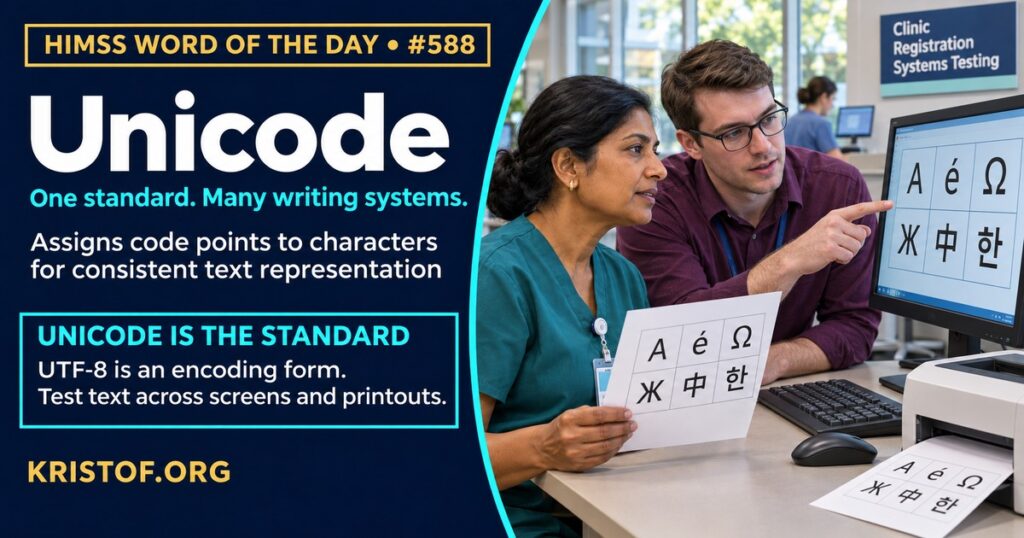
Nurse informaticists often help review printed and electronic documents, such as discharge instructions and patient education. Checking that special characters survive from the screen to the printout is a practical test step, particularly for units that serve multilingual patients.
In EHR Implementation (Go-Live Perspective)
During an Epic Go-Live, analysts at the elbow collect reports of garbled text, and many turn out to depend on one device, template, or interface rather than on the whole record. Clear examples, with the patient context removed, give the build and interface teams something to reproduce. Test plans that include names and text with accents are a simple way to catch these problems before go-live.
🎓 CAHIMS / CPHIMS & HIMSS Perspective
CAHIMS Exam Domain Mapping
Unicode supports data exchange and system reliability:
| CAHIMS Domain | How Unicode Appears |
|---|---|
| Healthcare & Technology Environments | Standards organizations, character sets, and encoding conventions |
| Clinical Informatics | Patient names, multilingual documentation, and readable clinical text |
| Healthcare Information & Systems Management | Interface testing, encoding settings, and troubleshooting garbled text |
| Management & Leadership | Requirements and testing plans for multilingual populations |
Key Terms to Know Alongside Unicode
- ASCII — an older, smaller character set whose range UTF-8 preserves
- Fast Healthcare Interoperability Resources (FHIR) — an HL7 standard whose R4 JSON format is always UTF-8
- DICOM — the imaging standard whose character set attribute can identify UTF-8
- HL7 V2 — a widely used messaging standard for exchanging clinical data between systems
- Interface engine — software that routes and transforms messages between systems
- Structural interoperability — agreement on the format and structure of exchanged data
HIMSS Organizational Position
HIMSS offers education and research on health information and technology topics through its Resource Center. Members can find related information on the HIMSS Resource Center page.
🧭 More HIMSS Word of The Day Terms
Related terms in the Interoperability and Standards series:
- Health Information Exchange (HIE)
- Data Mapping
- Interface Terminology
- DEEDS (Data Elements for Emergency Department Systems)
Browse all Interoperability and Standards terms or the A–Z glossary.
🔗 Explore Further: External References
- Unicode Consortium — What is Unicode? https://www.unicode.org/standard/WhatIsUnicode.html
- Unicode Consortium — UTF-8, UTF-16, UTF-32 & BOM (FAQ) https://www.unicode.org/faq/utf_bom.html
- IETF — RFC 3629, UTF-8, a transformation format of ISO 10646 https://www.rfc-editor.org/info/rfc3629/
- HL7 — FHIR R4, JSON Representation of Resources https://hl7.org/fhir/R4/json.html
- DICOM — PS3.5, Data Structures and Encoding, Section 6 Value Encoding https://dicom.nema.org/medical/dicom/current/output/chtml/part05/chapter_6.html
- Dalgleish et al. (2026), J Mol Diagn — Why Non-ASCII Unicode Characters Should Not Be Used in the Human Genome Variation Society Nomenclature. https://pubmed.ncbi.nlm.nih.gov/42034449/
- HIMSS — Resource Center https://www.himss.org/resource-center
Term source: HIMSS Dictionary of Health Information and Technology Terms, Acronyms, and Organizations, 6th Edition (2025). All definitions in this series are paraphrased for editorial purposes. Readers are encouraged to consult the primary source for exact language.
Eric Andrew Kristof, RN, CAHIMS is a Healthcare IT professional and HIMSS Arkansas Chapter member based in Hot Springs Village, AR, with hands-on Epic Go-Live experience and a diverse healthcare and IT background. He writes at kristof.org at the intersection of clinical care and healthcare technology.
Leave a Reply