By Eric Andrew Kristof, RN, CAHIMS | Healthcare IT Professional | HIMSS Arkansas Chapter Member
About This Series: The HIMSS Word of the Day is a running blog series drawing from the HIMSS Dictionary of Health Information and Technology Terms, Acronyms, and Organizations, 6th Edition (2025) — the authoritative reference for healthcare IT professionals and the primary study resource for CAHIMS and CPHIMS certification. Each post paraphrases the term in plain language, grounds it in real-world healthcare IT context, and adds a bedside nursing perspective you won’t find in a textbook.
📖 The Term: Zero-Day Threat
Source: HIMSS Dictionary of Health Information and Technology Terms, Acronyms, and Organizations, 6th Edition (2025)
🔍 Plain-Language Definition
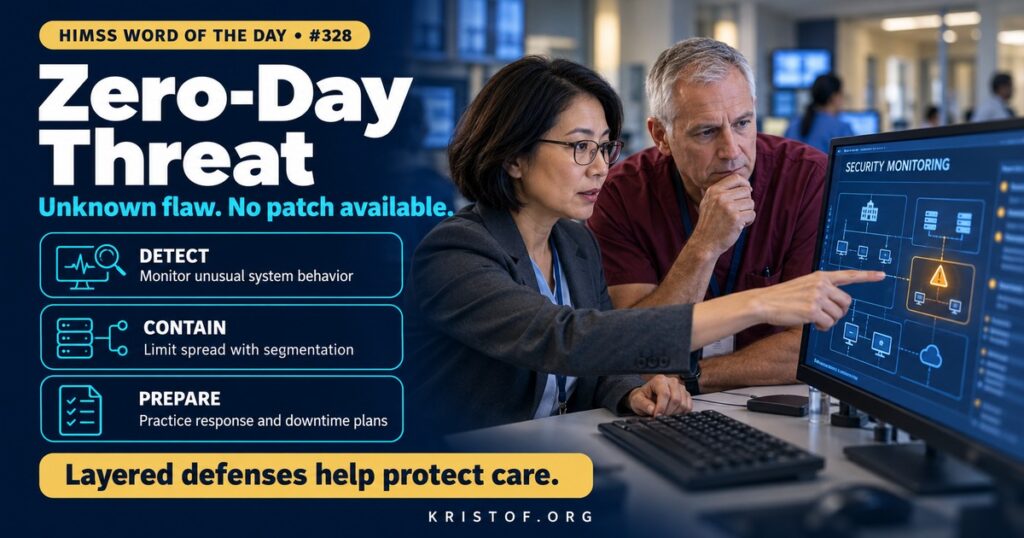
According to the HIMSS Dictionary, a zero-day threat takes advantage of a security flaw that the software maker has not yet discovered. The name refers to the time the developer has had to respond: the attack comes on or before the first, or “zeroth,” day the developer is aware of the problem. Because the flaw is unknown, there is no patch or official fix when the attack begins. The NIST Computer Security Resource Center glossary uses a similar definition for a zero-day attack: an attack that exploits a previously unknown hardware, firmware, or software vulnerability.
The terms sometimes get blurred, so a few distinctions help. A vulnerability is the flaw. An exploit is the code or method that uses the flaw. A zero-day vulnerability is one with no available fix, and a zero-day attack or zero-day threat is the use of such a flaw against a target. After a vendor learns of a flaw and releases a patch, the vulnerability is typically cataloged publicly, for example in the Common Vulnerabilities and Exposures (CVE) list and the NIST National Vulnerability Database. From that point it is a “known” vulnerability, and organizations that have not installed the patch are exposed to something different: not a zero-day, but a known and fixable problem.
| Stage | What Is Known | Defense |
|---|---|---|
| Before discovery | Flaw unknown to the vendor | Layered controls and monitoring |
| Zero-day exploitation | Attack under way, no patch | Containment, isolation, detection |
| Vendor aware, no patch yet | Advisory or workaround | Follow mitigations and monitor |
| Patch released | Flaw cataloged and fixable | Test and install quickly |
| Long after patch | Known, still unpatched in some systems | Patch management, retire legacy |
⚠️ Exam Alert: A zero-day threat exploits an unknown vulnerability with no patch available. Once a patch exists, the same flaw is a known vulnerability. Patching cannot stop a zero-day, so defense in depth, segmentation, and monitoring are the main protections. A vulnerability is the flaw; an exploit is the method.
🌐 Why It Matters: Real-World Healthcare IT Context
Zero-days are only one part of the threat picture, but they matter because the ordinary defense, installing patches, does not cover them. Health care has particular reasons to worry, and the research is still developing.
One reason is the environment. A 2024 systematic review in the Journal of Medical Internet Research looked at why digital health care systems are vulnerable to cyberattacks, reviewing literature from 2012 to 2022. It identified five themes: human error, lack of investment, complex network-connected endpoint devices, old legacy systems, and technology advancement through digitalization. The authors found that knowledge applications for solving these vulnerabilities were inconsistent and recommended cybersecurity education, information sharing through collaborations, secure design processes, phase-out of legacy systems, and improved investment. A zero-day against a hospital is more damaging where legacy and connected devices cannot be easily updated or replaced, which is the situation the review describes. The review does not measure zero-day attacks directly, so its link to this topic is as context.
A related point was made in a 2023 review in the Journal of Clinical Monitoring and Computing. It argued that the explosion of wired and wireless medical devices, including ventilators, infusion pumps, pacing devices, and monitors, adds opportunities for attackers once the devices are connected to hospital networks. Devices that cannot be quickly patched, even for known flaws, leave less margin when a new flaw is found.
Detection is the second theme. Because signature-based tools rely on known patterns, researchers are testing methods that learn to flag unusual behavior. A 2026 study in Scientific Reports compared two meta-learning approaches for zero-day intrusion detection when training data are scarce, evaluating them on three benchmark network datasets with simulated zero-day scenarios. The best-performing model, based on model-agnostic meta-learning, achieved 96.67 percent accuracy and 97.54 percent recall on one dataset, but 83.20 percent accuracy and 83.50 percent recall on another. The authors concluded that gradient-based meta-learning can adapt rapidly to previously unseen attacks. These are laboratory results on benchmark data and simulated attacks, and performance varied considerably by dataset, so they do not show how a tool would perform in a live hospital network.
The same caution applies to the field as a whole. A 2026 scoping review in the Journal of Medical Internet Research of machine learning in health care cybersecurity found intrusion detection was the most common application, with 29 studies, yet only one study demonstrated real-world deployment and most used synthetic or outdated benchmark datasets. Promising detection methods therefore have not yet been proven in clinical environments.
What can a hospital do when no patch exists? Practical measures reduce the chance that a zero-day succeeds and limit its effects if it does. Network segmentation keeps an attacker who gets in from moving freely. Least-privilege access and multifactor authentication limit what a stolen credential can do. Endpoint and network monitoring look for unusual behavior rather than known signatures. Email and web filtering block common delivery routes. Application allow-listing and restricted administrative tools limit what can run. Offline backups tested for recovery limit the damage of ransomware that arrives through an unknown flaw. And a practiced incident response plan with clinical downtime procedures keeps patients safe while IT investigates. When a vendor does announce a flaw, the response shifts to workarounds and rapid patching, which requires an accurate inventory of what is running where.
Common zero-day-related problems:
- Relying on patching as the main defense
- No inventory of systems and devices, so exposure is unknown
- Flat networks that let an intruder move freely
- Legacy systems that cannot be updated
- Monitoring that depends only on known signatures
- Downtime plans that are not practiced
What supports resilience against zero-days:
- Layered defenses and network segmentation
- Behavior-based monitoring with staffed response
- Accurate asset and software inventory
- Least privilege and strong authentication
- Tested offline backups and recovery plans
- Rapid patch and workaround processes once a flaw is public
🏥 The Nurse’s Perspective: Clinical, Bedside, & Workflow
Nurses will not see a zero-day itself, but they may be the first to notice that something is wrong when a system behaves strangely.
At the Bedside
A workstation that freezes, a pump that stops communicating, or a screen with an unexpected message can be early signs of a problem. Nurses report these quickly instead of waiting for the system to recover, because early reports help IT security contain a problem. When systems go down, nurses use downtime forms and manual checks to keep care safe.
In Clinical Workflow
Nurse managers keep downtime supplies current, confirm that staff know where to find the procedures, and join drills. They set expectations for reporting unusual system behavior, and they support staff who report problems without fear of blame.
Nurse informaticists help translate technical alerts into clinical impact, prioritize which clinical systems to restore first, and take part in tabletop exercises that test a cyber incident scenario.
In EHR Implementation (Go-Live Perspective)
An Epic Go-Live adds users, interfaces, and devices, and each is part of the attack surface. At-the-elbow support analysts reinforce habits that help in any incident: reporting odd behavior immediately, using only approved devices and software, and knowing the downtime process.
🎓 CAHIMS / CPHIMS & HIMSS Perspective
CAHIMS Exam Domain Mapping
Zero-day threats appear in security, continuity, and risk questions:
| CAHIMS Domain | How Zero-Day Threats Appear |
|---|---|
| Healthcare & Technology Environments | Threat landscape, vulnerability databases, regulation |
| Clinical Informatics | Downtime procedures, patient safety, clinical continuity |
| Healthcare Information & Systems Management | Segmentation, monitoring, patching, backups |
| Management & Leadership | Risk management, investment, incident response planning |
Key Terms to Know Alongside Zero-Day Threat
- Vulnerability — weakness that a threat can exploit
- Exploit — method or code that takes advantage of a vulnerability
- Patch — software update that fixes a vulnerability
- CVE — Common Vulnerabilities and Exposures, a public list of known vulnerabilities
- Defense in Depth — layered security so one failure does not expose everything
- Intrusion Detection System — tool that monitors for malicious activity
HIMSS Organizational Position
HIMSS supports healthcare cybersecurity through its Healthcare Cybersecurity Community, research, and education. Members can find related resources through the HIMSS Healthcare Cybersecurity Community page.
🔗 Explore Further: External References
- NIST — Computer Security Resource Center Glossary: Zero-Day Attack https://csrc.nist.gov/glossary/term/zero_day_attack
- NIST — National Vulnerability Database https://nvd.nist.gov/
- Ewoh and Vartiainen (2024), Journal of Medical Internet Research — Vulnerability to Cyberattacks and Sociotechnical Solutions for Health Care Systems: Systematic Review https://pubmed.ncbi.nlm.nih.gov/38820579/
- Cartwright (2023), Journal of Clinical Monitoring and Computing — The Elephant in the Room: Cybersecurity in Healthcare https://pubmed.ncbi.nlm.nih.gov/37088852/
- Ijaz et al. (2026), Scientific Reports — Evaluating Meta-Learning Strategies for Zero-Day Intrusion Detection Under Data Scarcity https://pubmed.ncbi.nlm.nih.gov/42469304/
- Rajput et al. (2026), Journal of Medical Internet Research — Mapping Machine Learning-Driven Cybersecurity Solutions in Health Care: Scoping Literature Review https://pubmed.ncbi.nlm.nih.gov/42507996/
Term source: HIMSS Dictionary of Health Information and Technology Terms, Acronyms, and Organizations, 6th Edition (2025). All definitions in this series are paraphrased for editorial purposes. Readers are encouraged to consult the primary source for exact language.
Eric Andrew Kristof, RN, CAHIMS is a Healthcare IT professional and HIMSS Arkansas Chapter member based in Hot Springs Village, AR, with hands-on Epic Go-Live experience and a diverse healthcare and IT background. He writes at kristof.org at the intersection of clinical care and healthcare technology.
Leave a Reply