By Eric Andrew Kristof, RN, CAHIMS | Healthcare IT Professional | HIMSS Arkansas Chapter Member
About This Series: The HIMSS Word of the Day is a running blog series drawing from the HIMSS Dictionary of Health Information and Technology Terms, Acronyms, and Organizations, 6th Edition (2025) — the authoritative reference for healthcare IT professionals and the primary study resource for CAHIMS and CPHIMS certification. Each post paraphrases the term in plain language, grounds it in real-world healthcare IT context, and adds a bedside nursing perspective you won’t find in a textbook.
📖 The Term: HISP (Health Information Service Provider)
Source: HIMSS Dictionary of Health Information and Technology Terms, Acronyms, and Organizations, 6th Edition (2025)
🔍 Plain-Language Definition
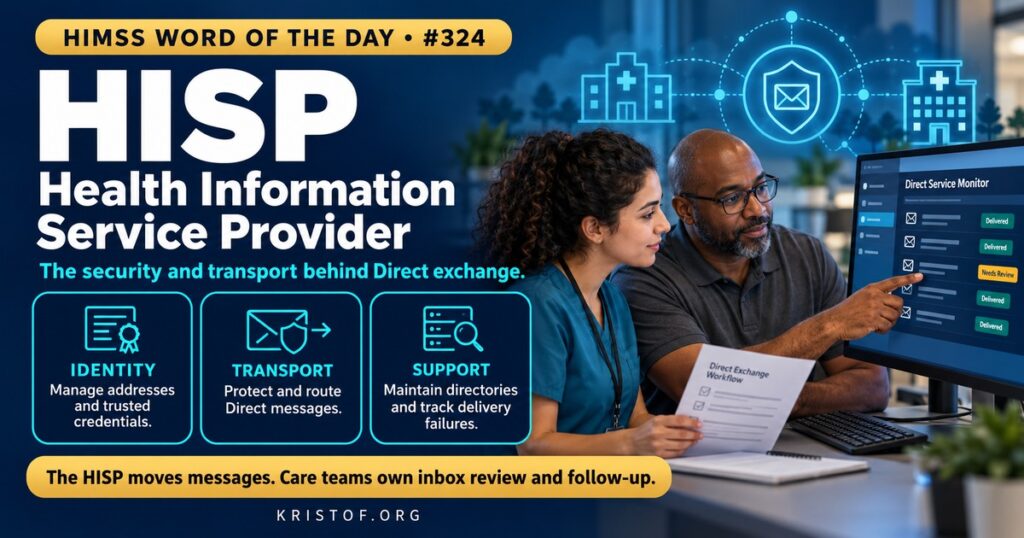
HISP stands for health information service provider. The HIMSS Dictionary says the Direct Project uses the term in two ways: for a function, which is managing security and transport for directed exchange, and for an organizational model, meaning an organization that performs that function on behalf of the sender or receiver, which may be an organization or an individual. In plain terms, a HISP is the service that sits behind a Direct address. When a clinician sends a Direct message, a HISP is what authenticates the parties, protects the message in transit, and gets it to the recipient’s HISP.
Typical HISP responsibilities include issuing and managing Direct addresses, handling the digital credentials that prove an address belongs to a trusted organization, encrypting and routing messages, and maintaining directories so that senders can find recipients. These descriptions reflect common practice; the regulations and the Dictionary define the function more broadly, and each HISP defines its own service.
Common models include a HISP run by an EHR vendor as part of its product, by a state or regional health information exchange, by a specialized vendor, or by a large health system for its own use. Organizations choose among these models on the basis of cost, control, and who they need to reach. Two HISPs must be able to trust each other to exchange messages, which is why shared trust frameworks and accreditation programs matter in this market.
| HISP Function | What It Does | Question to Ask |
|---|---|---|
| Address management | Issues and maintains Direct addresses | How are addresses verified and retired? |
| Credential management | Handles the certificates that prove identity | Who is the trust anchor? |
| Message transport | Encrypts and routes messages | Which other HISPs can it reach? |
| Directory services | Lets senders find recipients | How current and complete is the directory? |
| Monitoring and support | Tracks delivery and failures | Are failures reported to the sender? |
⚠️ Exam Alert: A HISP is both a function and an organization. It manages security and transport for Direct exchange. A Direct address belongs to a HISP, but the clinical content belongs to the sender. A HISP that routinely handles PHI is generally a business associate, so a business associate agreement applies.
🌐 Why It Matters: Real-World Healthcare IT Context
HISPs are easy to overlook because users see only an address and an inbox. Several facts show why they matter.
First, certified EHRs must support Direct. Under 45 CFR 170.315(h)(1), certified health IT must be able to send and receive health information using the ONC Applicability Statement for Secure Health Transport, Version 1.2, formatted as a “wrapped” message, and to support delivery notification. Criterion (h)(2) adds XDR/XDM and edge protocols. The regulation sets technical capabilities and does not decide which HISP an organization should use. That choice is local, so a hospital may rely on its EHR vendor’s HISP, a regional exchange, or another provider.
Second, a HISP often falls under HIPAA. The HIPAA definition of business associate at 45 CFR 160.103 specifically includes a health information organization, e-prescribing gateway, or other person that provides data transmission services for PHI to a covered entity and routinely needs access to that PHI. A HISP that provides Direct transport services to a hospital may therefore be a business associate, which calls for a business associate agreement, safeguards, and breach notification duties, as described in the posts on ePHI and business associates. Whether a particular arrangement meets the definition depends on its facts, so the hospital’s privacy officer and counsel should review each contract.
Third, HISPs enable scale. A 2016 article in the Journal of Digital Imaging described Direct messaging and the HISP infrastructure that supports it, drawing on statistics from DirectTrust.org. From 2013 to 2015, the number of secure Direct addresses issued rose from 8,724 to 752,496, participating organizations from 667 to 39,751, and secure messages sent from 122,842 to 27,316,438. Those figures illustrate how HISP services carried a sharp rise in volume within two years. They come from one source early in adoption, and later numbers may differ.
Fourth, directories are a shared responsibility. A 2025 article in Applied Clinical Informatics described a Texas workgroup that wrote a best practice policy for maintaining Direct address directories after finding that incomplete entries cause exchange to fail. The policy recommended standardizing address data, synchronizing routinely with external databases so that message flow does not depend on a single vendor, and updating entries immediately when a practitioner’s status changes. In a group of 38 hospitals, Direct messages not sent because of no known address fell from 50 percent to 42 percent between September 2021 and December 2022. A HISP’s directory service is only as good as the data feeding it, so organizations need processes to keep their own entries correct.
Fifth, the receiving side is part of the service. A 2024 paper in Studies in Health Technology and Informatics noted that as Direct adoption grows, clinicians and staff struggle to manage the volume and variety of external data, and that poor awareness of Direct features and uneven EHR capabilities limit its value. A HISP delivers messages, but it cannot decide who reads them or how they are filed, so organizations should plan the inbox workflow when choosing and configuring a service.
When evaluating a HISP, informatics and privacy teams usually ask which other HISPs it can exchange messages with, how it verifies identities, how it reports failed deliveries, what its uptime and support commitments are, how it handles directory updates, what its business associate terms say, and what happens to messages and addresses if the contract ends.
Common HISP-related problems:
- No one in the organization can say which HISP issues its addresses
- Missing business associate terms
- Directory entries that are not updated when staff change
- Messages that fail without alerting the sender
- Inbox workflows that nobody owns
- Dependence on one vendor without an exit plan
What supports a well-run HISP relationship:
- Documented ownership of the Direct service
- Business associate agreement and security review
- Routine directory synchronization and updates
- Delivery failure reporting reviewed by staff
- Defined inbox and filing workflows
- Contract terms covering transition and portability
🏥 The Nurse’s Perspective: Clinical, Bedside, & Workflow
Nurses never see a HISP, but they see the results when a transfer summary arrives or fails to.
At the Bedside
When a patient is transferred in, nurses look for the summary and medication list. If the sending facility’s message reaches the receiving unit’s inbox, admission is faster. If the address was wrong or the message failed, nurses spend time calling to request records.
In Clinical Workflow
Case managers and discharge planners know which receiving facilities can accept Direct messages and which still need fax. They report undelivered messages and missing addresses to the people who maintain the directory. Nurse managers support these routines by making sure staff changes are reported so directory entries remain correct.
Nurse informaticists help define who monitors the inbox, how documents are filed, and how staff are alerted to new outside records. They also contribute to reviews of vendor services by describing how the service is used in transfers and referrals.
In EHR Implementation (Go-Live Perspective)
An Epic Go-Live configures Direct sending and receiving along with the rest of the exchange workflows. At-the-elbow support analysts hear when a facility cannot be reached or an address is rejected, and pass those details to interface and interoperability teams, who work with the HISP to correct them.
🎓 CAHIMS / CPHIMS & HIMSS Perspective
CAHIMS Exam Domain Mapping
HISPs appear in exchange, privacy, and vendor management questions:
| CAHIMS Domain | How HISPs Appear |
|---|---|
| Healthcare & Technology Environments | Direct Project, ONC certification, HIPAA business associates |
| Clinical Informatics | Transitions of care, referrals, document handling |
| Healthcare Information & Systems Management | Addresses, certificates, directories, routing, monitoring |
| Management & Leadership | Vendor selection, contracts, business associate management |
Key Terms to Know Alongside HISP
- Direct Project — initiative that defined simple, secure transport for health information
- Direct Address — email-style identifier for sending and receiving Direct messages
- Business Associate — organization that handles PHI on behalf of a covered entity
- Trust Framework — agreed rules that let separate services trust each other
- Directed Exchange — sender-initiated exchange to a known recipient
- Delivery Notification — confirmation that a message reached its recipient
HIMSS Organizational Position
HIMSS supports secure, standards-based information exchange through its research, education, and community work. Members can find related resources through the HIMSS Resource Center.
🔗 Explore Further: External References
- eCFR — 45 CFR 170.315, Health IT Certification Criteria https://www.ecfr.gov/current/title-45/subtitle-A/subchapter-D/part-170/subpart-C/section-170.315
- eCFR — 45 CFR 160.103, Definitions https://www.ecfr.gov/current/title-45/subtitle-A/subchapter-C/part-160/subpart-A/section-160.103
- Reicher and Reicher (2016), Journal of Digital Imaging — Implementation of Certified EHR, Patient Portal, and “Direct” Messaging Technology in a Radiology Environment Enhances Communication of Radiology Results to Both Referring Physicians and Patients https://pubmed.ncbi.nlm.nih.gov/26588906/
- Feterik et al. (2025), Applied Clinical Informatics — Improving Direct Secure Messaging through Directory Management https://pubmed.ncbi.nlm.nih.gov/41135586/
- McCormack et al. (2024), Studies in Health Technology and Informatics — Direct Secure Messaging in Practice: Addressing Workflow Challenges https://pubmed.ncbi.nlm.nih.gov/38269791/
Term source: HIMSS Dictionary of Health Information and Technology Terms, Acronyms, and Organizations, 6th Edition (2025). All definitions in this series are paraphrased for editorial purposes. Readers are encouraged to consult the primary source for exact language.
Eric Andrew Kristof, RN, CAHIMS is a Healthcare IT professional and HIMSS Arkansas Chapter member based in Hot Springs Village, AR, with hands-on Epic Go-Live experience and a diverse healthcare and IT background. He writes at kristof.org at the intersection of clinical care and healthcare technology.
Leave a Reply