By Eric Andrew Kristof, RN, CAHIMS | Healthcare IT Professional | HIMSS Arkansas Chapter Member
About This Series: The HIMSS Word of the Day is a running blog series drawing from the HIMSS Dictionary of Health Information and Technology Terms, Acronyms, and Organizations, 6th Edition (2025) — the authoritative reference for healthcare IT professionals and the primary study resource for CAHIMS and CPHIMS certification. Each post paraphrases the term in plain language, grounds it in real-world healthcare IT context, and adds a bedside nursing perspective you won’t find in a textbook.
📖 The Term: Knowledge Base
Source: HIMSS Dictionary of Health Information and Technology Terms, Acronyms, and Organizations, 6th Edition (2025)
🔍 Plain-Language Definition
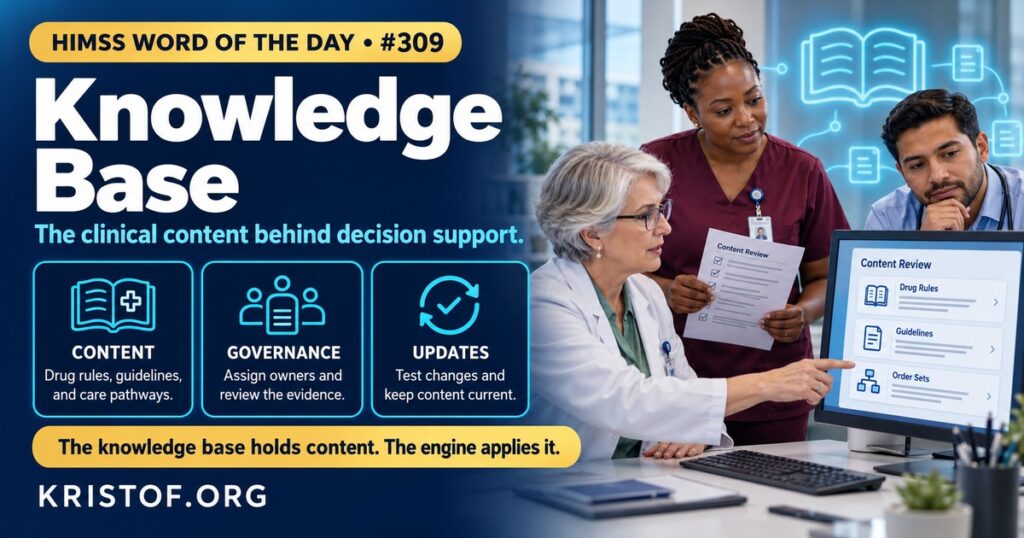
A knowledge base is, in the words of the HIMSS Dictionary, a collection of tables, databases, and other resources built to support the care process. In clinical informatics, the term usually refers to the content that decision support draws on: drug information, interaction rules, dosing limits, order set content, clinical guidelines, diagnostic criteria, and patient education text. The EHR software provides the screens and the engine, and the knowledge base provides what the engine knows.
Most organizations license drug knowledge bases from commercial suppliers and layer local rules on top. They also build local content, such as order sets and care pathways, which must be kept current as evidence changes. The knowledge base is therefore both a product and a local responsibility: someone has to decide which content is turned on, how severe an interaction must be to interrupt a prescriber, and who reviews updates.
| Knowledge Base Content | Used For | Governance Question |
|---|---|---|
| Drug interaction rules | Alerts on orders | Which severity levels interrupt? |
| Dosing and renal rules | Dose range checks | Who approves local limits? |
| Allergy cross-sensitivity | Allergy alerts | How broad should matching be? |
| Order sets and pathways | Standardized care | Who reviews content and how often? |
| Clinical guidelines and criteria | Reminders, risk scores | How quickly do updates reach the system? |
| Patient education | Instructions and handouts | Reading level and language |
⚠️ Exam Alert: A knowledge base holds content; a decision support engine applies it; clinical decision support (CDS) is the function delivered to the user. A terminology such as RxNorm or SNOMED CT provides codes, not clinical rules. Differences in knowledge bases change the alerts users see.
🌐 Why It Matters: Real-World Healthcare IT Context
Medication safety tools are only as good as their content, and the content is not uniform. A 2017 study in JAMIA compared three commercial knowledge bases used to detect drug-drug interactions in clinical decision support: First DataBank, Micromedex, and Multum. After mapping the drugs to RxNorm, the researchers compared them at the level of clinical drugs, ingredients, and interaction rules. The knowledge bases contained 1.6 million, 4.5 million, and 4.8 million drug pairs respectively. Of 8.6 million unique pairs across them, 79 percent appeared in only one knowledge base and only 5 percent appeared in all three. Severity rankings agreed more than previous studies had suggested, especially for contraindicated pairs, and all three covered 99.8 to 99.9 percent of the highly significant interactions on a reference list from the Office of the National Coordinator. Applied to a prescription data set, they would have generated 25, 145, and 84 alerts per 1,000 prescriptions. The authors concluded that the knowledge bases differ greatly in size and alert volume and called for standardized editorial policies. The practical lesson is that choosing a vendor or a configuration changes the alert burden that clinicians experience.
An older review of decision support safety raised a related concern. A 2006 article in the Yearbook of Medical Informatics noted evidence that commercial prescribing systems in the United States, United Kingdom, and Australia failed to uniformly detect significant drug interactions, probably because of errors in their knowledge bases. The same review observed that outcomes of decision support vary with the clinical setting, culture, training, and organizational process, and not only with technology, and it warned about automation biases such as ignoring relevant alerts or following prompts that contradict clinical knowledge. It is a 20-year-old review, so specific system findings are dated, but the principle that content quality and use both matter has not changed.
Even good content has to reach the user in a form they will act on. A 2026 study in the Journal of the American Board of Family Medicine implemented a computerized decision support tool for metabolic liver disease in three primary care clinics for three months. The tool triggered when a patient had a high or indeterminate FIB-4 score above 1.3 together with diabetes or at least two metabolic risk factors, and prompted elastography or subspecialty referral. It fired in 1,410 encounters. Confirmatory testing rose from 0 to 2.1 percent and subspecialty referral from 4 to 20 percent, though the referral change was not statistically significant. The tool was ignored in 75.4 percent of encounters, and the authors suggested refining triggers and the user interface. The study shows that a correct rule can still have limited effect if it appears at the wrong time or in the wrong form.
Usability evidence supports this. A 2026 usability study of pharmacogenomic decision support in Epic’s Genomic Indicators, with ten prescribers, found improvement in navigation efficiency between first and second attempts and generally positive system usability scores, and identified themes of navigation, workflow integration, visibility of key features, and content quality. It is a small, single-site study, but it illustrates the value of testing content in context with real users.
Good knowledge management therefore includes governance. A multidisciplinary group, often including pharmacists, nurses, physicians, and informaticists, decides which content is activated, how it is tailored, and how overrides are handled. The group sets an update schedule for vendor content and local order sets, tests changes before release, and reviews override and acceptance data to retire alerts that do not help. It documents the evidence and owner for each local rule. And it plans for the effect of changes on workflow, since turning on a new rule can add thousands of alerts.
Common knowledge base problems:
- Vendor content turned on without local tailoring or review
- Large differences in alert volume across vendors and settings
- Out-of-date order sets and guidelines
- Alerts at the wrong moment or to the wrong role
- No ownership of local rules
- No review of override data
What supports sound knowledge management:
- Multidisciplinary governance of content and alerts
- Scheduled updates with testing before release
- Standard terminologies such as RxNorm for mapping content
- Review of alert acceptance and override rates
- Usability testing of how content is presented
- Documented evidence and an owner for each rule
🏥 The Nurse’s Perspective: Clinical, Bedside, & Workflow
Nurses see the output of knowledge bases as alerts, order set choices, and reminders, and they have views on which ones help.
At the Bedside
At medication administration, nurses encounter alerts for allergies, interactions, duplicate therapy, and dose limits. They need to know when an alert signals a real danger and when it is routine noise, and they report patterns of unhelpful alerts to the unit leader or informatics team rather than bypassing them silently.
In Clinical Workflow
Nurse managers and educators take part in review of nursing-related content, such as care plans, assessment prompts, and patient education. They help decide which clinical reminders belong to nurses and which to other roles, and they watch for alert volume that interrupts care.
Nurse informaticists serve on content governance committees, review proposed changes for workflow effects, analyze override data, and test order sets and nursing documentation prompts with bedside nurses.
In EHR Implementation (Go-Live Perspective)
An Epic Go-Live turns on a large body of content at once, and the first weeks show where alert volume is too high. At-the-elbow support analysts record which alerts users dismiss and which cause confusion, and bring specific examples to the content governance group for adjustment.
🎓 CAHIMS / CPHIMS & HIMSS Perspective
CAHIMS Exam Domain Mapping
Knowledge bases appear in decision support, content management, and safety questions:
| CAHIMS Domain | How Knowledge Bases Appear |
|---|---|
| Healthcare & Technology Environments | Evidence sources, vendors, standards organizations |
| Clinical Informatics | Clinical decision support, order sets, alert design, medication safety |
| Healthcare Information & Systems Management | Content updates, terminology mapping, testing |
| Management & Leadership | Governance, ownership, evaluation of alerts |
Key Terms to Know Alongside Knowledge Base
- Clinical Decision Support (CDS) — tools that give clinicians knowledge and patient-specific information at the point of care
- Drug-Drug Interaction (DDI) — effect that one drug has on the action of another
- Alert Fatigue — reduced response to alerts caused by too many or low-value alerts
- Order Set — grouped orders for a clinical situation
- RxNorm — standard terminology for clinical drugs
- Content Governance — oversight of what clinical content is used and how it is maintained
HIMSS Organizational Position
HIMSS supports effective clinical decision support and evidence-based practice through its research, education, and community work. Members can find related resources through the HIMSS Resource Center.
🔗 Explore Further: External References
- Fung et al. (2017), Journal of the American Medical Informatics Association — Comparison of Three Commercial Knowledge Bases for Detection of Drug-Drug Interactions in Clinical Decision Support https://pubmed.ncbi.nlm.nih.gov/28339701/
- Coiera et al. (2006), Yearbook of Medical Informatics — The Safety and Quality of Decision Support Systems https://pubmed.ncbi.nlm.nih.gov/17051290/
- Xiao et al. (2026), Journal of the American Board of Family Medicine — A Computerized Clinical Decision Support Tool Increases Rates of Confirmatory Testing in MASLD Patients at Risk for Advanced Fibrosis https://pubmed.ncbi.nlm.nih.gov/42660653/
- Hong et al. (2026), BMC Pharmacology and Toxicology — Optimizing Pharmacogenomic Clinical Decision Support: A Usability Study of Epic’s Genomic-Indicators https://pubmed.ncbi.nlm.nih.gov/41723510/
- HealthIT.gov — Clinical Decision Support https://healthit.gov/clinical-quality-and-safety/clinical-decision-support/
Term source: HIMSS Dictionary of Health Information and Technology Terms, Acronyms, and Organizations, 6th Edition (2025). All definitions in this series are paraphrased for editorial purposes. Readers are encouraged to consult the primary source for exact language.
Eric Andrew Kristof, RN, CAHIMS is a Healthcare IT professional and HIMSS Arkansas Chapter member based in Hot Springs Village, AR, with hands-on Epic Go-Live experience and a diverse healthcare and IT background. He writes at kristof.org at the intersection of clinical care and healthcare technology.
Leave a Reply