By Eric Andrew Kristof, RN, CAHIMS | Healthcare IT Professional | HIMSS Arkansas Chapter Member
About This Series: The HIMSS Word of the Day is a running blog series drawing from the HIMSS Dictionary of Health Information and Technology Terms, Acronyms, and Organizations, 6th Edition (2025) — the authoritative reference for healthcare IT professionals and the primary study resource for CAHIMS and CPHIMS certification. Each post paraphrases the term in plain language, grounds it in real-world healthcare IT context, and adds a bedside nursing perspective you won’t find in a textbook.
📖 The Term: Medical Error
Source: HIMSS Dictionary of Health Information and Technology Terms, Acronyms, and Organizations, 6th Edition (2025)
🔍 Plain-Language Definition
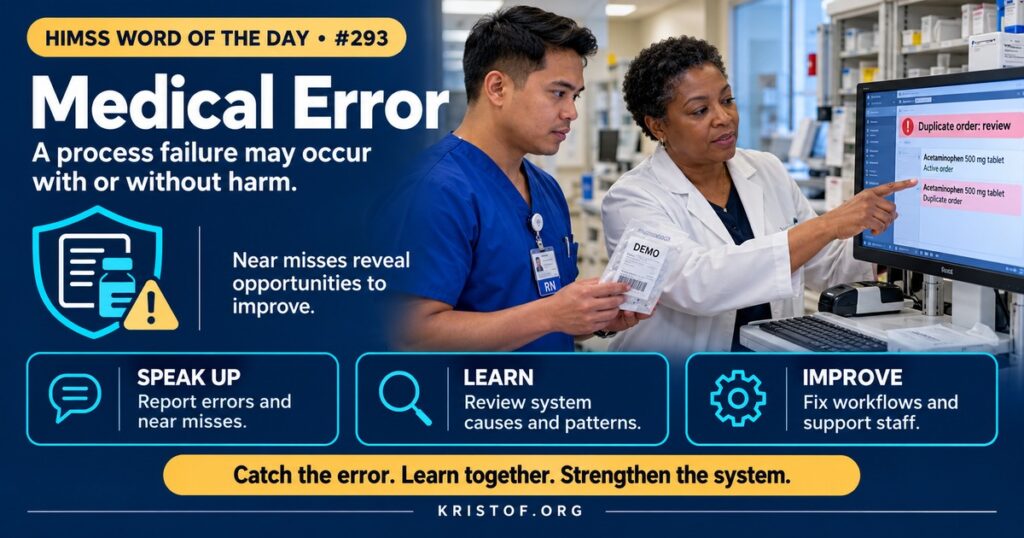
A medical error has two common meanings in the HIMSS Dictionary. The first is a failure in the process of care: an action that was planned but not carried out as intended, or a plan that was wrong for the goal. The second is narrower: a mistake that harms a patient. The Dictionary’s examples of preventable errors include harmful drug events, infections acquired in the hospital, and surgery on the wrong site.
The distinction matters. Many errors never reach a patient, or reach a patient without harm; these are often called near misses or no-harm events. An adverse event is harm caused by care, whether or not anyone made a mistake, and only some adverse events are preventable. Safety science also separates errors of execution (a slip or a lapse, such as picking the wrong drug from a cabinet) from errors of planning (a mistake in the plan, such as ordering a drug that interacts with another one).
| Term | Meaning | Example |
|---|---|---|
| Medical error | Failed or wrong plan of care | Wrong dose ordered |
| Near miss | Error caught before reaching the patient | Pharmacist intercepts a duplicate order |
| Adverse event | Harm from care | Allergic reaction to a drug |
| Preventable adverse event | Harm from an error | Allergy known but overridden |
| Sentinel event | Serious event with death or major harm | Wrong-site surgery |
⚠️ Exam Alert: An adverse event is harm; a medical error is a process failure that may or may not cause harm; a near miss is an error that does not reach the patient. Safety models focus on systems and just culture, not individual blame. Event reporting systems capture errors and near misses for learning.
🌐 Why It Matters: Real-World Healthcare IT Context
The World Health Organization describes patient safety as a global problem. Its fact sheet states that around 1 in 10 patients is harmed in health care and that more than 3 million deaths occur each year because of unsafe care. It also states that more than half of that harm, about 1 in every 20 patients, is preventable and that about half of the preventable harm is attributed to medications. WHO lists medication errors, unsafe surgical procedures, health care-associated infections, diagnostic errors, falls, pressure ulcers, patient misidentification, unsafe blood transfusion, and venous thromboembolism among the common sources of avoidable harm. These are estimates from the literature rather than counts from a single registry.
A 2026 study in the Journal of Korean Medical Science shows how such figures are generated. In the national Patient Safety Incident Inquiry, 500 patients discharged in 2021 were randomly selected from each of ten hospitals, for 5,000 in all. A three-stage retrospective chart review began with screening by nurses or health information managers, moved to physician or nurse review, and ended with adjudication by a central committee. Of the 5,000 patients, 2,208 (44.2 percent) met at least one screening criterion, and 565 patients (11.3 percent) had a confirmed adverse event, totaling 612 events. The most common types were patient care-related (37.3 percent), medication-, fluid-, or blood-related (36.1 percent), and surgery- or procedure-related (26.8 percent). Most events (62.4 percent) caused temporary harm needing intervention, 3.6 percent of patients died, and 28.3 percent of events were classified as preventable. The study describes one country’s hospitals and one year of discharges, but it shows that harm is detectable and that medication-related events are among the largest groups.
Technology can reduce some errors but introduces others. A systematic review of automated dispensing cabinets, barcode medication administration (BCMA), and closed-loop medication management for controlled medications in hospitals found 16 eligible papers. Three quantitative studies reported fewer medication errors after BCMA, but medications with wrong or unreadable barcodes caused confusion and administration errors, and cases of drug diversion were reported even after cabinets were introduced. The authors called for supporting processes and for post-implementation evaluation. The lesson for informatics teams is that a safety tool is a system: scanners, labels, workflows, and staff behavior all matter, and each can fail.
People are affected as well. A 2026 scoping review in Nursing Open of 23 studies found that nurses who were second victims of adverse events experienced high levels of distress and low perceived organizational support. A 2026 meta-analysis in Nurse Education in Practice of 46 studies with 14,681 nurses and student nurses in Turkey estimated that 24.5 percent had made a medical error and 45.5 percent had witnessed one. The prevalence depends on how each study asked the question and in which country, so the numbers are not a global rate, but they confirm that errors are a routine part of nursing experience and that support systems are needed.
Effective programs share several features. They make reporting easy and safe, review events for system causes, and feed lessons back to the people who work at the point of care. They use technology for what it does well, such as order checking and scanning, and monitor for unintended consequences, such as alert fatigue and workarounds. They measure outcomes, not only reports, since low reporting may signal fear and not safety. And they support staff after events.
Common medical error problems:
- Underreporting because staff fear blame
- Alerts and checks bypassed through workarounds
- Barcode, label, and device problems that undermine scanning
- Handoffs where information is lost
- Reports collected but not acted on
- No support for staff who are involved in serious events
What supports error prevention:
- A just culture with easy, non-punitive reporting
- Standardized processes and checklists
- Decision support and scanning, evaluated after go-live
- Review of near misses, not only harm
- Feedback to front-line teams about changes made
- Peer support for staff after events
🏥 The Nurse’s Perspective: Clinical, Bedside, & Workflow
Nurses are the last check before many medications reach a patient and are often the first to notice that something is wrong.
At the Bedside
At the bedside, safe practice includes verifying patient identity, scanning medications, questioning unclear orders, and speaking up when a plan does not fit the patient. Barcode scanning supports these steps only when labels read properly and the process is followed every time. When a scan fails, the safe response is to resolve the cause and not bypass the check.
In Clinical Workflow
Nurse managers review event reports, look for patterns in near misses, and work with pharmacy and informatics on fixes. Charge nurses help create an environment where colleagues can report errors without fear. After a serious event, they connect staff with peer support programs.
Nurse informaticists analyze override and alert data, review scan compliance, and work with clinicians to redesign order sets and screens that contribute to error. They also help ensure that event reporting tools are quick enough for busy staff to use.
In EHR Implementation (Go-Live Perspective)
An Epic Go-Live changes many routines at once, so risk of error rises temporarily. At-the-elbow support analysts watch for workarounds, such as scanning shortcuts or documenting in the wrong place, and report patterns to the command center the same day so that fixes and reminders can go out.
🎓 CAHIMS / CPHIMS & HIMSS Perspective
CAHIMS Exam Domain Mapping
Medical errors appear in safety, workflow, and governance questions:
| CAHIMS Domain | How Medical Errors Appear |
|---|---|
| Healthcare & Technology Environments | Patient safety organizations, regulation, accreditation |
| Clinical Informatics | Decision support, CPOE, BCMA, human factors |
| Healthcare Information & Systems Management | Event reporting systems, downtime, testing |
| Management & Leadership | Just culture, root cause analysis, quality improvement |
Key Terms to Know Alongside Medical Error
- Adverse Event — harm resulting from medical care
- Near Miss — error or hazard caught before it reaches a patient
- Root Cause Analysis — structured review that looks for underlying system causes
- Just Culture — approach that balances accountability with learning from error
- Barcode Medication Administration (BCMA) — scanning of patient and drug to verify a medication before giving it
- Second Victim — clinician who suffers distress after being involved in a patient safety event
HIMSS Organizational Position
HIMSS supports patient safety and the safe use of health information technology through its research, education, and community work. Members can find related resources through the HIMSS Nursing Informatics Community page.
🔗 Explore Further: External References
- World Health Organization — Patient Safety Fact Sheet https://www.who.int/news-room/fact-sheets/detail/patient-safety
- Cho et al. (2026), Journal of Korean Medical Science — Incidence and Characteristics of Adverse Events: The 2024 Patient Safety Incidents Inquiry in Korea https://pubmed.ncbi.nlm.nih.gov/42865287/
- Zheng et al. (2021), Research in Social and Administrative Pharmacy — The Impact of Introducing Automated Dispensing Cabinets, Barcode Medication Administration, and Closed-Loop Electronic Medication Management Systems on Work Processes and Safety of Controlled Medications in Hospitals: A Systematic Review https://pubmed.ncbi.nlm.nih.gov/32891535/
- Yang et al. (2026), Nursing Open — Factors Influencing Nurses’ Experiences and Support as Second Victims Following Adverse Events: A Scoping Review https://pubmed.ncbi.nlm.nih.gov/42594332/
- Dilmen et al. (2026), Nurse Education in Practice — The Prevalence of Making and Witnessing Medical Errors Among Nurses and Student Nurses in Turkey: A Systematic Review and Meta-Analysis of Cross-Sectional Studies https://pubmed.ncbi.nlm.nih.gov/42001758/
Term source: HIMSS Dictionary of Health Information and Technology Terms, Acronyms, and Organizations, 6th Edition (2025). All definitions in this series are paraphrased for editorial purposes. Readers are encouraged to consult the primary source for exact language.
Eric Andrew Kristof, RN, CAHIMS is a Healthcare IT professional and HIMSS Arkansas Chapter member based in Hot Springs Village, AR, with hands-on Epic Go-Live experience and a diverse healthcare and IT background. He writes at kristof.org at the intersection of clinical care and healthcare technology.
Leave a Reply