By Eric Andrew Kristof, RN, CAHIMS | Healthcare IT Professional | HIMSS Arkansas Chapter Member
About This Series: The HIMSS Word of the Day is a running blog series drawing from the HIMSS Dictionary of Health Information and Technology Terms, Acronyms, and Organizations, 6th Edition (2025) — the authoritative reference for healthcare IT professionals and the primary study resource for CAHIMS and CPHIMS certification. Each post paraphrases the term in plain language, grounds it in real-world healthcare IT context, and adds a bedside nursing perspective you won’t find in a textbook.
📖 The Term: Health Informatics
Source: HIMSS Dictionary of Health Information and Technology Terms, Acronyms, and Organizations, 6th Edition (2025)
🔍 Plain-Language Definition
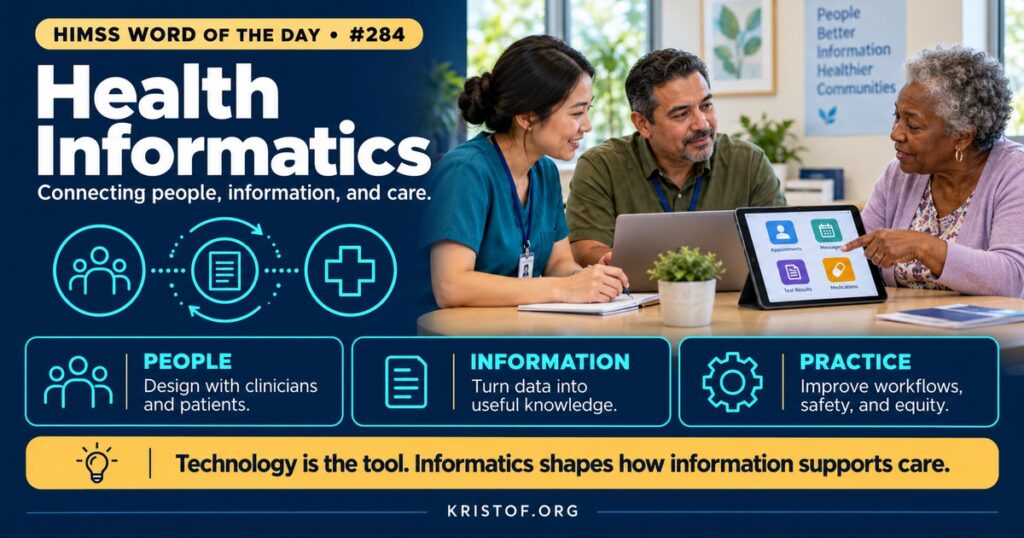
Health informatics is a field that studies how information technology is built, adopted, and used to improve the delivery, management, and planning of health care. According to the HIMSS Dictionary, it lies where clinical informatics meets public health informatics, and is one of several fields that together make up biomedical informatics. The Dictionary also describes it in practical terms, as the alignment of information technology and health sciences to build health information systems and provide specialized IT services to the health care industry.
The terms around health informatics overlap, and usage varies. Biomedical informatics is the broad science of using information in biology, medicine, and health. Clinical informatics applies informatics to patient care and the work of clinicians. Nursing informatics applies it to nursing practice, education, and administration. Public health informatics applies it to population health surveillance and prevention. Consumer health informatics focuses on tools that patients and the public use.
| Field | Main Focus | Example Work |
|---|---|---|
| Biomedical informatics | Science of biomedical information | Methods for analyzing genomic data |
| Clinical informatics | Care delivery and clinicians | Order sets, decision support, EHR optimization |
| Nursing informatics | Nursing practice and documentation | Flowsheet design, bedside barcode workflows |
| Public health informatics | Population health | Disease surveillance, immunization registries |
| Consumer health informatics | Patient and public tools | Portals, apps, wearables |
⚠️ Exam Alert: Health informatics is a field of study and practice, not a product or a job title alone. Health information technology (HIT) refers to the technology; informatics adds the science of how information is used and the people and processes around it. The CAHIMS and CPHIMS credentials test knowledge of this field.
🌐 Why It Matters: Real-World Healthcare IT Context
Every part of modern health care depends on information, and health informatics is the discipline that asks how to collect, organize, present, and use it well. It addresses questions such as how to design an order screen that prevents errors, how to measure quality from EHR data, how to share records across organizations, and how to bring patients into the data loop. Its methods draw on clinical care, human factors, computer science, statistics, ethics, and management.
Education and competency frameworks define what practitioners should know. A 2026 article in Methods of Information in Medicine reported the revision of the TIGER International Recommendation Framework of Core Competencies in Health Informatics for Nurses, first published in 2018 and used worldwide by educators and students. The update followed the same three steps as the original: a global survey rating the relevance of 43 core competency areas by 117 experts from every continent, four regional expert workshops, and 21 educational case studies. The role-based structure covers clinical nursing, nursing management, quality management in nursing, coordination of interprofessional care, and information technology management in nursing. The authors reported that informatics is highly relevant to all nursing roles, and that each role shows its own pattern. Clinical nursing emphasizes patient issues, personal skills for working in a digital environment, and the legal and ethical background of one’s work; nursing management adds management knowledge; IT management in nursing requires computer skills, problem solving, communication, and teamwork. The update strongly recommends that artificial intelligence topics be addressed in all domains and for all roles, and highlights patient safety, electronic health records, and the use of their data as areas of increased priority.
Physician education has similar needs. A 2025 report in Applied Clinical Informatics described a two-year longitudinal informatics curriculum in graduate medical education, now in its seventh year at a large tertiary academic center. It aligns with the core content of the clinical informatics subspecialty and is run by a multidisciplinary team. The pathway had 13 graduates, 11 from internal medicine and two from pediatrics, whose projects included clinical decision support tools, and some graduates went on to clinical informatics board certification or fellowship. The authors argued that such curricula can expand the informatics workforce by building a cadre of physicians with technology expertise across specialties, and noted that success required a dedicated team and leadership support. It is one program’s experience and does not show the effect on patient care.
The field is also widening its attention to equity. A 2025 scoping review in the Journal of the American Medical Informatics Association examined digital health equity frameworks. Of 910 publications identified, 44 describing 42 frameworks were included, and none was comprehensive. The authors extracted 243 concepts in 43 categories, from characteristics of individuals and communities to societal context, partnerships, and access to digital and in-person services, and proposed a consolidated definition of digital health equity. For informaticists, the message is that the benefits of technology are not automatic for every group, and design, evaluation, and deployment have to account for access, language, disability, and trust.
For people entering the field, there are many routes: clinicians who add informatics training, IT professionals who learn health care, and analysts who bring data science to clinical questions. Certifications such as CAHIMS and CPHIMS from HIMSS provide a structured way to demonstrate knowledge, and academic programs, fellowships, and community groups offer further paths. Whatever the route, the field rewards people who can translate between clinical, technical, and management perspectives.
Common challenges in health informatics:
- Terminology that varies across organizations and countries
- Informatics treated as an IT function and not a clinical one
- Limited protected time for clinicians who do informatics work
- Technology introduced without attention to workflow
- Unequal access to digital tools
- Rapid change, especially with AI, outpacing education
What supports a strong informatics practice:
- Clinician leadership paired with technical and analytic skills
- Competency frameworks and structured education
- Multidisciplinary teams and governance
- Evaluation of effects on safety, workflow, and equity
- Continuous learning, including AI literacy
- Connection to professional communities and credentials
🏥 The Nurse’s Perspective: Clinical, Bedside, & Workflow
Informatics is part of every nursing role, whether or not the title says so.
At the Bedside
Bedside nurses use informatics every shift: choosing the right field in a flowsheet, scanning a wristband, responding to an alert, and noticing when a screen does not fit the work. The TIGER recommendations reflect this by listing personal skills in a digital environment and an understanding of legal and ethical issues among the core competencies for clinical nursing.
In Clinical Workflow
Nurse managers use data to guide staffing, safety, and quality work, and need enough informatics knowledge to ask good questions of reports. Nurses who become super users, informatics champions, or unit representatives on governance groups build a bridge between the bedside and the build team.
Nurse informaticists design and optimize systems, teach staff, analyze data, and advocate for safe, usable technology. Some pursue graduate degrees or certifications, and many learn on the job through projects such as EHR implementations.
In EHR Implementation (Go-Live Perspective)
An Epic Go-Live is one of the most visible informatics projects a nurse can join. Nurses serve as testers, trainers, and at-the-elbow support analysts, learning how requirements become build and how decisions affect the unit. Many informatics careers begin with that experience.
🎓 CAHIMS / CPHIMS & HIMSS Perspective
CAHIMS Exam Domain Mapping
Health informatics is the foundation of all four CAHIMS domains:
| CAHIMS Domain | How Health Informatics Appears |
|---|---|
| Healthcare & Technology Environments | Scope of the field, related disciplines, policy and standards |
| Clinical Informatics | Clinical workflow, decision support, documentation, education |
| Healthcare Information & Systems Management | Systems, data, interoperability, security |
| Management & Leadership | Governance, change, workforce, ethics |
Key Terms to Know Alongside Health Informatics
- Biomedical Informatics — broad science of information in biology, medicine, and health
- Clinical Informatics — informatics applied to care delivery
- Public Health Informatics — informatics applied to population health
- TIGER — initiative that created international health informatics competency frameworks for nurses
- Digital Health Equity — opportunity for all to engage with digital health tools
- Learning Health System — system that uses data and evidence to continuously improve care
HIMSS Organizational Position
HIMSS supports health informatics practice, credentialing, and community through the CAHIMS and CPHIMS certifications, its Nursing Informatics Community, research, and education. Members can find related resources through the HIMSS Nursing Informatics Community page.
🔗 Explore Further: External References
- Hübner et al. (2026), Methods of Information in Medicine — Revising the TIGER 2018 Health Informatics Competency Framework: Updated Core Competency Areas for Nurses in a Digital Health Era https://pubmed.ncbi.nlm.nih.gov/42532118/
- Rowland et al. (2025), Applied Clinical Informatics — A Longitudinal Graduate Medical Education Curriculum in Clinical Informatics: Function, Structure, and Evaluation https://pubmed.ncbi.nlm.nih.gov/39362291/
- Kim et al. (2025), Journal of the American Medical Informatics Association — Digital Health Equity Frameworks and Key Concepts: A Scoping Review https://pubmed.ncbi.nlm.nih.gov/39936843/
- HIMSS — Nursing Informatics Community https://www.himss.org/networking/communities/nursing-informatics/
- HealthIT.gov — Health IT Playbook https://playbook.healthit.gov/
Term source: HIMSS Dictionary of Health Information and Technology Terms, Acronyms, and Organizations, 6th Edition (2025). All definitions in this series are paraphrased for editorial purposes. Readers are encouraged to consult the primary source for exact language.
Eric Andrew Kristof, RN, CAHIMS is a Healthcare IT professional and HIMSS Arkansas Chapter member based in Hot Springs Village, AR, with hands-on Epic Go-Live experience and a diverse healthcare and IT background. He writes at kristof.org at the intersection of clinical care and healthcare technology.
Leave a Reply