By Eric Andrew Kristof, RN, CAHIMS | Healthcare IT Professional | HIMSS Arkansas Chapter Member
About This Series: The HIMSS Word of the Day is a running blog series drawing from the HIMSS Dictionary of Health Information and Technology Terms, Acronyms, and Organizations, 6th Edition (2025) — the authoritative reference for healthcare IT professionals and the primary study resource for CAHIMS and CPHIMS certification. Each post paraphrases the term in plain language, grounds it in real-world healthcare IT context, and adds a bedside nursing perspective you won’t find in a textbook.
📖 The Term: RTO (Recovery Time Objective)
Source: HIMSS Dictionary of Health Information and Technology Terms, Acronyms, and Organizations, 6th Edition (2025)
🔍 Plain-Language Definition
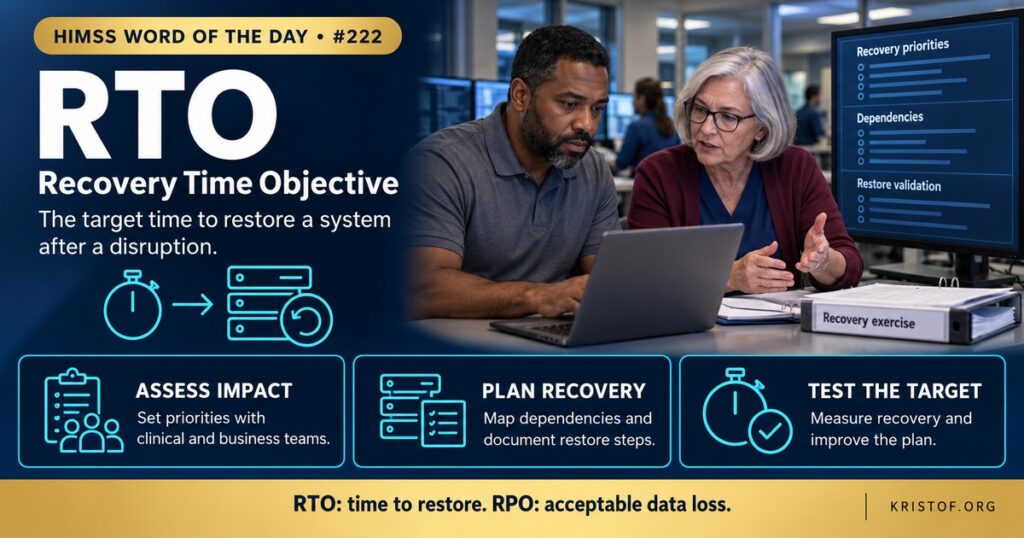
A recovery time objective (RTO) is the longest stretch of time an application, server, network, or other system may stay down after a failure or disaster before the consequences become unacceptable. The HIMSS Dictionary explains that the RTO depends on how much the interruption disrupts normal operations and on how much revenue or care capacity is lost for every hour of delay, factors that vary with the systems involved. Expressed as a span of time, from seconds to days, it is a key input to a disaster recovery plan.
An RTO is a target, not a prediction. It is a decision about how fast recovery must be, made by the organization after weighing risk, clinical need, and cost. Actual recovery may be faster or slower, which is why organizations test.
| Term | Question It Answers | Example |
|---|---|---|
| RTO (Recovery Time Objective) | How quickly must the system be back? | EHR restored within a few hours |
| RPO (Recovery Point Objective) | How much recent data can be lost? | Restore to a point no more than minutes before failure |
| Downtime | How long was the system actually unavailable? | A measured outage |
| Maximum Tolerable Downtime | How long before the impact becomes unacceptable? | The ceiling that RTO must stay under |
| Business Impact Analysis (BIA) | What does each system’s loss cost? | Ranked list of critical systems |
⚠️ Exam Alert: RTO concerns time to restore; RPO concerns how much data can be lost. A system can have a short RTO and a long RPO, or the reverse. The RTO must be shorter than the maximum tolerable downtime for the function the system supports.
🌐 Why It Matters: Real-World Healthcare IT Context
Health care now depends on electronic systems at every step. When they stop, patient identification, orders, results, medication administration, imaging, scheduling, and communication can all be affected. Setting RTOs forces an organization to decide in advance which systems matter most, how quickly they must return, and what resources recovery requires.
The process usually starts with a business impact analysis. Teams list systems and processes, estimate the effect of losing each at various durations, and rank them. A pharmacy system, an EHR, and an emergency department tracking board will likely have shorter RTOs than a training portal. NIST’s contingency planning guide for information systems, SP 800-34, lays out this reasoning and shows how impact analysis feeds recovery strategies, and it defines recovery time and recovery point as separate concepts.
HIPAA ties into this directly. The Security Rule‘s contingency plan standard at 45 CFR 164.308(a)(7) requires policies and procedures for responding to an emergency or other occurrence, such as fire, vandalism, system failure, or natural disaster, that damages systems containing electronic protected health information. Required implementation specifications include a data backup plan to create retrievable exact copies, a disaster recovery plan to restore any loss of data, and an emergency mode operation plan to continue critical processes while protecting information. Testing and revision procedures and an applications and data criticality analysis are addressable. The criticality analysis is, in effect, the input to RTO setting.
Evidence shows how often and how widely outages occur. A 2025 retrospective analysis of one hospital’s adverse event reports identified 204 EHR downtime events, 96.1 percent of them unplanned. Medication-related events were most frequent at 25.5 percent, followed by imaging-related events at 17.2 percent, and 76.0 percent were reported as patient care disruptions. Downtime incidence was higher on weekdays than on weekends, with an incidence rate ratio of 2.22. A narrative review from a pediatric anesthesiology department described a prolonged EHR outage in which all aspects of care, from patient identification materials to operating room schedules to in-house communication, were significantly affected, and it stressed the need to be ready to move to pre-established downtime protocols while keeping care safe and the department financially sustainable. These accounts show that the RTO is not just an IT number: when it is exceeded, clinical teams run the hospital on paper and memory.
Recovery targets also drive cost. Shorter RTOs generally require more redundancy, such as duplicate infrastructure, replication, and automated failover, and more testing. Organizations cannot afford the shortest RTO for every system, so they tier systems, and clinical leaders should take part in that tiering because they know what the loss of each system means at the bedside.
Cyberattacks changed the picture. Ransomware can corrupt both primary systems and backups, which makes recovery slower than a hardware failure and may undermine an RTO built on assumptions about backup integrity. Good practice includes protected, tested backups kept separate from the production network, recovery runbooks, and exercises that simulate a prolonged outage rather than a short blip.
Common RTO problems:
- RTOs set by IT alone without clinical input
- Targets never tested, so actual recovery time is unknown
- All systems given the same target
- Dependencies missed, such as identity services, networks, or interfaces
- Backups that cannot be restored within the target
- Downtime procedures designed for hours but outages last days
What supports realistic RTOs:
- A current business impact analysis with clinical review
- Tiered systems with documented targets
- Mapped dependencies for each critical application
- Regular restore tests and full downtime exercises
- Protected, isolated backups
- Downtime kits and procedures that clinicians have practiced
🏥 The Nurse’s Perspective: Clinical, Bedside, & Workflow
Nurses experience the RTO as the hours when the screen is dark and care continues anyway.
At the Bedside
During an outage, nurses use downtime forms, printed medication administration records, and reports prepared ahead of time. Knowing where the kit is, how to identify patients without the usual wristband scan, and how to verify high-risk medications by hand can prevent errors. When the system returns, back-entry of data follows a defined procedure so that the record is complete and late entries are marked.
In Clinical Workflow
Nurse leaders take part in setting priorities by describing what happens on their units without each system. They help decide which reports to print regularly, how long the unit can function on paper, and when to trigger surge staffing or diversion decisions. Charge nurses and house supervisors often coordinate communication and resources during long outages.
Nurse informaticists contribute by joining downtime planning, reviewing read-only access options, and making sure printed reports contain what bedside staff actually need.
In EHR Implementation (Go-Live Perspective)
An Epic Go-Live includes downtime planning, because new users are most vulnerable to disruption. Teams test the downtime viewing tools, confirm printers and report schedules, and rehearse reconciliation. At-the-elbow support analysts help staff practice and report problems with downtime materials so they can be fixed before an actual event.
🎓 CAHIMS / CPHIMS & HIMSS Perspective
CAHIMS Exam Domain Mapping
RTO appears in infrastructure, security, and continuity questions:
| CAHIMS Domain | How the RTO Appears |
|---|---|
| Healthcare & Technology Environments | HIPAA contingency planning, disaster preparedness |
| Clinical Informatics | Downtime workflows, clinical impact of outages |
| Healthcare Information & Systems Management | Backup, replication, failover, restore testing |
| Management & Leadership | Risk tolerance, budget tradeoffs, governance of recovery priorities |
Key Terms to Know Alongside the RTO
- RPO (Recovery Point Objective) — the maximum acceptable data loss measured in time
- Business Impact Analysis (BIA) — assessment of the effects of losing a system or process
- Disaster Recovery Plan — procedures to restore systems and data after a disaster
- Business Continuity Plan — plan for keeping operations going during disruption
- Failover — switching to a standby system when the primary fails
- Downtime Procedures — manual processes used while systems are unavailable
HIMSS Organizational Position
HIMSS supports cybersecurity readiness and resilience through its Healthcare Cybersecurity Community, research, and education. Members can find related resources through the HIMSS Resource Center.
🔗 Explore Further: External References
- NIST — SP 800-34 Rev. 1, Contingency Planning Guide for Federal Information Systems https://csrc.nist.gov/pubs/sp/800/34/r1/upd1/final
- eCFR — 45 CFR 164.308, Administrative Safeguards (Contingency Plan) https://www.ecfr.gov/current/title-45/subtitle-A/subchapter-C/part-164/subpart-C/section-164.308
- ASPR TRACIE — Healthcare Emergency Preparedness Information Gateway https://asprtracie.hhs.gov/
- Fang et al. (2025), Applied Clinical Informatics — Electronic Health Record Downtime Events of a Hospital: A Retrospective Analysis from Adverse Event Reports https://pubmed.ncbi.nlm.nih.gov/41135583/
- Cheon et al. (2025), Anesthesiology — Continuing Anesthesia Services in the Face of a Prolonged Digital Health System Outage https://pubmed.ncbi.nlm.nih.gov/40493406/
- ONC — SAFER Guides https://healthit.gov/clinical-quality-and-safety/safer-guides/
Term source: HIMSS Dictionary of Health Information and Technology Terms, Acronyms, and Organizations, 6th Edition (2025). All definitions in this series are paraphrased for editorial purposes. Readers are encouraged to consult the primary source for exact language.
Eric Andrew Kristof, RN, CAHIMS is a Healthcare IT professional and HIMSS Arkansas Chapter member based in Hot Springs Village, AR, with hands-on Epic Go-Live experience and a diverse healthcare and IT background. He writes at kristof.org at the intersection of clinical care and healthcare technology.
Leave a Reply