By Eric Andrew Kristof, RN, CAHIMS | Healthcare IT Professional | HIMSS Arkansas Chapter Member
About This Series: The HIMSS Word of the Day is a running blog series drawing from the HIMSS Dictionary of Health Information and Technology Terms, Acronyms, and Organizations, 6th Edition (2025) — the authoritative reference for healthcare IT professionals and the primary study resource for CAHIMS and CPHIMS certification. Each post paraphrases the term in plain language, grounds it in real-world healthcare IT context, and adds a bedside nursing perspective you won’t find in a textbook.
📖 The Term: Identity and Access Management (IAM)
Source: HIMSS Dictionary of Health Information and Technology Terms, Acronyms, and Organizations, 6th Edition (2025)
🔍 Plain-Language Definition
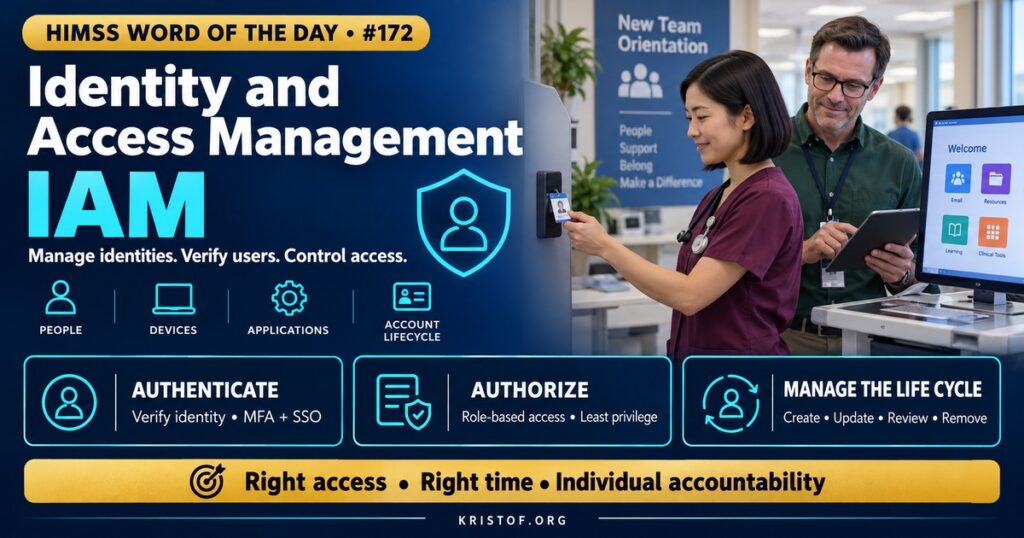
Identity and access management (IAM) is the framework of policies, processes, and technologies used to create and manage digital identities for people, devices, and applications, verify those identities, and control what resources each identity can access.
The HIMSS Dictionary describes IAM as a set of services that includes authentication, user provisioning, password management, role management, enterprise single sign-on, access management, federation, directory services, and auditing. It explains that IAM is how organizations grant or deny people access to secure systems, combining workflows, policies, procedures, and technologies to verify requests and protect organizational resources, and that it also handles administrative tasks such as password problems and the user life cycle.
| IAM Component | What It Does | Healthcare Example |
|---|---|---|
| Identity Life Cycle (Provisioning) | Creates, changes, and removes accounts as roles change | Automatic access when a nurse is hired; removal at termination |
| Authentication | Verifies identity | Badge tap plus PIN or multifactor login |
| Single Sign-On (SSO) | One login provides access to multiple applications | Logging into the EHR and connected apps at once |
| Authorization and Roles | Determines permitted actions | Role-based EHR security classes |
| Privileged Access Management (PAM) | Controls administrator and high-risk accounts | Vaulted credentials for system administrators |
| Identity Governance | Reviews and certifies who has access | Quarterly manager review of access rights |
| Federation | Trusts identities across organizations | Affiliated clinicians using home credentials |
⚠️ Exam Alert: IAM is the umbrella for managing identities and access. Authentication verifies who you are; authorization determines what you can do. SSO reduces login burden but makes the single credential more valuable, so it should be paired with MFA. PAM protects privileged accounts that attackers often target.
🌐 Why It Matters: Real-World Healthcare IT Context
Healthcare organizations manage enormous numbers of identities: employees, physicians, students, contractors, vendors, patients using portals, devices, and applications. People constantly join, transfer, take on temporary roles, and leave. IAM ensures that each identity has appropriate access at the right time and no longer than necessary.
Stolen or misused credentials are among the most common paths into healthcare systems. Attackers use phishing, password reuse, and social engineering to obtain logins, then move through systems with legitimate-looking access. Strong authentication, especially multifactor authentication, and careful control of privileged accounts are central defenses.
Provisioning connects IAM to human resources. When hiring, transfers, and terminations flow automatically from HR systems to IAM, access can be granted on the first day and removed promptly at departure. Manual processes often leave orphaned accounts that attackers can exploit.
Single sign-on improves clinician efficiency. Clinicians use many applications, and SSO, often combined with badge tap-in, reduces repeated logins and the temptation to leave sessions open. Because one credential unlocks many systems, SSO should be paired with strong authentication and monitoring.
Least privilege and access reviews limit exposure. Role-based access gives users what their jobs require, and periodic reviews by managers remove access that is no longer needed. HIPAA requires information access management and workforce security procedures, and many organizations use identity governance tools to support them.
Privileged access needs special controls. Administrator accounts can change configurations, access large data sets, or disable security tools. Privileged access management solutions vault credentials, require approval for elevated access, and record sessions.
Federation and digital identity standards connect organizations. Standards such as SAML and OpenID Connect allow trusted identities to be used across systems, and NIST’s digital identity guidelines define assurance levels for identity proofing and authentication.
Patient identities are part of IAM too. Patient portals and apps require identity proofing and secure authentication so that patients, and authorized proxies such as parents or caregivers, can access the right records. Proxy access rules, especially for adolescents, must balance family involvement with privacy, and IAM systems must enforce those rules reliably.
IAM underpins zero trust. Zero trust architectures depend on strong identity verification and context-aware access decisions for every request, making IAM a foundation of modern security strategy.
Common IAM gaps in healthcare:
- Accounts not removed promptly after departure
- Shared or generic logins on clinical workstations
- Excessive access accumulated over time
- Weak authentication on remote and privileged accounts
- Vendor accounts without monitoring or expiration
- Manual provisioning that delays access for new staff
Practices for strong IAM:
- Automated provisioning tied to HR systems
- Multifactor authentication, especially for remote and privileged access
- Single sign-on with badge tap-in for clinical efficiency
- Role-based access and periodic access reviews
- Privileged access management and session monitoring
- Time-limited, monitored vendor access
🏥 The Nurse’s Perspective: Clinical, Bedside, & Workflow
Nurses experience IAM every shift, from badge tap-in to the access available in each application.
At the Bedside
Fast, secure login matters in clinical work. Badge tap-in and single sign-on let nurses move between patients and workstations without retyping passwords, reducing the urge to stay logged in or share sessions.
Multifactor prompts protect accounts. Nurses should approve only prompts they initiated and report unexpected ones, which may signal someone attempting to use stolen credentials.
In Clinical Workflow
Access should match responsibilities. When nurses float, take charge roles, or cover other units, they may need temporary access. Requesting it through proper channels, rather than borrowing another person’s login, preserves accountability.
New nurses depend on timely provisioning. Delays in access can disrupt orientation and push new staff toward workarounds. Nurse managers who complete onboarding requests early help avoid these problems.
Managers participating in access reviews confirm that staff still need their current access, removing permissions from people who have changed roles.
Password resets and account lockouts can interrupt care. Self-service reset tools and clear help desk processes reduce downtime for clinicians, while strong verification prevents attackers from resetting accounts.
Students and agency staff present special IAM challenges. Time-limited accounts with appropriate supervision rules help them contribute safely without lingering access after assignments end.
In EHR Implementation (Go-Live Perspective)
During an Epic Go-Live, IAM teams create accounts for thousands of users, assign roles, configure SSO and badge tap-in, and test access across devices. Ensuring every user can log in before Go-Live is a major readiness milestone.
At-the-elbow support analysts frequently resolve access issues in the first days. Routing access problems through proper requests rather than sharing logins maintains security and accountability.
🎓 CAHIMS / CPHIMS & HIMSS Perspective
CAHIMS Exam Domain Mapping
IAM appears in security and systems management questions:
| CAHIMS Domain | How IAM Appears |
|---|---|
| Healthcare & Technology Environments | HIPAA access requirements; digital identity standards; threat landscape |
| Clinical Informatics | Login workflows, badge tap-in, temporary access for clinical roles |
| Healthcare Information & Systems Management | Provisioning, SSO, MFA, PAM, federation, directories |
| Management & Leadership | Access governance, policy, vendor management, zero trust strategy |
Key Terms to Know Alongside IAM
- User Provisioning — creating, changing, and removing user accounts and access
- Single Sign-On (SSO) — one authentication providing access to multiple systems
- Multifactor Authentication (MFA) — verifying identity with two or more factor types
- Privileged Access Management (PAM) — controls for high-risk administrative accounts
- Identity Governance — processes for reviewing and certifying access
- Federation — trusting identities across organizations or systems
HIMSS Organizational Position
HIMSS emphasizes strong identity and access management as a cybersecurity foundation through its Healthcare Cybersecurity Community, research, and education. Members can find related education and research through the HIMSS Resource Center.
🔗 Explore Further: External References
- NIST — SP 800-63-4, Digital Identity Guidelines https://csrc.nist.gov/pubs/sp/800/63/4/final
- NIST — SP 800-207, Zero Trust Architecture https://csrc.nist.gov/pubs/sp/800/207/final
- eCFR — 45 CFR 164.308, HIPAA Administrative Safeguards https://www.ecfr.gov/current/title-45/subtitle-A/subchapter-C/part-164/subpart-C/section-164.308
- eCFR — 45 CFR 164.312, HIPAA Technical Safeguards https://www.ecfr.gov/current/title-45/subtitle-A/subchapter-C/part-164/subpart-C/section-164.312
- HHS 405(d) Program — Health Industry Cybersecurity Practices https://405d.hhs.gov/
- HIMSS — Healthcare Cybersecurity Community https://www.himss.org/networking/communities/healthcare-cybersecurity/
Term source: HIMSS Dictionary of Health Information and Technology Terms, Acronyms, and Organizations, 6th Edition (2025). All definitions in this series are paraphrased for editorial purposes. Readers are encouraged to consult the primary source for exact language.
Eric Andrew Kristof, RN, CAHIMS is a Healthcare IT professional and HIMSS Arkansas Chapter member based in Hot Springs Village, AR, with hands-on Epic Go-Live experience and a diverse healthcare and IT background. He writes at kristof.org at the intersection of clinical care and healthcare technology.
Leave a Reply