By Eric Andrew Kristof, RN, CAHIMS | Healthcare IT Professional | HIMSS Arkansas Chapter Member
About This Series: The HIMSS Word of The Day is a running blog series drawing from the HIMSS Dictionary of Health Information and Technology Terms, Acronyms, and Organizations, 6th Edition (2025) — the authoritative reference for healthcare IT professionals and the primary study resource for CAHIMS and CPHIMS certification. Each post paraphrases the term in plain language, grounds it in real-world healthcare IT context, and adds a bedside nursing perspective you won’t find in a textbook.
📖 The Term: VAN (Value-Added Network)
Source: HIMSS Dictionary of Health Information and Technology Terms, Acronyms, and Organizations, 6th Edition (2025)
🔍 Plain-Language Definition
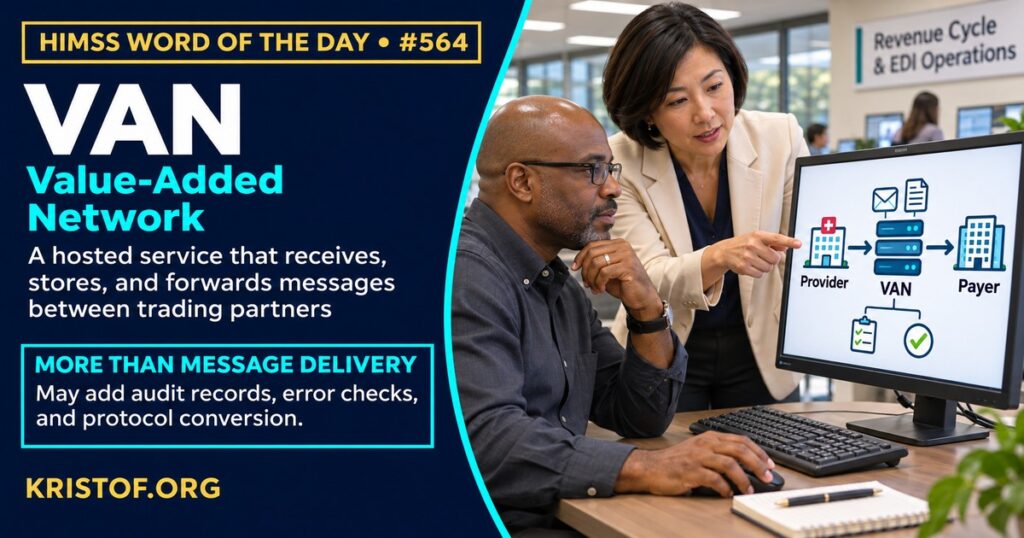
The HIMSS Dictionary describes a value-added network (VAN) as a hosted service that handles messages by receiving, storing, and forwarding them. The entry adds that a VAN may record audit data and may change data in order to detect and correct errors automatically or to convert between communication protocols.
The HIPAA Administrative Simplification regulation at 45 CFR 160.103 defines a health care clearinghouse as a public or private entity that includes billing services, repricing companies, community health management information systems, and “value-added” networks and switches, among others. The definition describes two functions, converting health information from a nonstandard format or content into a standard transaction, and converting a standard transaction into a nonstandard form for the receiving entity. In other words, the regulation names value-added networks as examples, and whether a given VAN is a clearinghouse depends on whether it performs those functions.
| Related term | How it relates to a VAN |
|---|---|
| EDI (Electronic Data Interchange) | Structured exchange of business documents, which a VAN may carry between trading partners |
| Health care clearinghouse | HIPAA entity type whose regulatory definition names value-added networks as examples |
| Transaction standard | Adopted format for electronic transactions, such as ASC X12 version 5010 for most HIPAA transactions |
| Trading partner | A participant in an ongoing exchange of electronic transactions |
| Audit data | Records of message handling that a VAN may add, as the dictionary entry notes |
The table is a teaching sketch and not an official taxonomy.
⚠️ Exam Alert: A VAN is a hosted service for passing messages between parties, and it is not the same as a health information exchange, a HISP, or a payer. The term health care clearinghouse has a regulatory definition, and the regulation lists value-added networks as examples, so the two terms overlap without being identical. Not every entity that carries transactions converts them, so the function of a service matters more than the label it uses.
🌐 Why It Matters: Real-World Healthcare IT Context
Published research on value-added networks in health care is thin. A PubMed search turned up few relevant items, and the ones found are from 1993. For that reason, this post relies on federal regulation and CMS documents, and it treats the older articles as history.
What the regulation says. The definition at 45 CFR 160.103 puts value-added networks and switches among the entities that can be health care clearinghouses, and ties clearinghouse status to the conversion functions described above. For readers preparing for an exam, the practical point is to read the function, not the label.
What CMS has said. CMS’s Medicare Claims Processing Manual, Chapter 24, discusses clearinghouses and notes that a clearinghouse may also be called a value-added network, and that some entities that call themselves clearinghouses act only as a telecommunications switch. In Transmittal 3346 (September 4, 2015), CMS stated that it would no longer provide information about network service vendors in that chapter. The transmittal gives no reason, so older vendor lists in manuals and training materials should not be assumed to be current. The CMS Administrative Simplification page lists ASC X12 version 5010 as the adopted format for most HIPAA transactions, and these are the kinds of transactions a VAN may carry.
How a provider once weighed options. Romo, in Healthcare Financial Management (1993), described four ways a provider could receive ANSI 835 claim payments: direct transmission from payers, VAN services, banks with EDI capability, and paper reports. The article is more than thirty years old and shows how the VAN option was framed at the time, not how providers choose today.
A different use of the term. Friedman and Mitchell, in the American Journal of Clinical Pathology (1993), proposed a regional value-added laboratory network to integrate test results from decentralized testing sites. This is a concept paper from the same period and uses the term for laboratory data integration, which differs from claims EDI.
Common VAN problems:
- Treating “VAN” and “clearinghouse” as identical without checking what the service does
- Relying on dated vendor lists, since CMS stopped providing network service vendor information in that manual chapter in 2015
- Unclear responsibility for errors when a service modifies or converts data
- Not tracking the audit data that the service provides
- Assuming 1990s descriptions of VAN options describe current practice
- Little recent published evidence, which makes vendor claims hard to compare
What supports use of a VAN:
- Receiving, storing, and forwarding messages as a hosted service, which the dictionary entry describes
- Audit data and automatic error detection and correction that a VAN may add
- Conversion between communication protocols, which the dictionary entry lists
- Standard transaction formats, such as ASC X12 version 5010, that give partners a common language
- Regulatory recognition of value-added networks in the HIPAA definition of a clearinghouse
🏥 The Nurse’s Perspective: Clinical, Bedside, & Workflow
For nurses, a VAN sits far from the bedside, but its effects reach the unit through registration, authorization, and billing.
At the Bedside
Nurses seldom see a VAN, but eligibility checks, authorizations, and claims that pass through networks like it depend on accurate information gathered at the bedside and in registration. Documentation that supports the care provided helps later claim review. When a payer asks for more information, the request may begin as an electronic transaction.
In Clinical Workflow
Case managers, utilization review nurses, and clinical documentation specialists often work with payer communications that start as standard electronic transactions. Understanding that these messages travel through intermediaries, and may be converted or checked along the way, helps explain why a rejection can come back for a formatting reason and not a clinical one. Nurse informaticists can help by clarifying who owns each step.
In EHR Implementation (Go-Live Perspective)
During an Epic Go-Live, analysts at the elbow hear about registration and billing issues alongside clinical ones. Project teams typically test connections with the organization’s clearinghouse or network service, including how rejections and acknowledgments come back, and who monitors them. The specific services and settings vary by organization, so they should be confirmed with the revenue cycle and interface teams.
🎓 CAHIMS / CPHIMS & HIMSS Perspective
CAHIMS Exam Domain Mapping
The VAN connects data exchange, regulation, and administrative transactions:
| CAHIMS Domain | How the VAN Appears |
|---|---|
| Healthcare & Technology Environments | Payers, clearinghouses, and networks that connect trading partners |
| Clinical Informatics | Documentation that supports eligibility, authorization, and claims |
| Healthcare Information & Systems Management | Interfaces, EDI connections, and monitoring of transactions |
| Management & Leadership | Vendor selection, trading partner agreements, and revenue cycle oversight |
Key Terms to Know Alongside the VAN
- EDI (Electronic Data Interchange) — structured exchange of business documents between organizations
- Healthcare clearinghouse — entity that converts data between standard and nonstandard transaction formats
- Transaction standard — adopted standard format for an electronic health care transaction
- HIPAA Administrative Simplification — HIPAA provisions that standardize electronic health care transactions
- Payer — organization that pays for or manages health care coverage
- Audit trail — record of who did what and when in a system
HIMSS Organizational Position
HIMSS offers education and research on health information and technology topics through its Resource Center. Members can find related information on the HIMSS Resource Center page.
🧭 More HIMSS Word of The Day Terms
Related terms in the Interoperability and Standards series:
- Health Information Exchange (HIE)
- The Sequoia Project
- SMTP (Simple Mail Transfer Protocol)
- W3C (World Wide Web Consortium)
Browse all Interoperability and Standards terms or the A–Z glossary.
🔗 Explore Further: External References
- Cornell Law School Legal Information Institute — 45 CFR 160.103, Definitions (health care clearinghouse) https://www.law.cornell.edu/cfr/text/45/160.103
- CMS — Medicare Claims Processing Manual Transmittal 3346 (Change Request 9280), September 4, 2015 https://www.cms.gov/regulations-and-guidance/guidance/transmittals/downloads/r3346cp.pdf
- CMS — Adopted Standards and Operating Rules https://www.cms.gov/priorities/key-initiatives/burden-reduction/administrative-simplification/hipaa/adopted-standards-operating-rules
- Romo (1993), Healthcare financial management — Adapting to the ANSI 835 transaction set https://pubmed.ncbi.nlm.nih.gov/10145738/
- Friedman and Mitchell (1993), American journal of clinical pathology — Integrating information from decentralized laboratory testing sites. The creation of a value-added network https://pubmed.ncbi.nlm.nih.gov/8493955/
- HIMSS — Resource Center https://www.himss.org/resource-center
Term source: HIMSS Dictionary of Health Information and Technology Terms, Acronyms, and Organizations, 6th Edition (2025). All definitions in this series are paraphrased for editorial purposes. Readers are encouraged to consult the primary source for exact language.
Eric Andrew Kristof, RN, CAHIMS is a Healthcare IT professional and HIMSS Arkansas Chapter member based in Hot Springs Village, AR, with hands-on Epic Go-Live experience and a diverse healthcare and IT background. He writes at kristof.org at the intersection of clinical care and healthcare technology.
Leave a Reply