By Eric Andrew Kristof, RN, CAHIMS | Healthcare IT Professional | HIMSS Arkansas Chapter Member
About This Series: The HIMSS Word of the Day is a running blog series drawing from the HIMSS Dictionary of Health Information and Technology Terms, Acronyms, and Organizations, 6th Edition (2025) — the authoritative reference for healthcare IT professionals and the primary study resource for CAHIMS and CPHIMS certification. Each post paraphrases the term in plain language, grounds it in real-world healthcare IT context, and adds a bedside nursing perspective you won’t find in a textbook.
📖 The Term: ARRA (American Recovery and Reinvestment Act of 2009)
Source: HIMSS Dictionary of Health Information and Technology Terms, Acronyms, and Organizations, 6th Edition (2025)
🔍 Plain-Language Definition
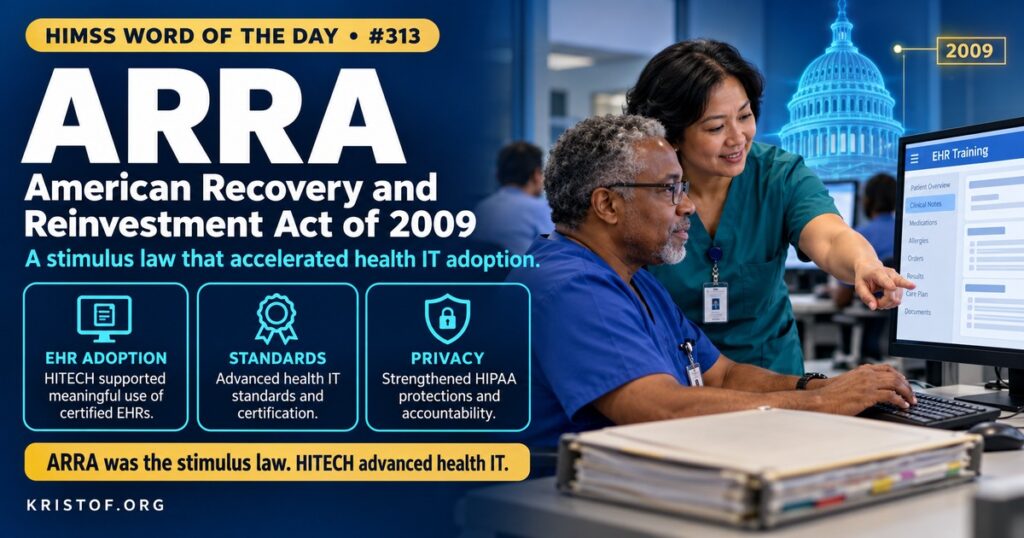
The American Recovery and Reinvestment Act of 2009 (ARRA) was an economic stimulus law passed by the 111th US Congress and signed by President Barack Obama. For health informatics, its most important feature was Title XIII, the Health Information Technology for Economic and Clinical Health (HITECH) Act. The HIMSS Dictionary credits HITECH with providing $30 billion for health IT investments, including incentives to help acute care hospitals and physicians in private practice adopt certified EHRs. ONC describes the HITECH Act as giving HHS the authority to establish programs that improve health care quality, safety, and efficiency through the promotion of health IT, including EHRs and private and secure electronic health information exchange.
HITECH worked on several fronts. It established ONC in statute and gave it responsibility for standards and certification. It created Medicare and Medicaid incentive payments for the “meaningful use” of certified EHR technology, later renamed the Promoting Interoperability programs. It funded regional extension centers, workforce training, and state health information exchange grants. And it strengthened HIPAA privacy and security, including breach notification and direct liability for business associates, which is why HITECH appears in the posts on privacy and business associates in this series.
| HITECH Component | Purpose | Lasting Effect |
|---|---|---|
| Incentive payments | Encourage meaningful use of certified EHRs | Near-universal hospital EHR adoption |
| ONC and certification | Set standards and certify EHR technology | Certification criteria still in use |
| Extension centers and training | Help small practices adopt EHRs | Informatics workforce growth |
| Privacy and security provisions | Strengthen HIPAA enforcement | Breach notification and BA liability |
| Exchange grants | Build state and regional health information exchange | Regional exchange infrastructure |
⚠️ Exam Alert: ARRA is the stimulus law; HITECH is Title XIII of that law dealing with health IT. Meaningful use was the incentive program created under HITECH and later became Promoting Interoperability. ONC gained statutory authority under HITECH. The HITECH Act also changed HIPAA enforcement.
🌐 Why It Matters: Real-World Healthcare IT Context
The question policy analysts asked was whether the money changed behavior or merely rewarded organizations that would have adopted EHRs anyway. Two studies address it.
A 2017 study in Health Affairs used national hospital data to compare EHR adoption among hospitals eligible for the meaningful use incentives, short-term acute care hospitals, with ineligible hospitals, before the program (2008 to 2010) and after it (2011 to 2015). Among eligible hospitals, annual increases in adoption rose from 3.2 percent before the program to 14.2 percent after it. Ineligible hospitals saw much smaller annual increases of 0.1 percent before and 3.3 percent after, giving a difference-in-differences of 7.9 percentage points. The authors concluded that the recent gains in hospital EHR adoption could be attributed specifically to HITECH. The comparison group was not perfect, since ineligible hospitals differ from eligible ones, but the design was stronger than simple before-and-after comparisons.
An international comparison reached a similar conclusion. A 2019 study in the International Journal of Medical Informatics modeled EHR diffusion in German and US hospitals. In the US, adoption followed the typical S-shaped curve with a strong imitation effect (q = 0.583) but a low innovation effect (p = 0.025). In Germany, where the government left adoption to the market and stakeholder consensus, adoption stagnated at roughly 50 percent between 2007 and 2017 despite a higher innovation effect. The authors argued that imitation appears to work only when there are financial incentives, as with HITECH in the US, and that the imitation parameter in diffusion models should be interpreted to include incentives and regulation. Differences between the two countries’ health systems limit how far the comparison can be pushed, but it supports the incentive explanation.
Adoption was not the only goal. A 2016 Milbank Quarterly assessment looked back at HITECH after five years. It described the goals as expansive, requiring a complex and interdependent infrastructure and relationships that created points of vulnerability, and noted that federal legislation can be a powerful stimulus but depends on accommodating state and local policies and private markets. With grant funding mostly exhausted but statutory authority for standards still in place, the authors drew lessons about the need for long-term support and for technology that satisfies its users. Later sections of this series cover the interoperability, usability, and burden issues that followed.
For informatics professionals, HITECH explains much of the landscape: why certification criteria exist, why hospitals and clinics implemented EHRs when they did, why many still report documentation burden, and why interoperability became the next policy focus. The program’s quality reporting requirements shaped how clinicians document. Its HIPAA changes set today’s expectations for breach notification and business associate accountability. The later transition from meaningful use to Promoting Interoperability and then to Quality Payment Program categories shows how incentive design evolves when the first goal, adoption, is largely achieved.
Common misunderstandings about ARRA and HITECH:
- Treating ARRA and HITECH as the same thing
- Assuming that adoption alone achieved interoperability
- Thinking incentives ended the need for usability work
- Forgetting HITECH’s privacy and security provisions
- Believing the program applied equally to all provider types
- Seeing the incentive era as unrelated to today’s payment programs
Lessons from the HITECH experience:
- Financial incentives can move adoption quickly
- Standards and certification need to accompany payment
- Long time horizons and sustained support matter
- Usability and burden must be addressed alongside adoption
- State and local policies affect results
- Evaluation should continue after the first goal is reached
🏥 The Nurse’s Perspective: Clinical, Bedside, & Workflow
Nurses lived through HITECH as the move from paper charts to electronic documentation at the bedside.
At the Bedside
For many nurses, the effect of HITECH was personal: bar code scanning, electronic medication administration records, and structured assessments appeared on the unit within a few years, often with new expectations for documentation. Much of the data behind meaningful use quality measures came from nursing documentation.
In Clinical Workflow
Nurse managers adapted staffing and workflows to EHR demands. Nurses became super users, trainers, and informatics champions as organizations raced to meet program deadlines. Many nurse informaticist careers began in this period.
Nurse informaticists today work on the second-generation questions HITECH left open: reducing documentation burden, improving usability, sharing information across organizations, and ensuring that data support safe care.
In EHR Implementation (Go-Live Perspective)
Epic Go-Lives across the country accelerated after HITECH, and many of the go-live practices used today, including at-the-elbow support and command centers, grew from those years. Analysts who work at the elbow help translate regulatory requirements into daily workflow and report back when requirements do not fit the unit.
🎓 CAHIMS / CPHIMS & HIMSS Perspective
CAHIMS Exam Domain Mapping
ARRA and HITECH appear in policy, history, and regulation questions:
| CAHIMS Domain | How ARRA and HITECH Appear |
|---|---|
| Healthcare & Technology Environments | Federal legislation, ONC, incentive programs, HIPAA changes |
| Clinical Informatics | Meaningful use, quality measures, clinical documentation |
| Healthcare Information & Systems Management | Certified EHR technology, interoperability, health information exchange |
| Management & Leadership | Policy compliance, incentive management, project planning |
Key Terms to Know Alongside ARRA
- HITECH Act — health IT provisions of ARRA that funded EHR adoption and strengthened HIPAA
- Meaningful Use — incentive program requiring use of certified EHRs to achieve defined objectives
- ONC — Office of the National Coordinator for Health Information Technology
- Certified EHR Technology (CEHRT) — EHR software meeting federal certification criteria
- Promoting Interoperability Programs — later name for the EHR incentive programs
- Breach Notification — HIPAA requirement to notify affected individuals of a breach of unsecured PHI
HIMSS Organizational Position
HIMSS has long supported policy that advances health information technology and its effective use through its public policy work, research, and education. Members can find related resources through the HIMSS Resource Center.
🔗 Explore Further: External References
- HealthIT.gov — Legislation https://healthit.gov/legislation/
- Adler-Milstein and Jha (2017), Health Affairs — HITECH Act Drove Large Gains in Hospital Electronic Health Record Adoption https://pubmed.ncbi.nlm.nih.gov/28784734/
- Esdar et al. (2019), International Journal of Medical Informatics — Diffusion Dynamics of Electronic Health Records: A Longitudinal Observational Study Comparing Data From Hospitals in Germany and the United States https://pubmed.ncbi.nlm.nih.gov/31557699/
- Gold and McLaughlin (2016), Milbank Quarterly — Assessing HITECH Implementation and Lessons: 5 Years Later https://pubmed.ncbi.nlm.nih.gov/27620687/
- CMS — Value-Based Programs https://www.cms.gov/medicare/quality/value-based-programs
Term source: HIMSS Dictionary of Health Information and Technology Terms, Acronyms, and Organizations, 6th Edition (2025). All definitions in this series are paraphrased for editorial purposes. Readers are encouraged to consult the primary source for exact language.
Eric Andrew Kristof, RN, CAHIMS is a Healthcare IT professional and HIMSS Arkansas Chapter member based in Hot Springs Village, AR, with hands-on Epic Go-Live experience and a diverse healthcare and IT background. He writes at kristof.org at the intersection of clinical care and healthcare technology.
Leave a Reply