By Eric Andrew Kristof, RN, CAHIMS | Healthcare IT Professional | HIMSS Arkansas Chapter Member
About This Series: The HIMSS Word of the Day is a running blog series drawing from the HIMSS Dictionary of Health Information and Technology Terms, Acronyms, and Organizations, 6th Edition (2025) — the authoritative reference for healthcare IT professionals and the primary study resource for CAHIMS and CPHIMS certification. Each post paraphrases the term in plain language, grounds it in real-world healthcare IT context, and adds a bedside nursing perspective you won’t find in a textbook.
📖 The Term: Integration
Source: HIMSS Dictionary of Health Information and Technology Terms, Acronyms, and Organizations, 6th Edition (2025)
🔍 Plain-Language Definition
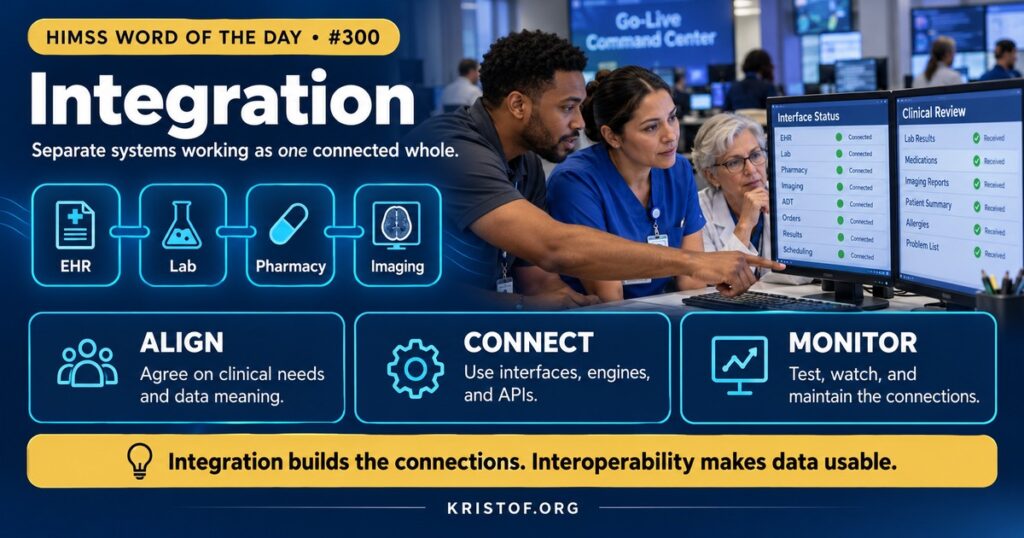
Integration is the process of bringing separately developed parts together so that they work as a connected system. The HIMSS Dictionary notes that the means can vary: the parts can simply be joined at an interface, they can be changed substantially to fit together, or something can be placed between them to mediate. In health IT, the parts are applications such as the EHR, laboratory, pharmacy, imaging, billing, devices, and external partners.
Integration is related to interoperability, but they are not identical. Interoperability is the ability of systems to exchange and use information; integration is the work of connecting particular systems so that they do so in a given environment. A hospital achieves integration project by project, often over many years.
Common approaches include several patterns. Point-to-point interfaces connect two systems directly, which is simple for a few systems and unmanageable for many. An interface engine sits in the middle, receives messages from one system, transforms and routes them to others. APIs, increasingly based on HL7 FHIR, allow applications to request and exchange data on demand. Platform strategies reduce the number of separate systems by using modules from one vendor. Data warehouses and health information exchanges bring data together for analysis or sharing across organizations.
| Approach | Strength | Typical Weakness |
|---|---|---|
| Point-to-point interface | Fast for one connection | Becomes tangled as systems multiply |
| Interface engine | Central routing and transformation | Requires skilled maintenance and monitoring |
| API (such as FHIR) | Flexible, on-demand access | Needs consistent implementation and security |
| Single platform | Fewer interfaces to manage | Dependence on one vendor, variable module depth |
| Data warehouse or exchange | Combined view across sources | Latency and data quality issues |
⚠️ Exam Alert: Integration connects specific systems; interoperability is the capability to exchange and use data. An interface is a connection point; an interface engine is middleware that routes and translates messages. HL7 v2 messages, C-CDA documents, and FHIR resources are different exchange formats.
🌐 Why It Matters: Real-World Healthcare IT Context
Most health care happens across many systems and many organizations, and the patient pays the price when they do not connect. The consequences are practical: duplicate testing, missing allergy information, delayed referrals, and clinicians who spend time hunting for data.
A qualitative study in BMC Health Services Research examined care coordination across emergency departments, acute care hospitals, skilled nursing facilities, and home health agencies in six US regions chosen as leaders in health IT. It enrolled 29 respondents from 17 organizations in six focus groups. Respondents described using health IT to monitor patients and to align system resources with population needs, but identified multiple areas where a lack of interoperability led to inefficient processes and missing data. A literature review in the same paper found ten intervention studies addressing information transfer, seven of which used health IT and three of which relied on telephone calls, faxed records, or nurse case management. The authors concluded that significant care coordination gaps exist and that tools should be designed, evaluated, and incentivized, with attention to information transfer, patient monitoring, self-management support, and links between patients and clinicians. The study is from 2016, so some technologies have changed, but the categories of problems remain recognizable.
A 2025 study in the Journal of the American Medical Directors Association interviewed participants about health IT in transitions for sepsis survivors moving to home health and outpatient care. It reported 61 interviews with 91 participants from five US health systems and affiliated home health agencies, and identified 17 themes. Health IT supported identification of sepsis, documentation, communication, information sharing, care coordination, and quality monitoring. Barriers included missing, delayed, or inaccessible information across disparate EHR systems, and proposed strategies included interoperable EHRs and health IT tools to support follow-up with continuous monitoring of functionality. The findings suggest that even well-implemented systems can fail at the boundaries between organizations.
Integration is also a long-term social process. A 2026 qualitative study in the Journal of Medical Internet Research traced the Key Information Summary in Lothian, Scotland, a summary record that shares key patient information from general practitioner records with out-of-hours services, ambulance services, hospitals, social workers, and caregivers, over its 13 years of use. Using 54 interviews, 20 hours of observation, and 59 documents, the authors described three successive waves of attempts to interlink disparate information systems, shaped by changing expectations, coding practices, data-sharing mechanisms, and stakeholder needs. The study is about one region, but it shows that integration evolves over years and rarely ends in a single go-live.
Practical lessons follow. Teams define the clinical use case first: what decision or handoff will the connection support, and what data are needed for it? They agree on data definitions and code sets before building. They monitor interfaces actively, because messages fail silently if no one is watching, and they test with realistic data and volumes. They plan for change, since upgrades on either side can break a working interface. Governance sets priorities among competing requests, and downtime procedures cover the case when a connection fails. Finally, they evaluate whether the integration changed work and outcomes, not only whether messages flow.
Common integration problems:
- Point-to-point interfaces that multiply and become unmanageable
- Different codes or definitions for the same concept in two systems
- Interfaces that fail without alerting anyone
- Data displayed in ways that clinicians cannot use
- Upgrades that break connections
- Integration with outside organizations left to informal workarounds
What supports sound integration:
- Use cases defined by clinical need
- Agreed data definitions and standard code sets
- An interface engine or API strategy with active monitoring
- Testing with real data and volumes
- Governance for requests and changes
- Downtime plans and post-implementation evaluation
🏥 The Nurse’s Perspective: Clinical, Bedside, & Workflow
Nurses notice integration most when it fails: the result that is not there, the order that did not reach pharmacy, the discharge summary that never arrived.
At the Bedside
Bedside nurses depend on interfaces to deliver medication orders to dispensing cabinets, vital signs from monitors to flowsheets, and lab results to the chart. When something does not appear, they report what they expected to see and when, which helps analysts trace the message.
In Clinical Workflow
Nurse managers learn which handoffs rely on systems that do not connect, such as transfers to skilled nursing facilities or home health, and set up workarounds with clear responsibility. In care transitions, nurses often serve as the bridge, phoning or faxing when electronic exchange fails.
Nurse informaticists define clinical requirements for interfaces, test with real scenarios, review error queues, and make sure that data arrive where nurses expect to find them.
In EHR Implementation (Go-Live Perspective)
An Epic Go-Live is an integration event: devices, lab, pharmacy, imaging, and external partners must all connect on day one. At-the-elbow support analysts and command center staff watch for missing results, duplicate orders, and device data that do not flow, and give interface teams concrete examples that speed up diagnosis.
🎓 CAHIMS / CPHIMS & HIMSS Perspective
CAHIMS Exam Domain Mapping
Integration appears in architecture, standards, and project questions:
| CAHIMS Domain | How Integration Appears |
|---|---|
| Healthcare & Technology Environments | Standards organizations, interoperability policy, care continuum |
| Clinical Informatics | Workflow across systems, care coordination, data use |
| Healthcare Information & Systems Management | Interfaces, interface engines, APIs, testing, monitoring |
| Management & Leadership | Vendor management, governance, project planning |
Key Terms to Know Alongside Integration
- Interface — connection through which two systems exchange data
- Interface Engine — middleware that receives, translates, and routes messages
- HL7 v2 — widely used message standard for exchanging clinical and administrative data
- FHIR — HL7 standard that exchanges data as resources through web APIs
- Middleware — software that mediates between applications
- Health Information Exchange (HIE) — network or organization that enables sharing of health information across organizations
HIMSS Organizational Position
HIMSS supports interoperability and integration through its public policy work, research, and education. Members can find related resources through the HIMSS Resource Center.
🔗 Explore Further: External References
- Samal et al. (2016), BMC Health Services Research — Care Coordination Gaps Due to Lack of Interoperability in the United States: A Qualitative Study and Literature Review https://pubmed.ncbi.nlm.nih.gov/27106509/
- You et al. (2025), Journal of the American Medical Directors Association — Qualitative Study of the Context of Health Information Technology in Sepsis Care Transitions: Facilitators, Barriers, and Strategies for Improvement https://pubmed.ncbi.nlm.nih.gov/40286812/
- Sai et al. (2026), Journal of Medical Internet Research — Evolution of Regional Information Infrastructures Integrating Health and Social Care in Scotland: Qualitative Study https://pubmed.ncbi.nlm.nih.gov/42430230/
- HL7 International — FHIR R4 https://hl7.org/fhir/R4/
- HealthIT.gov — Health IT Playbook https://playbook.healthit.gov/
Term source: HIMSS Dictionary of Health Information and Technology Terms, Acronyms, and Organizations, 6th Edition (2025). All definitions in this series are paraphrased for editorial purposes. Readers are encouraged to consult the primary source for exact language.
Eric Andrew Kristof, RN, CAHIMS is a Healthcare IT professional and HIMSS Arkansas Chapter member based in Hot Springs Village, AR, with hands-on Epic Go-Live experience and a diverse healthcare and IT background. He writes at kristof.org at the intersection of clinical care and healthcare technology.
Leave a Reply