By Eric Andrew Kristof, RN, CAHIMS | Healthcare IT Professional | HIMSS Arkansas Chapter Member
About This Series: The HIMSS Word of the Day is a running blog series drawing from the HIMSS Dictionary of Health Information and Technology Terms, Acronyms, and Organizations, 6th Edition (2025) — the authoritative reference for healthcare IT professionals and the primary study resource for CAHIMS and CPHIMS certification. Each post paraphrases the term in plain language, grounds it in real-world healthcare IT context, and adds a bedside nursing perspective you won’t find in a textbook.
📖 The Term: Vulnerability Assessment
Source: HIMSS Dictionary of Health Information and Technology Terms, Acronyms, and Organizations, 6th Edition (2025)
🔍 Plain-Language Definition
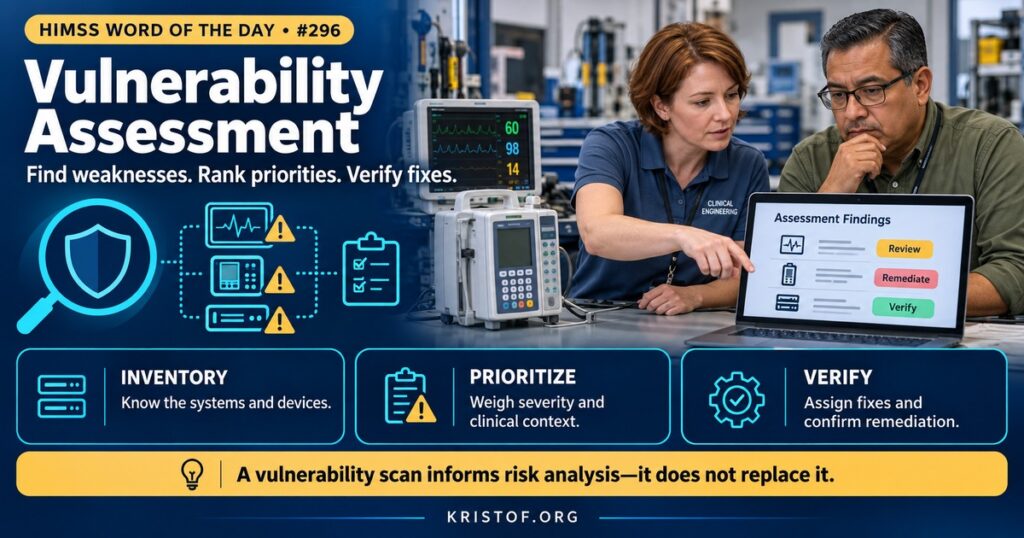
A vulnerability assessment is a systematic look at an information system or product to find weaknesses in its security. The HIMSS Dictionary gives two related descriptions. In the first, the assessment judges whether security measures are adequate, identifies deficiencies, supplies data for predicting how well proposed measures would work, and confirms their adequacy after they are put in place. In the second, it is the process of identifying and measuring vulnerabilities and ranking them by priority.
Three related activities are often confused. A vulnerability assessment finds and ranks weaknesses, often with automated scanning tools. A penetration test goes further by attempting to exploit weaknesses, as an attacker would, to show what could actually be reached. A risk analysis combines vulnerabilities with threats, likelihood, and impact to decide which risks matter most to the organization. NIST Special Publication 800-115, Technical Guide to Information Security Testing and Assessment, describes technical testing techniques such as network discovery, vulnerability scanning, and penetration testing. NIST Special Publication 800-30 Revision 1, Guide for Conducting Risk Assessments, describes the broader risk process.
HIPAA ties these ideas together. The Security Rule at 45 CFR 164.308(a)(1)(ii)(A) requires an accurate and thorough assessment of the potential risks and vulnerabilities to the confidentiality, integrity, and availability of electronic PHI. Paragraph (B) requires risk management measures sufficient to reduce those risks and vulnerabilities to a reasonable and appropriate level, and 164.308(a)(8) requires periodic technical and nontechnical evaluation in response to environmental or operational changes. A vulnerability scan alone does not satisfy these requirements, but it is a key input.
| Activity | Question It Answers | Typical Output |
|---|---|---|
| Vulnerability assessment | What weaknesses exist? | Ranked list of vulnerabilities |
| Penetration test | What can an attacker reach by exploiting them? | Demonstrated attack paths |
| Risk analysis | Which risks matter most, and why? | Prioritized risks and treatment plan |
| Evaluation | Do controls still meet requirements after change? | Periodic review report |
⚠️ Exam Alert: A vulnerability is a weakness; a threat is something that can exploit it; risk combines likelihood and impact. A vulnerability assessment identifies; a penetration test exploits; a risk analysis prioritizes. The Common Vulnerability Scoring System (CVSS) rates severity of vulnerabilities.
🌐 Why It Matters: Real-World Healthcare IT Context
Hospitals run large and varied technology estates: workstations, servers, cloud services, imaging systems, infusion pumps, building controls, and patient-owned devices. Many items cannot be patched easily, and some run old software for years because replacement is costly or requires regulatory re-validation. A vulnerability assessment gives security teams an inventory-based picture of exposure.
A study from a radiology department illustrates what such an assessment can find. Published in the American Journal of Roentgenology in 2015, it scanned all networked medical equipment in one department with a port scanner and a network vulnerability scanner and classified findings using the Common Vulnerability Scoring System. Of 144 items scanned, 64 (44 percent) had at least one critical vulnerability and 119 (83 percent) had at least one high-risk vulnerability. Most equipment did not encrypt traffic, and a network sniffer could capture confidential patient data. Only two items (1 percent) used antivirus software and three (2 percent) had a firewall enabled. USB ports were not secure on 49 of 58 items that had them (84 percent), and CD or DVD drives were not secure on 17 of 31 (55 percent). One of three vendors had an insecure implementation of remote VPN access. The study is a decade old and describes a single department, so it cannot be generalized to today’s equipment, but it shows how the combination of old software, open services, and weak controls creates exposure, and how a systematic scan can quantify it.
The stakes are clinical as well as financial. A 2026 narrative review in the Journal of Emergency Medicine found that ransomware and other malicious software disrupt care, delay diagnostics, and compromise data integrity in emergency departments. A hospital that knows which systems are exposed can prioritize fixes before an attacker finds them. The same review stressed that preparedness should include realistic simulations and downtime protocols, which complement technical fixes.
A sound program has several parts. It begins with an asset inventory, since a scan cannot assess what the organization does not know it owns. Scans run regularly and after major changes, using approved tools and scheduled windows, because scanning can disrupt fragile devices such as older medical equipment. Findings are rated by severity and by context: a critical vulnerability on an isolated device may rank below a moderate one on an internet-facing server. Teams assign owners and deadlines, apply patches or compensating controls such as network segmentation, and rescan to confirm that fixes worked. Where a device cannot be patched, they work with the vendor, restrict its connections, and document the decision. Results feed the HIPAA risk analysis and risk management plan.
Common vulnerability assessment problems:
- Incomplete inventory of devices and software
- Scanning that is avoided because it might disrupt clinical devices
- Long lists of findings without ranking or owners
- Unpatchable medical equipment left on flat networks
- One-time assessments that are never repeated
- Findings that are never rescanned to confirm remediation
What supports an effective program:
- A current asset inventory that includes medical devices
- Regular, approved scanning with clinical engineering input
- Severity and context scoring, including exposure
- Network segmentation and compensating controls for unpatchable devices
- Defined owners, deadlines, and rescans
- Results linked to the risk analysis and management plan
🏥 The Nurse’s Perspective: Clinical, Bedside, & Workflow
Nurses rarely run scans, but they depend on the devices being scanned and are affected by the fixes.
At the Bedside
Infusion pumps, monitors, and other connected devices are clinical tools first, and patching or network changes can affect their behavior. Nurses report devices that behave unexpectedly after an update, and keep downtime procedures ready in case a device must be taken out of service.
In Clinical Workflow
Nurse managers coordinate with clinical engineering and IT so that scans and patch windows do not coincide with peak activity, and so that devices are available when needed. Unit leaders help identify equipment that is missing from inventories, such as a device brought in for a pilot.
Nurse informaticists take part in device and system selection, ask vendors about patching and security support, and represent clinical needs when security teams propose controls. They also make sure that clinicians understand why a device may be restricted or replaced.
In EHR Implementation (Go-Live Perspective)
An Epic Go-Live adds interfaces, devices, and workstations to the network. At-the-elbow support analysts notice unapproved devices or workarounds, such as personal tablets used to reach the system, and report them to security staff so that the inventory and scans reflect what is actually in use.
🎓 CAHIMS / CPHIMS & HIMSS Perspective
CAHIMS Exam Domain Mapping
Vulnerability assessment appears in security, risk, and operations questions:
| CAHIMS Domain | How Vulnerability Assessment Appears |
|---|---|
| Healthcare & Technology Environments | HIPAA Security Rule, regulatory expectations, medical device oversight |
| Clinical Informatics | Clinical device safety, downtime, user impact |
| Healthcare Information & Systems Management | Scanning, patching, network segmentation, asset inventory |
| Management & Leadership | Risk management, prioritization, vendor oversight |
Key Terms to Know Alongside Vulnerability Assessment
- Vulnerability — weakness that could be exploited to harm a system
- Threat — circumstance or actor that can exploit a vulnerability
- Penetration Test — authorized attempt to exploit weaknesses to show what an attacker could reach
- Risk Analysis — HIPAA-required assessment of risks and vulnerabilities to ePHI
- CVSS — scoring system that rates the severity of vulnerabilities
- Network Segmentation — dividing a network into zones to limit exposure
HIMSS Organizational Position
HIMSS supports healthcare cybersecurity through its Healthcare Cybersecurity Community, research, and education. Members can find related resources through the HIMSS Healthcare Cybersecurity Community page.
🔗 Explore Further: External References
- eCFR — 45 CFR 164.308, Administrative Safeguards https://www.ecfr.gov/current/title-45/subtitle-A/subchapter-C/part-164/subpart-C/section-164.308
- NIST — SP 800-115, Technical Guide to Information Security Testing and Assessment https://csrc.nist.gov/pubs/sp/800/115/final
- NIST — SP 800-30 Rev. 1, Guide for Conducting Risk Assessments https://csrc.nist.gov/pubs/sp/800/30/r1/final
- Moses et al. (2015), AJR American Journal of Roentgenology — Lack of Security of Networked Medical Equipment in Radiology https://pubmed.ncbi.nlm.nih.gov/25615757/
- Kahl et al. (2026), Journal of Emergency Medicine — Cybersecurity and Emergency Medicine: A Literary Review https://pubmed.ncbi.nlm.nih.gov/42150298/
Term source: HIMSS Dictionary of Health Information and Technology Terms, Acronyms, and Organizations, 6th Edition (2025). All definitions in this series are paraphrased for editorial purposes. Readers are encouraged to consult the primary source for exact language.
Eric Andrew Kristof, RN, CAHIMS is a Healthcare IT professional and HIMSS Arkansas Chapter member based in Hot Springs Village, AR, with hands-on Epic Go-Live experience and a diverse healthcare and IT background. He writes at kristof.org at the intersection of clinical care and healthcare technology.
Leave a Reply