By Eric Andrew Kristof, RN, CAHIMS | Healthcare IT Professional | HIMSS Arkansas Chapter Member
About This Series: The HIMSS Word of the Day is a running blog series drawing from the HIMSS Dictionary of Health Information and Technology Terms, Acronyms, and Organizations, 6th Edition (2025) — the authoritative reference for healthcare IT professionals and the primary study resource for CAHIMS and CPHIMS certification. Each post paraphrases the term in plain language, grounds it in real-world healthcare IT context, and adds a bedside nursing perspective you won’t find in a textbook.
📖 The Term: Point-of-Care System
Source: HIMSS Dictionary of Health Information and Technology Terms, Acronyms, and Organizations, 6th Edition (2025)
🔍 Plain-Language Definition
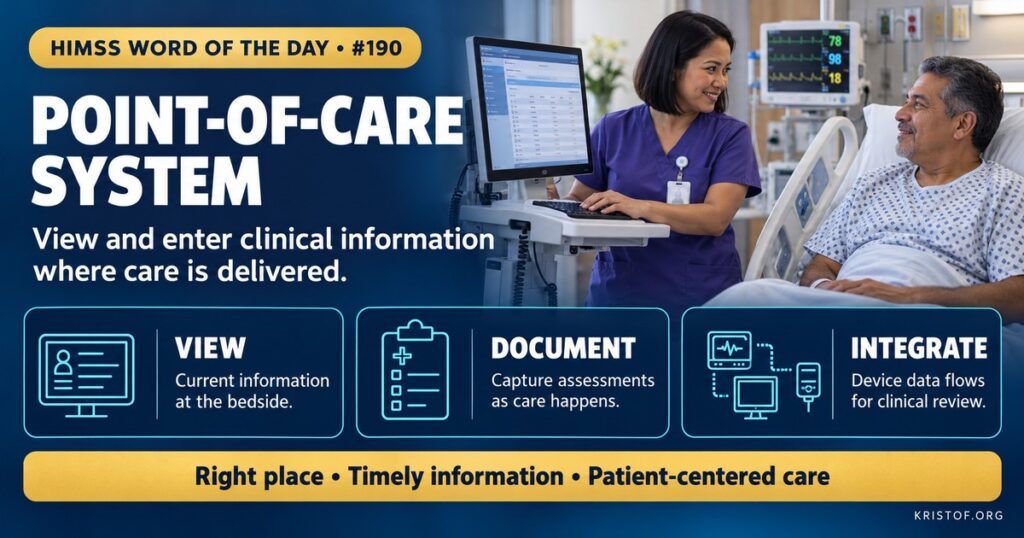
A point-of-care system is a clinical information system, and the devices that support it, designed so clinicians can view and enter information at the place where care is delivered, such as the bedside, exam room, procedure area, or patient’s home.
The HIMSS Dictionary describes a point-of-care system as a hospital information system equipped with bedside workstations or similar devices so that data can be recorded and entered right where patients are cared for.
| Point-of-Care Technology | What It Does | Example |
|---|---|---|
| Bedside or In-Room Workstation | Fixed computer in the patient room | Charting an admission assessment at the bedside |
| Workstation on Wheels | Mobile cart with a computer and scanner | Medication pass from room to room |
| Handheld Device | Smartphone or tablet with clinical apps | Documenting vital signs and scanning medications |
| Barcode Scanner | Reads patient and medication barcodes | Verifying the right patient and drug before administration |
| Device Integration | Transfers data from monitors and pumps | Vital signs flowing directly into flowsheets |
| Point-of-Care Testing (POCT) | Lab tests performed near the patient | Bedside glucose testing with results sent to the EHR |
⚠️ Exam Alert: A point-of-care system captures data where care occurs. Point-of-care testing refers to diagnostic tests performed near the patient, regulated in the United States under CLIA. Retrospective documentation happens after the fact, often at a central station, and is more prone to omissions and recall errors.
🌐 Why It Matters: Real-World Healthcare IT Context
Documentation that happens long after care is delivered depends on memory and handwritten notes, which increases the risk of missing or inaccurate information. Point-of-care systems aim to capture data as care happens, improving accuracy, timeliness, and availability of information for the whole team.
Patient safety depends on it. Barcode medication administration requires scanning at the bedside, which only works when devices are available where medications are given. Real-time documentation of vital signs and assessments also feeds early warning scores and decision support, which lose value when data is delayed.
Research has examined both benefits and barriers. A study of nursing staff on a telemetry unit found that barriers to point-of-care documentation included the location of in-room computers, concerns about computer reliability, privacy concerns, perceptions of how patients would react, and workflow priorities that placed documentation behind other care tasks. Other work has noted that point-of-care documentation can reduce inefficiencies and errors and keep nurses at the bedside, while also risking distraction from the patient if the screen dominates the interaction.
Device choice shapes workflow. In-room workstations keep information close but must be positioned so nurses can face patients. Workstations on wheels are flexible but can be heavy and crowd rooms. Handheld devices are portable and support quick tasks, while complex documentation may still be easier on larger screens. Many organizations combine options based on unit needs.
Device integration reduces manual entry. Data from monitors, infusion pumps, and other equipment can flow directly into the record, with nurses validating values. Specialized systems, such as anesthesia information management systems in the operating room, apply the same principle in high-acuity settings. Location technologies such as RFID can also help staff find point-of-care equipment quickly.
Point-of-care testing brings laboratory results to the bedside. Glucose meters, blood gas analyzers, coagulation monitors, and rapid infectious disease tests produce results quickly, supporting faster decisions. Under the Clinical Laboratory Improvement Amendments, laboratories, including those performing point-of-care tests, must meet regulatory requirements, and many point-of-care devices connect to middleware so results, operator identity, and quality control data flow to the EHR and laboratory systems.
Reliability is essential. Point-of-care systems only help if devices are charged, connected, and fast. Poor wireless coverage, slow logins, and frequent device failures push clinicians back to paper notes and delayed charting, so system availability at the bedside is a patient safety issue.
Infection prevention matters too. Devices that move between rooms must be cleanable with approved disinfectants, and organizations need cleaning protocols that fit busy workflows.
Structured point-of-care data supports broader uses. When nursing assessments and interventions are captured consistently at the bedside, the data can support quality measurement, research, and frameworks such as the Nursing Minimum Data Set that aim to make nursing care visible.
Common barriers to point-of-care documentation:
- Poorly placed or unreliable devices
- Slow logins and connectivity problems
- Privacy concerns about screens in patient rooms
- Workflow pressures that defer documentation
- Devices that are hard to clean or carry
- Screens that pull attention away from patients
What supports effective point-of-care systems:
- Devices placed so clinicians can face patients
- Fast authentication, such as badge tap-in
- Reliable wireless coverage and device support
- Barcode scanning and device integration
- Clear expectations for real-time documentation
- Cleaning protocols and durable, cleanable hardware
🏥 The Nurse’s Perspective: Clinical, Bedside, & Workflow
Point-of-care systems are built around nursing workflows, and nurses determine whether they work in practice.
At the Bedside
Documenting assessments, medications, and interventions in the room, as care happens, improves accuracy and helps the whole team see current information. Even brief entries, such as vital signs or pain scores, add value when entered promptly.
Positioning matters for the nurse-patient relationship. Turning the screen so the patient can see it, explaining what is being documented, and maintaining eye contact keep the focus on the person rather than the computer.
Scanning patient wristbands and medications at the bedside is one of the most important point-of-care safety steps. Scanning away from the patient, or scanning copied barcodes, defeats the purpose.
In Clinical Workflow
Point-of-care glucose testing and other bedside tests require proper operator identification, patient scanning, and quality control so results file to the correct patient and meet regulatory requirements.
When devices are slow, missing, or broken, reporting problems promptly helps teams fix them before staff develop workarounds such as paper notes or end-of-shift charting.
Privacy can be protected in shared rooms by locking screens, using privacy filters, and being mindful of what visitors can see.
Nurse informaticists help choose devices, design mobile workflows, and balance what belongs on a handheld screen versus a larger workstation.
In EHR Implementation (Go-Live Perspective)
During an Epic Go-Live, organizations deploy in-room workstations, workstations on wheels, handheld devices, scanners, and point-of-care testing integrations, and test them in every patient area. Device readiness checks are a key part of Go-Live preparation.
At-the-elbow support analysts spend much of their time helping nurses with logins, scanning, and mobile documentation at the bedside. Quick resolution of device issues keeps documentation at the point of care rather than delayed until later.
🎓 CAHIMS / CPHIMS & HIMSS Perspective
CAHIMS Exam Domain Mapping
Point-of-care systems appear in clinical informatics and infrastructure questions:
| CAHIMS Domain | How Point-of-Care Systems Appear |
|---|---|
| Healthcare & Technology Environments | Mobile and bedside technology trends; CLIA for point-of-care testing |
| Clinical Informatics | Real-time documentation, barcode scanning, nurse-patient interaction |
| Healthcare Information & Systems Management | Device selection, wireless infrastructure, device integration, middleware |
| Management & Leadership | Device investment, workflow expectations, infection prevention policy |
Key Terms to Know Alongside Point-of-Care System
- Point-of-Care Documentation — recording information at the time and place care is delivered
- Workstation on Wheels (WOW) — a mobile computer cart used at the bedside
- Barcode Medication Administration (BCMA) — scanning patients and medications before administration
- Point-of-Care Testing (POCT) — diagnostic testing performed near the patient
- Device Integration — automated transfer of medical device data into clinical systems
- CLIA — federal standards for laboratory testing, including point-of-care tests
HIMSS Organizational Position
HIMSS supports point-of-care technology and bedside workflows through its clinical and nursing informatics education, research on usability, and focus on patient safety. Members can find related education and research through the HIMSS Resource Center.
🔗 Explore Further: External References
- Kohle-Ersher et al. (2012), CIN: Computers, Informatics, Nursing — Evaluating the Barriers to Point-of-Care Documentation for Nursing Staff https://pubmed.ncbi.nlm.nih.gov/22024972/
- Duffy et al. (2010), Nursing Administration Quarterly — Point of Care Documentation Impact on the Nurse-Patient Interaction https://pubmed.ncbi.nlm.nih.gov/20023554/
- CMS — Clinical Laboratory Improvement Amendments (CLIA) https://www.cms.gov/medicare/quality/clinical-laboratory-improvement-amendments
- Clinical and Laboratory Standards Institute (CLSI) https://clsi.org/
- ONC — SAFER Guides https://healthit.gov/clinical-quality-and-safety/safer-guides/
- HIMSS — Nursing Informatics Community https://www.himss.org/networking/communities/nursing-informatics/
Term source: HIMSS Dictionary of Health Information and Technology Terms, Acronyms, and Organizations, 6th Edition (2025). All definitions in this series are paraphrased for editorial purposes. Readers are encouraged to consult the primary source for exact language.
Eric Andrew Kristof, RN, CAHIMS is a Healthcare IT professional and HIMSS Arkansas Chapter member based in Hot Springs Village, AR, with hands-on Epic Go-Live experience and a diverse healthcare and IT background. He writes at kristof.org at the intersection of clinical care and healthcare technology.
Leave a Reply