By Eric Andrew Kristof, RN, CAHIMS | Healthcare IT Professional | HIMSS Arkansas Chapter Member
About This Series: The HIMSS Word of the Day is a running blog series drawing from the HIMSS Dictionary of Health Information and Technology Terms, Acronyms, and Organizations, 6th Edition (2025) — the authoritative reference for healthcare IT professionals and the primary study resource for CAHIMS and CPHIMS certification. Each post paraphrases the term in plain language, grounds it in real-world healthcare IT context, and adds a bedside nursing perspective you won’t find in a textbook.
📖 The Term: Simulation
Source: HIMSS Dictionary of Health Information and Technology Terms, Acronyms, and Organizations, 6th Edition (2025)
🔍 Plain-Language Definition
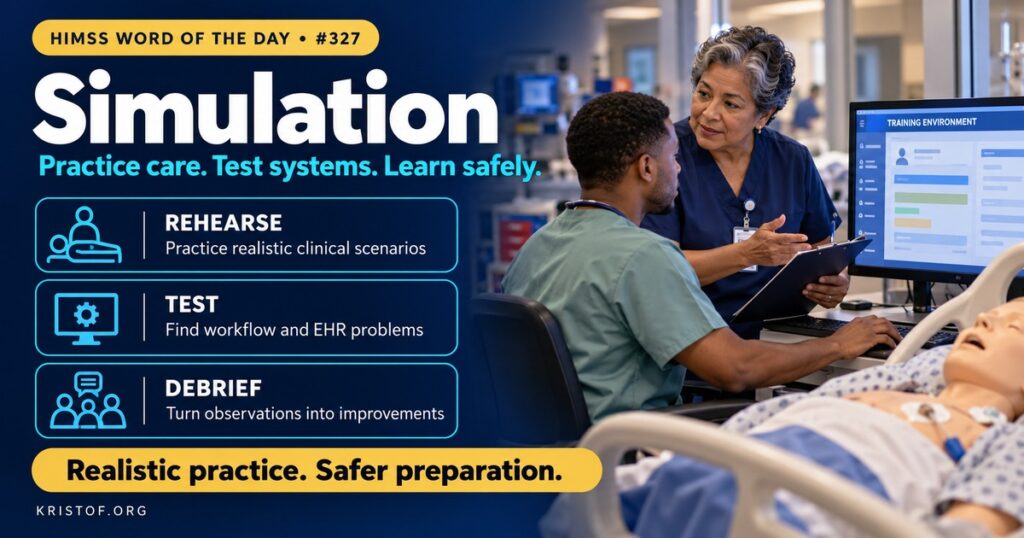
In the HIMSS Dictionary, a simulation is a learning activity that resembles a real-life situation the learner might meet, so the learner can make decisions safely. That educational meaning is the core of clinical simulation: a mannequin, a standardized patient, a virtual scenario, or a test version of the EHR is used to rehearse care or documentation without risk to a real patient.
In health informatics, simulation has two main uses. The first is training and assessment. Learners practice a scenario, make decisions, and receive feedback in a structured debrief. The second is system testing. A team runs realistic clinical scenarios through a new or changed system, often in the actual care space, to find usability problems and latent safety threats before go-live. The second use is sometimes called in situ simulation or systems simulation.
A third use, computational modeling, applies simulation to forecast demand, test staffing, or model system behavior. This post focuses on the first two, because they connect most directly to nursing practice and implementation.
| Simulation Type | Purpose | Example |
|---|---|---|
| Training simulation | Build skills and confidence | Practicing EHR navigation with a test patient |
| Assessment simulation | Measure competence | Documenting a simulated encounter |
| In situ simulation | Test workflows in real spaces | Running an operating room scenario in the new EHR |
| Usability testing | Observe individuals using a system | A nurse completes tasks while thinking aloud |
| Tabletop exercise | Discuss a scenario step by step | Downtime or cyber incident drill |
⚠️ Exam Alert: A simulation recreates a realistic situation without patient risk. Debriefing is a core element of simulation-based learning. In situ simulation takes place in the real care environment, and usability testing looks at individuals’ interaction with a system. A latent safety threat is a hidden weakness that simulation can reveal before harm occurs.
🌐 Why It Matters: Real-World Healthcare IT Context
Informatics teams use simulation because training in a live system can distract from patient care, and because problems found after go-live are costly. Several studies show what simulation can and cannot do.
For testing, a 2025 quality improvement study in Advances in Simulation described a children’s hospital preparing to move from one EHR to another. Between September 2023 and April 2024, the team ran two cycles of usability testing followed by in situ simulations of the new EHR with interprofessional perioperative team members. Usability sessions used the EHR testing environment with individual providers over video, while in situ simulations took place in the real perioperative and otolaryngology clinic spaces with full teams. The project produced 475 recommendations to improve safety, efficiency, usability, and optimization, including latent safety threats, and some critical issues were uncovered and addressed before go-live. The study was a single-site quality improvement project with qualitative data, so it does not measure patient outcomes, but it shows how testing in realistic conditions finds issues that scripted testing may miss.
For EHR training, a 2020 literature review in Computers, Informatics, Nursing summarized simulation-based training for health professionals. The authors argued that traditional EHR training, which uses lectures plus hands-on classroom time, leaves out the sociotechnical factors present in real settings, and that learning on the job can distract clinicians from patient care. They reported that simulation-based training that incorporated organizational context was associated with improved interdisciplinary team communication, clinical performance, clinician-patient-technology communication skills, and recognition of patient safety issues. Design considerations included clear course objectives, outcome measures, realistic content, and adequate debriefing. It is a literature review of studies with varying quality, so the findings are directional.
For skills, studies of structured practice show gains. A 2025 observational cohort in the Journal of Clinical Medicine followed 60 final-year medical students in London who completed a three-phase EHR navigation program of a workshop, hands-on case practice, and guided reflection. Before the program, 28 percent reported feeling confident using EHRs effectively, and afterward 87 percent did. Ratings of efficiency in finding critical patient information rose from 3.2 to 4.6 on the study’s scale. Students also became more aware of information overload and fragmented documentation. The study had no control group and relied partly on self-report, so it shows promise but not proof of better care. A 2026 study in Frontiers in Medicine used a simulated electronic record to track the clinical documentation skills of third-year medical students across five clerkships over seven months, and found that scores for history of present illness, assessment, and plan all improved, with variation by clerkship and case content.
The evidence on simulation overall is mixed in detail. A 2026 systematic review in Nurse Education in Practice examined 52 studies with 4,774 nursing and midwifery students and the effect of scenario-based simulation on clinical self-efficacy. Simulation was broadly associated with gains, but only 55.8 percent of studies showed statistically significant between-group superiority. The most consistent benefits appeared in studies with explicit theoretical frameworks, well-calibrated scenario difficulty, and structured debriefing, and the reviewers concluded that educational design and faculty preparation mattered more than technical fidelity. Because most outcomes were self-reported, the effects are less certain than they appear.
These studies suggest how informatics teams can use simulation well. Build scenarios from real workflows and include the roles that actually work together. Run testing early enough that fixes are still possible, and track recommendations to completion. Use debriefing to turn observations into specific changes. Match the fidelity of the simulation to the learning goal, since a simple test environment can be enough. And measure what changes: errors found, time to complete tasks, confidence, and later performance in the live system.
Common simulation problems:
- Scenarios that do not match real workflow
- Testing too late to fix major problems
- No debriefing, so observations are lost
- Findings that are not tracked to resolution
- Reliance on self-reported confidence alone
- Overinvestment in equipment instead of design and facilitation
What supports effective simulation:
- Scenarios based on real workflows and roles
- Early testing with time to act on results
- Structured debriefing
- Tracked recommendations with owners
- Fidelity matched to the goal
- Measures beyond self-reported confidence
🏥 The Nurse’s Perspective: Clinical, Bedside, & Workflow
Nurses learn and test in simulation, and they are often the best observers of whether a scenario looks like real work.
At the Bedside
Simulation gives nurses a safe place to rehearse rare or high-risk events, such as a rapid response or a downtime, and to practice charting in a test patient before a new system goes live. It also exposes workarounds, such as a missing barcode label or a screen that does not match the order of tasks.
In Clinical Workflow
Nurse educators build scenarios and run debriefs, nurse managers release staff for sessions, and unit leaders use findings to adjust procedures. Charge nurses can lead short in situ drills on the unit to test a new process.
Nurse informaticists design scenarios from real workflows, facilitate usability sessions, log issues, and follow them through to resolution. They help decide when a simple test patient is enough and when a full team simulation is worth the time.
In EHR Implementation (Go-Live Perspective)
Before an Epic Go-Live, simulations and dress rehearsals reveal gaps that the build team can still fix. At-the-elbow support analysts and super users often take part, and the experience helps them recognize the same issues when they appear on the unit after go-live.
🎓 CAHIMS / CPHIMS & HIMSS Perspective
CAHIMS Exam Domain Mapping
Simulation appears in training, testing, and implementation questions:
| CAHIMS Domain | How Simulation Appears |
|---|---|
| Healthcare & Technology Environments | Education standards, patient safety, human factors |
| Clinical Informatics | Workflow testing, usability, clinician training |
| Healthcare Information & Systems Management | Test environments, system validation, go-live readiness |
| Management & Leadership | Training plans, resource planning, risk reduction |
Key Terms to Know Alongside Simulation
- In Situ Simulation — simulation conducted in the real care environment
- Usability Testing — observation of users performing tasks with a system
- Latent Safety Threat — hidden system weakness that could contribute to harm
- Debriefing — structured discussion after a simulation to extract lessons
- Human Factors — study of how people interact with systems and environments
- Go-Live Readiness — assessment that a system and its users are prepared for launch
HIMSS Organizational Position
HIMSS supports effective education and safe implementation of health information technology through its research, education, and community work, including the Nursing Informatics Community. Members can find related resources through the HIMSS Nursing Informatics Community page.
🔗 Explore Further: External References
- Dubé et al. (2025), Advances in Simulation — Human Factors and Systems Simulation Methods to Optimize Peri-operative EHR Design and Implementation https://pubmed.ncbi.nlm.nih.gov/40269997/
- Wilbanks and Aroke (2020), Computers, Informatics, Nursing — Using Clinical Simulations to Train Healthcare Professionals to Use Electronic Health Records: A Literature Review https://pubmed.ncbi.nlm.nih.gov/32520783/
- Ramkumar et al. (2025), Journal of Clinical Medicine — From Clicks to Care: Enhancing Clinical Decision Making Through Structured Electronic Health Records Navigation Training https://pubmed.ncbi.nlm.nih.gov/40725506/
- Dimassi et al. (2026), Frontiers in Medicine — Tracking the Evolution of Medical Students’ Clinical Documentation Skills: A Pilot Study Leveraging a Simulated Electronic Record and a Longitudinal Panel Data Analysis https://pubmed.ncbi.nlm.nih.gov/42292271/
- Chung et al. (2026), Nurse Education in Practice — The Impact of Scenario-Based Simulation Learning on Clinical Self-Efficacy Among Pre-Licensure Nursing and Midwifery Students: A Systematic Review of Design Features and Educational Outcomes https://pubmed.ncbi.nlm.nih.gov/42933096/
- HIMSS — Nursing Informatics Community https://www.himss.org/networking/communities/nursing-informatics/
Term source: HIMSS Dictionary of Health Information and Technology Terms, Acronyms, and Organizations, 6th Edition (2025). All definitions in this series are paraphrased for editorial purposes. Readers are encouraged to consult the primary source for exact language.
Eric Andrew Kristof, RN, CAHIMS is a Healthcare IT professional and HIMSS Arkansas Chapter member based in Hot Springs Village, AR, with hands-on Epic Go-Live experience and a diverse healthcare and IT background. He writes at kristof.org at the intersection of clinical care and healthcare technology.
Leave a Reply