By Eric Andrew Kristof, RN, CAHIMS | Healthcare IT Professional | HIMSS Arkansas Chapter Member
About This Series: The HIMSS Word of the Day is a running blog series drawing from the HIMSS Dictionary of Health Information and Technology Terms, Acronyms, and Organizations, 6th Edition (2025) — the authoritative reference for healthcare IT professionals and the primary study resource for CAHIMS and CPHIMS certification. Each post paraphrases the term in plain language, grounds it in real-world healthcare IT context, and adds a bedside nursing perspective you won’t find in a textbook.
📖 The Term: Direct Messaging
Source: HIMSS Dictionary of Health Information and Technology Terms, Acronyms, and Organizations, 6th Edition (2025)
🔍 Plain-Language Definition
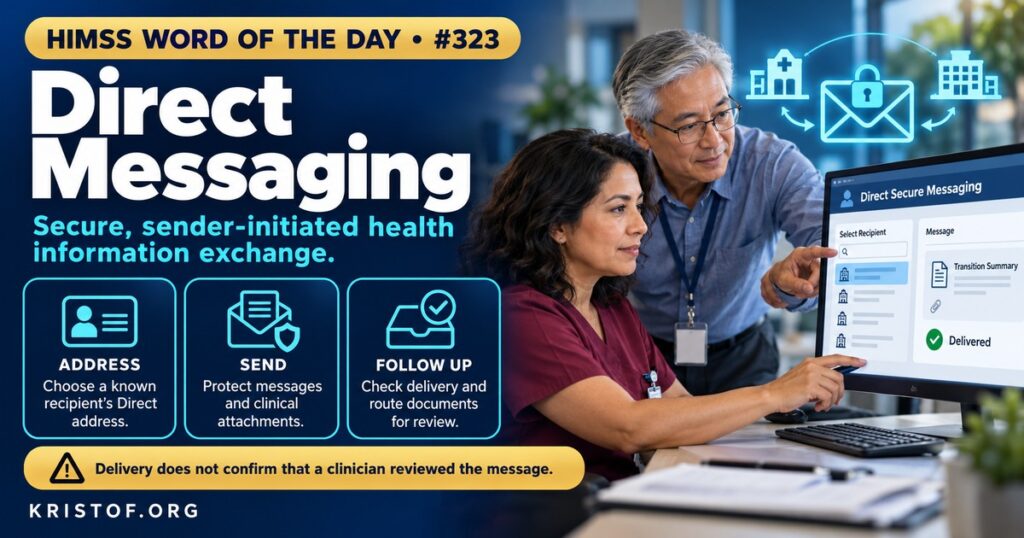
Direct messaging, often called Direct secure messaging (DSM), is a form of secure messaging that the HIMSS Dictionary describes as a generally recognized, effective, encrypted way to send sensitive clinical and administrative information from one point to another. Think of it as email with identity checks and encryption: a sender with a Direct address sends a message, and often an attached document, to a recipient with a Direct address, and only those two parties can read the content. A 2024 paper in Studies in Health Technology and Informatics describes it as a sender-initiated technology for exchanging patient-specific information between clinicians and organizations that are otherwise disconnected.
The technology comes from the Direct Project, a public-private effort to define simple, secure transport for health information. In federal rules, Direct is part of ONC’s certification program. Under 45 CFR 170.315(h)(1), certified health IT must be able to send and receive health information using the ONC Applicability Statement for Secure Health Transport, Version 1.2, formatted as a “wrapped” message, and to support delivery notification in Direct. A related criterion, 170.315(h)(2), adds support for XDR/XDM and edge protocols. Because the capability is built into certified EHRs, many organizations already own the functions they need.
| Direct Messaging Feature | What It Does | Why It Matters |
|---|---|---|
| Direct address | Identifies a sender or recipient | Messages need a known address |
| Encryption and identity | Protects content and verifies parties | Supports secure exchange of PHI |
| Attachments | Carry documents such as summaries | Useful for transitions of care |
| Delivery notification | Confirms receipt | Closes the loop for the sender |
| Point-to-point design | Sends to a specific recipient | Differs from query-based exchange |
⚠️ Exam Alert: Direct messaging is push, meaning the sender chooses the recipient; query-based exchange is pull. It uses Direct addresses and works across different EHR vendors. ONC certification requires certified EHRs to support Direct transport. Direct is not the same as patient portal messaging or ordinary email.
🌐 Why It Matters: Real-World Healthcare IT Context
Direct messaging matters because it was one of the first interoperable ways for organizations on different EHRs to send each other patient information. Studies of its use show both progress and friction.
On growth, a 2016 article in the Journal of Digital Imaging examined how certified EHRs, patient portals, and Direct messaging affected communication of radiology results. Using statistics from DirectTrust.org, the authors reported that from 2013 to 2015 the number of secure Direct addresses issued rose from 8,724 to 752,496, the number of participating health care organizations rose from 667 to 39,751, and the number of secure messages sent rose from 122,842 to 27,316,438. In the same paper, radiology report access was strongly associated with patient portal use, with a likelihood ratio of 2.63. The data are from a short period early in adoption, and the paper describes one specialty’s perspective, but the growth in addresses and organizations shows how quickly a standard can spread once certification and incentive programs require it.
On directories, a 2025 article in Applied Clinical Informatics described Texas efforts to increase Direct use. Direct depends on an address directory, and the authors noted that when directory entries are incomplete, exchange breaks down. A workgroup formed by the Texas Health Services Authority used a modified Delphi process between August 2021 and March 2022 to write a directory management best practice policy, published in May 2022. Among 38 hospitals monitored, the share of Direct messages not sent because no address was known fell from 50 percent to 42 percent between September 2021 and December 2022. Participating organizations also reported a steady monthly increase in new Direct addresses issued from July 2021 to March 2024. The recommendations were to standardize address data, synchronize routinely with external databases, and update an entry as soon as a practitioner’s status changes. The study shows improvement but also that 42 percent of messages still failed for lack of an address, and it does not isolate the policy as the cause.
On workflow, a 2024 paper in Studies in Health Technology and Informatics reviewed problems from the receiving clinician’s side. As Direct adoption grows, clinicians and staff find it harder to manage the volume and variety of outside data they receive, which can cause information overload and reduce their ability to process patient data. The authors found that low awareness of Direct features and uneven EHR capabilities for sending, receiving, and managing messages mean that more work is needed to realize Direct’s potential as a low-barrier option for clinical interoperability, and they offered best practices for senders and recipients. It is an experience-based paper and not a controlled study, but it points to the part of the process that gets less attention than sending.
Putting these findings together, successful Direct use depends on four things. First, a complete and current directory, because a message cannot go where no address exists. Second, clear workflows for sending: who sends what, when, and with which attachments. Third, clear workflows for receiving: who monitors the inbox, how attachments are filed in the chart, and how clinicians are alerted. Fourth, measurement of failed and undelivered messages, because silent failures harm patients more than visible ones.
Common Direct messaging problems:
- Missing or outdated recipient addresses
- Messages that arrive in an inbox no one monitors
- Attachments that are not filed to the right chart
- Information overload from unsolicited or unneeded documents
- Clinicians unaware of how to use Direct features
- No tracking of undelivered messages
What supports effective Direct messaging:
- A maintained, synchronized address directory
- Defined sending and receiving workflows
- Staff and clinician training on Direct features
- Rules that route messages and attachments to the chart
- Delivery notifications and failure reports
- Governance that updates addresses when staff change
🏥 The Nurse’s Perspective: Clinical, Bedside, & Workflow
Direct messages carry the transition summaries and referral documents that nurses depend on when patients move between settings.
At the Bedside
A nurse receiving a patient from another facility wants the summary, medication list, and recent results. When a Direct message with those documents is filed in the chart, admission is smoother. When it lands in an unmonitored inbox, the nurse is back to phone calls and faxes.
In Clinical Workflow
Case managers and nurse managers often send and receive Direct messages for transfers and referrals. They know which receiving facilities have addresses and which still need faxes, and they report address problems to informatics or health information management staff.
Nurse informaticists help define who monitors the Direct inbox, how documents are indexed, and how nurses are notified when outside records arrive. They also test whether received documents are readable and useful.
In EHR Implementation (Go-Live Perspective)
An Epic Go-Live often switches on Direct sending from discharge workflows. At-the-elbow support analysts hear from case managers when an address is missing or a message fails, and these examples help the team correct directory entries and workflows early.
🎓 CAHIMS / CPHIMS & HIMSS Perspective
CAHIMS Exam Domain Mapping
Direct messaging appears in exchange, standards, and certification questions:
| CAHIMS Domain | How Direct Messaging Appears |
|---|---|
| Healthcare & Technology Environments | ONC certification, exchange policy, trust frameworks |
| Clinical Informatics | Transitions of care, referral workflows, document use |
| Healthcare Information & Systems Management | Addresses, directories, encryption, monitoring |
| Management & Leadership | Governance, vendor coordination, adoption measures |
Key Terms to Know Alongside Direct Messaging
- Direct Project — public-private initiative that defined simple, secure health information transport
- HISP — organization or function that manages security and transport for Direct exchange
- Directed Exchange — sender-initiated exchange to a known recipient
- Query-Based Exchange — exchange in which a requester searches for information
- Transitions of Care — movement of patients between settings of care
- Delivery Notification — confirmation that a message was received
HIMSS Organizational Position
HIMSS supports secure, standards-based information exchange through its research, education, and community work. Members can find related resources through the HIMSS Resource Center.
🔗 Explore Further: External References
- eCFR — 45 CFR 170.315, Health IT Certification Criteria https://www.ecfr.gov/current/title-45/subtitle-A/subchapter-D/part-170/subpart-C/section-170.315
- eCFR — 45 CFR 170.202, Transport Standards and Other Protocols https://www.ecfr.gov/current/title-45/subtitle-A/subchapter-D/part-170/subpart-B/section-170.202
- Reicher and Reicher (2016), Journal of Digital Imaging — Implementation of Certified EHR, Patient Portal, and “Direct” Messaging Technology in a Radiology Environment Enhances Communication of Radiology Results to Both Referring Physicians and Patients https://pubmed.ncbi.nlm.nih.gov/26588906/
- Feterik et al. (2025), Applied Clinical Informatics — Improving Direct Secure Messaging through Directory Management https://pubmed.ncbi.nlm.nih.gov/41135586/
- McCormack et al. (2024), Studies in Health Technology and Informatics — Direct Secure Messaging in Practice: Addressing Workflow Challenges https://pubmed.ncbi.nlm.nih.gov/38269791/
Term source: HIMSS Dictionary of Health Information and Technology Terms, Acronyms, and Organizations, 6th Edition (2025). All definitions in this series are paraphrased for editorial purposes. Readers are encouraged to consult the primary source for exact language.
Eric Andrew Kristof, RN, CAHIMS is a Healthcare IT professional and HIMSS Arkansas Chapter member based in Hot Springs Village, AR, with hands-on Epic Go-Live experience and a diverse healthcare and IT background. He writes at kristof.org at the intersection of clinical care and healthcare technology.
Leave a Reply