By Eric Andrew Kristof, RN, CAHIMS | Healthcare IT Professional | HIMSS Arkansas Chapter Member
About This Series: The HIMSS Word of the Day is a running blog series drawing from the HIMSS Dictionary of Health Information and Technology Terms, Acronyms, and Organizations, 6th Edition (2025) — the authoritative reference for healthcare IT professionals and the primary study resource for CAHIMS and CPHIMS certification. Each post paraphrases the term in plain language, grounds it in real-world healthcare IT context, and adds a bedside nursing perspective you won’t find in a textbook.
📖 The Term: CMS Promoting Interoperability Programs
Source: HIMSS Dictionary of Health Information and Technology Terms, Acronyms, and Organizations, 6th Edition (2025)
🔍 Plain-Language Definition
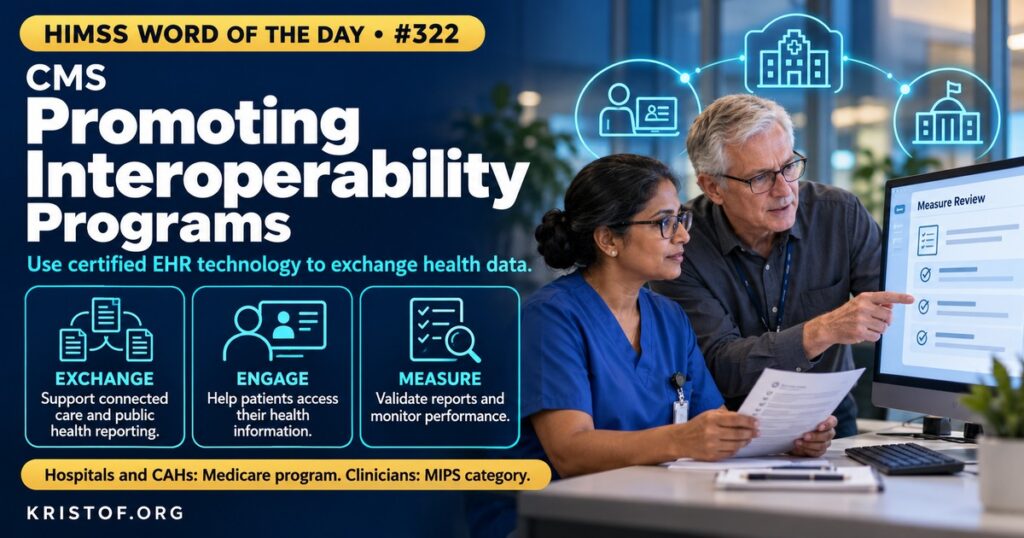
The CMS Promoting Interoperability Programs are the federal quality programs that grew out of the Medicare and Medicaid EHR Incentive Programs, better known as meaningful use. The HIMSS Dictionary describes them as programs that paid Medicare incentives to eligible clinicians, hospitals, and critical access hospitals (CAHs) for adopting, implementing, upgrading, or showing meaningful use of certified EHR technology, and that adjusted payments for those who did not meet the criteria. That wording describes the program’s earlier design. The CMS website now describes the Medicare Promoting Interoperability Program as a quality program whose goal is better quality, safety, and efficiency of care through interoperability and the exchange of health care data using certified EHR technology (CEHRT).
CMS explains the history this way. The programs were established in 2011 as required by the HITECH Act, itself part of the American Recovery and Reinvestment Act of 2009, and they encouraged eligible hospitals, CAHs, and professionals to adopt and meaningfully use CEHRT. The Medicare Access and CHIP Reauthorization Act (MACRA) ended the Medicare EHR Incentive Program for eligible professionals and folded similar requirements into the Merit-based Incentive Payment System (MIPS) as the Promoting Interoperability performance category. The Medicare program for eligible hospitals and CAHs continues, and CMS states that the Medicaid Promoting Interoperability Program ended on December 31, 2021.
Hospitals and CAHs in the Medicare program submit measure data, including electronic clinical quality measures (eCQMs), answer attestations, and earn a minimum total score under timelines that CMS sets for each reporting period. CMS directs participants to its rulemaking for official requirements, which change from year to year.
| Program | Who Participates | Where Requirements Live |
|---|---|---|
| Medicare Promoting Interoperability Program | Eligible hospitals and critical access hospitals | CMS hospital payment rules, QualityNet |
| MIPS Promoting Interoperability category | MIPS eligible clinicians | Quality Payment Program rules |
| Medicaid Promoting Interoperability Program | Ended December 31, 2021 | Historical |
| Original EHR Incentive Programs (meaningful use) | Hospitals and professionals, from 2011 | Historical |
⚠️ Exam Alert: Meaningful use was the original name of the EHR incentive programs; Promoting Interoperability is the later name. The Medicare program applies to hospitals and CAHs; clinicians report through the MIPS category. CEHRT is ONC-certified EHR technology. The HITECH Act created the original program.
🌐 Why It Matters: Real-World Healthcare IT Context
The programs shape what hospitals and clinics build, because measures and reporting requirements become IT projects. Two examples show how.
Public health reporting is one. Data briefs from the Office of the National Coordinator for Health IT, based on American Hospital Association survey data, describe a requirement that began in 2022. Beginning in January 2022, eligible hospitals and CAHs in the Medicare Promoting Interoperability Program were required to submit data electronically to public health agencies for syndromic surveillance, immunization registries, electronic laboratory results, and electronic case reporting. Before that, hospitals reported three or fewer measures of their choice. Beginning in January 2024, hospitals were also required to report antimicrobial use and resistance data, while public health and clinical data registry reporting earned bonus points. The 2024 data brief uses a national survey of non-federal acute care hospitals to describe their engagement and the challenges they face in submitting this information. The abstracts describe the requirements and the purpose of the analysis, so readers should consult the full briefs for the measured rates. The takeaway for informatics teams is that reporting interfaces, such as those described in the post on NEDSS, became a compliance item, not an option.
Patient access is another. A 2026 analysis in Advances in Health Information Science and Practice examined American Hospital Association survey data from 2012 to 2024 to see how hospital patient portal features changed alongside federal policies such as Meaningful Use, Promoting Interoperability, and the 21st Century Cures Act. By 2024, 92 percent of hospitals offered both viewing and downloading of health information. Secure messaging rose from 28.2 percent of hospitals in 2012 to 88.7 percent in 2024, and patient-generated data submission rose from 8.4 percent to 67.7 percent. Bill payment rose from 45.9 percent in 2012 to 87.0 percent in 2020. In contrast, amending information and importing outside records showed no significant monotonic trend. The authors described the progress as broadly paralleling federal policy developments and called for continued policy support, technical assistance, and equity-focused strategies, because uptake of advanced features was uneven. The study is descriptive and cannot prove that the programs caused the changes, since other policies and market forces also acted during that period.
These examples show how program rules turn into daily work. Each measure needs clean source data, a defined workflow, and a report. Organizations assign owners for each measure, test their reports against chart review, and monitor performance during the reporting period, not only at the end. Since the rules change through annual rulemaking, hospitals track proposed and final rules, plan IT changes ahead of time, and confirm that their certified technology supports each measure. For clinicians, the MIPS Promoting Interoperability category adds expectations for how they use CEHRT, which clinic managers and informatics staff support with training and reporting.
Common Promoting Interoperability problems:
- Measures that depend on fields clinicians do not use consistently
- Reporting interfaces with public health that break after upgrades
- Late discovery of low scores near the end of the reporting period
- No owner for each measure
- Confusion between the hospital program and the clinician category
- Treating the program as a yearly project instead of ongoing work
What supports success in the programs:
- Named owners and monitoring for each measure
- Validated reports built from certified technology
- Tested, monitored public health reporting interfaces
- Tracking of annual rulemaking
- Workflow design that captures data at the point of care
- Coordination among quality, compliance, and IT teams
🏥 The Nurse’s Perspective: Clinical, Bedside, & Workflow
Many Promoting Interoperability measures depend on data that nurses document and workflows that nurses perform.
At the Bedside
Many program measures draw on information that nurses document, such as allergies, vital signs, and patient education, although the exact measures change over time. Consistent use of the structured fields, rather than free text, determines whether the data can be counted. Nurses also help patients use portals, for example by explaining how to read results and send a message.
In Clinical Workflow
Nurse managers review measure performance for their units, spot documentation patterns that lower scores, and coach staff. Quality nurses help reconcile eCQM reports with chart review.
Nurse informaticists design workflows that capture required data without extra clicks, help build and validate reports, and represent nursing in discussions about measure changes. They also advise on training for portal use and secure messaging.
In EHR Implementation (Go-Live Perspective)
An Epic Go-Live sets the fields and workflows from which program measures will be calculated. At-the-elbow support analysts see when staff use a field differently from the intended design, which would later affect a report. Passing that finding to quality and build teams early prevents low scores that reflect workflow gaps, not care quality.
🎓 CAHIMS / CPHIMS & HIMSS Perspective
CAHIMS Exam Domain Mapping
The programs appear in policy, quality reporting, and certification questions:
| CAHIMS Domain | How the Programs Appear |
|---|---|
| Healthcare & Technology Environments | CMS programs, HITECH, MACRA, certification |
| Clinical Informatics | Quality measures, documentation, patient engagement |
| Healthcare Information & Systems Management | CEHRT, reporting interfaces, measure calculation |
| Management & Leadership | Compliance, performance monitoring, rulemaking tracking |
Key Terms to Know Alongside Promoting Interoperability
- Meaningful Use — original name of the EHR incentive requirements
- Certified EHR Technology (CEHRT) — EHR software certified under the ONC program
- MIPS — Merit-based Incentive Payment System for eligible clinicians
- Critical Access Hospital (CAH) — small rural hospital with special Medicare status
- eCQM — electronic clinical quality measure calculated from EHR data
- Attestation — formal statement that requirements were met
HIMSS Organizational Position
HIMSS supports policy that advances interoperability and effective use of health information technology through its public policy work, research, and education. Members can find related resources through the HIMSS Resource Center.
🔗 Explore Further: External References
- CMS — Promoting Interoperability Program https://www.cms.gov/medicare/regulations-guidance/promoting-interoperability-programs
- QPP — Promoting Interoperability: Traditional MIPS Requirements https://qpp.cms.gov/reporting-requirements/ways-to-report/traditional-mips/promoting-interoperability
- Owusu-Mensah and Richwine, ONC Data Brief — Electronic Public Health Reporting Among Non-Federal Acute Care Hospitals, 2024 https://pubmed.ncbi.nlm.nih.gov/40663643/
- Richwine, ONC Data Brief — Progress and Ongoing Challenges to Electronic Public Health Reporting Among Non-Federal Acute Care Hospitals https://pubmed.ncbi.nlm.nih.gov/39475518/
- Houser and Lyu (2026), Advances in Health Information Science and Practice — Impact of Health Care Policies on Patient Portal Adoption and Engagement in US Hospitals: Trends From 2012 to 2024 https://pubmed.ncbi.nlm.nih.gov/42500356/
Term source: HIMSS Dictionary of Health Information and Technology Terms, Acronyms, and Organizations, 6th Edition (2025). All definitions in this series are paraphrased for editorial purposes. Readers are encouraged to consult the primary source for exact language.
Eric Andrew Kristof, RN, CAHIMS is a Healthcare IT professional and HIMSS Arkansas Chapter member based in Hot Springs Village, AR, with hands-on Epic Go-Live experience and a diverse healthcare and IT background. He writes at kristof.org at the intersection of clinical care and healthcare technology.
Leave a Reply