By Eric Andrew Kristof, RN, CAHIMS | Healthcare IT Professional | HIMSS Arkansas Chapter Member
About This Series: The HIMSS Word of the Day is a running blog series drawing from the HIMSS Dictionary of Health Information and Technology Terms, Acronyms, and Organizations, 6th Edition (2025) — the authoritative reference for healthcare IT professionals and the primary study resource for CAHIMS and CPHIMS certification. Each post paraphrases the term in plain language, grounds it in real-world healthcare IT context, and adds a bedside nursing perspective you won’t find in a textbook.
📖 The Term: Archetype
Source: HIMSS Dictionary of Health Information and Technology Terms, Acronyms, and Organizations, 6th Edition (2025)
🔍 Plain-Language Definition
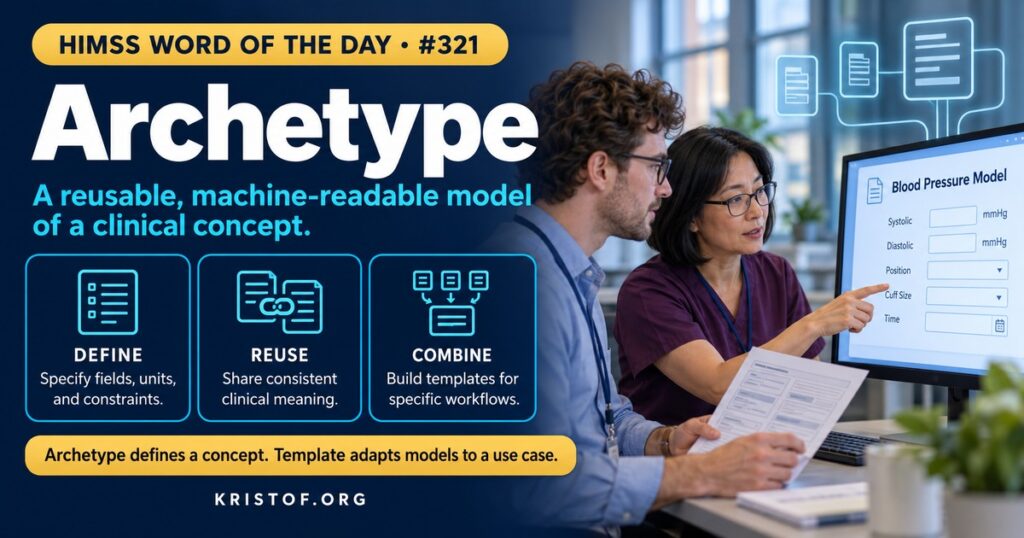
In health informatics, an archetype is a model of a clinical concept that a computer can read. The HIMSS Dictionary gives two related meanings: a labeled specification of a type of content, with its attributes spelled out, and a reusable pattern for capturing clinical information, meaning a specification a machine can read that describes how patient data should be stored. A blood pressure archetype, for example, might define fields for systolic and diastolic values, the position of the patient, the cuff size, and the time of the reading, along with the allowed ranges and units for each.
The best-known use is in openEHR, an open specification for EHR platforms. According to the openEHR specifications site, openEHR is completely model-driven and separates domain meaning from software by placing it in models created by domain professionals. Its specifications include information models for health data, a portable query language called AQL (Archetype Query Language), and the archetype formalism, which the site notes was adopted in ISO 13606-2:2019. The practical idea is that clinicians and informaticists build and review the clinical models, and software reads them, so a change in clinical content does not require rewriting the system.
Archetypes are building blocks. A template combines and constrains archetypes for a specific purpose, such as an admission assessment or a registry form, by choosing which fields to use and which to hide. Terminology bindings connect archetype elements to standard codes such as LOINC or SNOMED CT.
| Element | Role | Example |
|---|---|---|
| Reference model | Defines basic data structures | Observation, evaluation, instruction |
| Archetype | Defines a reusable clinical concept | Blood pressure, medication order |
| Template | Combines archetypes for a use case | Ambulatory monitoring form |
| Terminology binding | Links elements to codes | Systolic pressure mapped to a LOINC code |
| AQL query | Retrieves data using archetype paths | Find patients with a high reading |
⚠️ Exam Alert: An archetype is a model of a clinical concept; a template combines and constrains archetypes for a use case. openEHR separates clinical models from software. Archetypes support semantic interoperability because the same concept is defined the same way across systems. They are not terminologies, although they can be bound to terminologies.
🌐 Why It Matters: Real-World Healthcare IT Context
The case for archetypes is reuse. If hospitals model blood pressure once, agree on it, and share the model, then registries, decision support, and exchange can all rely on the same structure. Case studies show how that plays out, and where it gets hard.
A 2018 study in BMC Medical Informatics and Decision Making proposed an openEHR-based approach to registries and tested it by building a coronary CT angiography registry able to interoperate with an existing EHR. The registry had 183 data elements involving 20 archetypes. Of 45 registry elements that overlapped semantically with EHR elements, 38 (84 percent) could be found in 10 reused EHR archetypes, so the data could be collected from the EHR directly without transformation. The other seven (16 percent) corresponded to one coarse-grained EHR element and needed mapping rules. The authors identified challenges for wider use: the involvement of domain experts, sharing and reuse of archetypes, and mapping between archetypes. It is a single case study, but it shows the payoff when registry and EHR share models.
A second 2018 study in Artificial Intelligence in Medicine used archetypes for decision support. The authors built a system for automatic detection of systemic inflammatory response syndrome (SIRS) in pediatric intensive care using openEHR archetypes, terminology bindings including LOINC, and AQL queries against a repository at Hannover Medical School. In a first pilot on 16 patients with 129 days of stay, the system’s results compared with clinical experts’ assessments had sensitivity of 1.00, specificity of 0.94, and a Cohen’s kappa of 0.92. The authors described it as the first openEHR-based decision support system shown to work in a real context. The sample was small, so the statistics are early, but the design allows the same logic to move to another institution that uses the same archetypes.
More recent work shows the modeling effort required. A 2026 implementation case study in Studies in Health Technology and Informatics translated an existing ambulatory blood pressure monitoring module in a university hospital into an openEHR template and prototype. The resulting template represented repeated blood pressure observations, interval-based summaries, encounter context, pulse-related parameters, and interpretation in one structure. The authors found that representing this module required a constrained combination of several archetypes, not the blood pressure archetype alone, and that low-code prototyping was a useful early check of template quality. This is a reminder that real clinical work rarely maps to one model.
Another 2024 case study in JMIR Medical Informatics standardized corneal transplantation records with openEHR in a Portuguese hospital. The team modeled archetypes, templates, forms, decision rules, and work plans with clinicians, then deployed forms, decision logic modules, and work plans. Over the period from May 1, 2022, to March 31, 2023, the completion rate of the recorded process was 63.9 percent (530 of 830), which the authors attributed to external factors such as patient health and organ availability, and they reported improved task control and follow-up. The study is a descriptive implementation report without a comparison group.
From these cases, the lessons are consistent. Archetype modeling is a clinical activity as much as a technical one, because domain experts must agree on what a concept means. Shared repositories, such as the openEHR Clinical Knowledge Manager where reviewed archetypes are published, help avoid duplicate models, but teams still need governance for versions, local constraints, and terminology binding. Archetypes are not the only approach to clinical models, since HL7 FHIR resources and profiles serve a similar function in other ecosystems, but the underlying question is the same: how do we define clinical data once so it can be reused reliably?
Common archetype-related problems:
- Creating new models when suitable ones exist
- Disagreement among clinicians on the meaning of a concept
- Templates that hide needed fields or expose too many
- Weak terminology binding
- No governance for versions and local changes
- Treating the modeling work as purely technical
What supports effective use of archetypes:
- Clinician involvement in modeling and review
- Reuse of shared, reviewed models before creating new ones
- Templates designed around real workflows
- Terminology bindings to standard codes
- Prototype testing with real data
- Governance for versions and local constraints
🏥 The Nurse’s Perspective: Clinical, Bedside, & Workflow
Nurses supply the clinical meaning that good archetypes depend on, because many core models describe assessments, observations, and care plans.
At the Bedside
Fields on a nursing flowsheet or admission assessment often come from a clinical model. When a nurse records a pain score, a skin finding, or a blood pressure, the structure behind that entry determines whether the value can be compared, trended, and shared later. Nurses notice when a form lacks a field they need or forces a choice that does not fit.
In Clinical Workflow
Nurse managers and educators help review models for assessments and care plans, ensuring that the wording and options reflect practice. Their feedback prevents forms that look tidy but cannot capture what really happens on the unit.
Nurse informaticists take part in modeling sessions, review proposed models against workflow, check terminology bindings, and test templates with bedside staff before release.
In EHR Implementation (Go-Live Perspective)
An Epic Go-Live builds flowsheet rows, assessments, and documentation templates that act much like clinical models. At-the-elbow support analysts hear when a field means different things to different units, and bring those examples back to build teams so definitions can be aligned.
🎓 CAHIMS / CPHIMS & HIMSS Perspective
CAHIMS Exam Domain Mapping
Archetypes appear in standards, data modeling, and interoperability questions:
| CAHIMS Domain | How Archetypes Appear |
|---|---|
| Healthcare & Technology Environments | Standards organizations, ISO and open specifications |
| Clinical Informatics | Clinical content models, semantic meaning, documentation |
| Healthcare Information & Systems Management | Data modeling, templates, queries, terminology binding |
| Management & Leadership | Governance of content, reuse, vendor neutrality |
Key Terms to Know Alongside Archetype
- openEHR — open specification for model-driven EHR platforms
- Template — constrained combination of archetypes for a specific use
- Clinical Information Model — formal description of how a clinical concept is represented
- Semantic Interoperability — exchange of data with shared meaning
- Terminology Binding — link between a model element and a standard code
- Archetype Query Language (AQL) — query language for data structured by archetypes
HIMSS Organizational Position
HIMSS supports standards-based, interoperable health information through its research, education, and community work. Members can find related resources through the HIMSS Resource Center.
🔗 Explore Further: External References
- openEHR — Specifications https://specifications.openehr.org/
- openEHR — Clinical Knowledge Manager https://ckm.openehr.org/ckm/
- Min et al. (2018), BMC Medical Informatics and Decision Making — An openEHR Based Approach to Improve the Semantic Interoperability of Clinical Data Registry https://pubmed.ncbi.nlm.nih.gov/29589572/
- Wulff et al. (2018), Artificial Intelligence in Medicine — An Interoperable Clinical Decision-Support System for Early Detection of SIRS in Pediatric Intensive Care Using openEHR https://pubmed.ncbi.nlm.nih.gov/29753616/
- Bürki and Sariyar (2026), Studies in Health Technology and Informatics — Modeling Blood Pressure Monitoring in openEHR: An Implementation Case Study https://pubmed.ncbi.nlm.nih.gov/42394079/
- Ferreira et al. (2024), JMIR Medical Informatics — Standardizing Corneal Transplantation Records Using openEHR: Case Study https://pubmed.ncbi.nlm.nih.gov/39284177/
Term source: HIMSS Dictionary of Health Information and Technology Terms, Acronyms, and Organizations, 6th Edition (2025). All definitions in this series are paraphrased for editorial purposes. Readers are encouraged to consult the primary source for exact language.
Eric Andrew Kristof, RN, CAHIMS is a Healthcare IT professional and HIMSS Arkansas Chapter member based in Hot Springs Village, AR, with hands-on Epic Go-Live experience and a diverse healthcare and IT background. He writes at kristof.org at the intersection of clinical care and healthcare technology.
Leave a Reply