By Eric Andrew Kristof, RN, CAHIMS | Healthcare IT Professional | HIMSS Arkansas Chapter Member
About This Series: The HIMSS Word of the Day is a running blog series drawing from the HIMSS Dictionary of Health Information and Technology Terms, Acronyms, and Organizations, 6th Edition (2025) — the authoritative reference for healthcare IT professionals and the primary study resource for CAHIMS and CPHIMS certification. Each post paraphrases the term in plain language, grounds it in real-world healthcare IT context, and adds a bedside nursing perspective you won’t find in a textbook.
📖 The Term: EMPI (Enterprise Master Patient Index)
Source: HIMSS Dictionary of Health Information and Technology Terms, Acronyms, and Organizations, 6th Edition (2025)
🔍 Plain-Language Definition
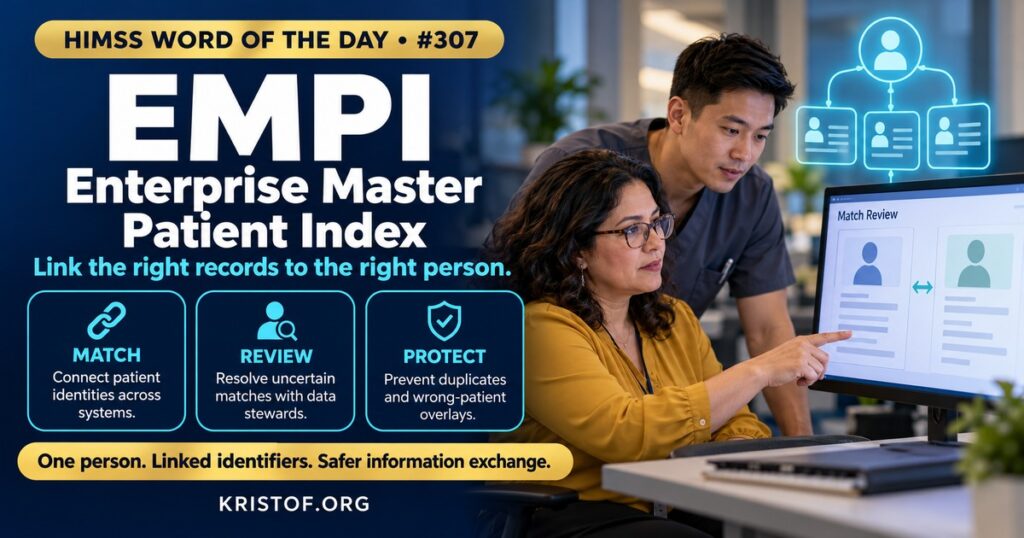
An enterprise master patient index (EMPI) is a system that keeps consistent, accurate identity information for each patient registered by a health care organization. The HIMSS Dictionary notes that an EMPI may tie together several smaller patient indexes, such as those of outpatient clinics and rehabilitation facilities, and may pull together patient data from distinct systems inside a single facility. In effect, it assigns each person an enterprise identifier and links all the local identifiers (medical record numbers) that belong to that person.
The central task is patient matching: deciding whether two records describe the same person. Errors go in two directions. A duplicate is two or more records for one patient that were not linked, which splits the patient’s history and can hide allergies, medications, and results. An overlay (or false match) is two different patients merged into one record, which can place one person’s information in another’s chart. Duplicates are a nuisance and a safety risk; overlays are often the more dangerous.
Methods differ. Deterministic matching requires exact agreement on defined fields. Probabilistic matching assigns weights to agreement and disagreement across fields and sets a threshold. Referential matching compares records with an external reference dataset of identities, in order to resolve variations in names, addresses, and other data. Many systems combine methods and send uncertain pairs to a person for review, sometimes called a work queue or data steward queue.
| Method | How It Works | Strength | Weakness |
|---|---|---|---|
| Deterministic | Exact match on rules | Fast and transparent | Misses variations and typos |
| Probabilistic | Weighted scores and thresholds | Handles variation | Needs tuning to the local data |
| Referential | Compares to external reference data | Strong with messy demographics | Depends on reference quality |
| Machine learning | Learned from labeled pairs | Can reach high accuracy | Needs labeled data and compute |
⚠️ Exam Alert: An EMPI links identities; a registry organizes records of one entity type; a data warehouse integrates many data types. A false positive match creates an overlay; a false negative leaves a duplicate. Sensitivity measures found true matches; positive predictive value measures how many declared matches are correct.
🌐 Why It Matters: Real-World Healthcare IT Context
Reliable patient identity is the foundation for safe exchange. If a clinician requests outside records and the other system cannot find the patient, the clinician sees nothing. If it returns the wrong person’s data, the results can be harmful. Evidence on how well different approaches perform is surprisingly limited, so real-world evaluations matter.
A 2022 study in JAMIA evaluated referential and probabilistic matching algorithms against a manually reviewed gold standard of 30,000 records taken from a large health information exchange with more than 47 million patient registrations. The probabilistic algorithm showed sensitivity of 0.6366, positive predictive value of 0.9995, and F-score of 0.7778; the referential algorithm showed sensitivity of 0.9351, positive predictive value of 0.9996, and F-score of 0.9663. Treating discordant and limited-data records as nonmatches raised referential sensitivity to 0.9578. In other words, both methods were very precise, but the probabilistic algorithm missed many true matches that the referential one found. The authors noted that probabilistic matching usually needs adaptation to local data, which was not done here, and recommended that policymakers expand the evidence base on real-world matching performance. The data come from one exchange.
Research settings face a related problem when they link de-identified records. A 2026 study in JMIR Medical Informatics compared deterministic, probabilistic, and machine learning linkage for 2,247 patients with multiple sclerosis in records from two Saudi sources. In simulation, deterministic linkage achieved an average F1 score of 97.2 percent and probabilistic linkage 93.9 percent; in real-world linkage, match rates varied widely, from 46.6 to 86.6 percent for the deterministic rules and from 65.5 to 95.4 percent for the probabilistic rules. Machine learning methods achieved F1 scores up to 99.8 percent but needed far more computing time. The study shows that the same method can behave very differently depending on which fields are used and how complete they are.
Fragmentation raises the stakes. A 2026 rapid review in the Journal of Medical Internet Research described digital health fragmentation, the dispersal of patient data across multiple systems with difficulty obtaining complete information at the point of care, as a challenge for antimicrobial prescribing in the United Kingdom. Although the setting differs, it illustrates that where data are dispersed, reliable identity linking becomes a prerequisite for safe decisions.
Good EMPI management is partly technology and partly process. Registration staff capture demographics carefully and consistently, verify identity with documents when possible, and avoid shortcuts such as default names or dates for unidentified patients. Data stewards review and resolve potential duplicates and potential overlays promptly, and track rates over time. Organizations define who may merge or unmerge records and keep audit trails, because mistakes must be reversible. When exchanging with outside organizations, they test matching with partners, review false match reports, and agree on which demographic fields are sent. Policies handle special cases: newborns, patients without identification, name changes, and patients who require privacy protections.
Common EMPI problems:
- Inconsistent or incomplete demographics at registration
- Temporary names for unidentified patients that never get reconciled
- Duplicate records that split histories
- Overlays that mix two patients’ information
- Thresholds that are never tuned to local data
- Exchange partners using different matching rules
What supports accurate patient identity:
- Careful, standardized registration practices
- A data steward team with clear workflows and metrics
- Matching methods validated on local data
- Audit trails and reversible merges
- Testing of matching with exchange partners
- Special-case policies for newborns and unidentified patients
🏥 The Nurse’s Perspective: Clinical, Bedside, & Workflow
Nurses and registration staff are the first line of identity accuracy.
At the Bedside
Nurses confirm identity with two identifiers before medications, specimens, and procedures. When a wristband or chart looks wrong, such as a different date of birth or a result that does not fit the patient, they stop and report a possible record error immediately, because it may reflect a duplicate or overlay.
In Clinical Workflow
In emergency departments and clinics, nurses often see patients who arrive unidentified or with variations in names. Managers set clear rules for temporary registration, and make sure that records are reconciled once identity is known. Care managers who rely on outside records watch for missing or mismatched information.
Nurse informaticists work with health information management on duplicate and overlay reports, help set registration standards, and test how outside records display, particularly when the match is uncertain.
In EHR Implementation (Go-Live Perspective)
An Epic Go-Live that merges patient indexes or imports legacy records can create many new duplicates and mismatches. At-the-elbow support analysts hear about wrong-patient or missing-history reports and escalate them quickly, because early cleanup is easier than finding problems later.
🎓 CAHIMS / CPHIMS & HIMSS Perspective
CAHIMS Exam Domain Mapping
The EMPI appears in data management, exchange, and safety questions:
| CAHIMS Domain | How the EMPI Appears |
|---|---|
| Healthcare & Technology Environments | Patient identification policy, exchange networks, privacy |
| Clinical Informatics | Patient safety, record integrity, workflow at registration |
| Healthcare Information & Systems Management | Matching algorithms, interfaces, data stewardship |
| Management & Leadership | Governance, data quality metrics, exchange agreements |
Key Terms to Know Alongside EMPI
- Master Patient Index (MPI) — index of patients within one organization or system
- Duplicate Record — more than one record for the same patient
- Overlay — two patients’ information combined in one record
- Referential Matching — matching using an external reference dataset of identities
- Deterministic Matching — matching based on exact agreement of defined fields
- Probabilistic Matching — matching based on weighted scores across fields
HIMSS Organizational Position
HIMSS supports accurate patient identification and interoperability through its public policy work, research, and education. Members can find related resources through the HIMSS Resource Center.
🔗 Explore Further: External References
- Grannis et al. (2022), Journal of the American Medical Informatics Association — Evaluation of Real-World Referential and Probabilistic Patient Matching to Advance Patient Identification Strategy https://pubmed.ncbi.nlm.nih.gov/35568993/
- Almadani et al. (2026), JMIR Medical Informatics — Linking Electronic Health Records for Multiple Sclerosis Research: Comparative Study of Deterministic, Probabilistic, and Machine Learning Linkage Methods https://pubmed.ncbi.nlm.nih.gov/41637753/
- Waruhari et al. (2017), Studies in Health Technology and Informatics — A Review of Current Patient Matching Techniques https://pubmed.ncbi.nlm.nih.gov/28679924/
- Schneider et al. (2026), Journal of Medical Internet Research — Extent of Digital Health Fragmentation and Potential Implications for Antimicrobial Prescribing: Rapid Evidence Review https://pubmed.ncbi.nlm.nih.gov/42837652/
- HealthIT.gov — Health IT Playbook https://playbook.healthit.gov/
Term source: HIMSS Dictionary of Health Information and Technology Terms, Acronyms, and Organizations, 6th Edition (2025). All definitions in this series are paraphrased for editorial purposes. Readers are encouraged to consult the primary source for exact language.
Eric Andrew Kristof, RN, CAHIMS is a Healthcare IT professional and HIMSS Arkansas Chapter member based in Hot Springs Village, AR, with hands-on Epic Go-Live experience and a diverse healthcare and IT background. He writes at kristof.org at the intersection of clinical care and healthcare technology.
Leave a Reply