By Eric Andrew Kristof, RN, CAHIMS | Healthcare IT Professional | HIMSS Arkansas Chapter Member
About This Series: The HIMSS Word of the Day is a running blog series drawing from the HIMSS Dictionary of Health Information and Technology Terms, Acronyms, and Organizations, 6th Edition (2025) — the authoritative reference for healthcare IT professionals and the primary study resource for CAHIMS and CPHIMS certification. Each post paraphrases the term in plain language, grounds it in real-world healthcare IT context, and adds a bedside nursing perspective you won’t find in a textbook.
📖 The Term: AE (Adverse Event/Adverse Experience)
Source: HIMSS Dictionary of Health Information and Technology Terms, Acronyms, and Organizations, 6th Edition (2025)
🔍 Plain-Language Definition
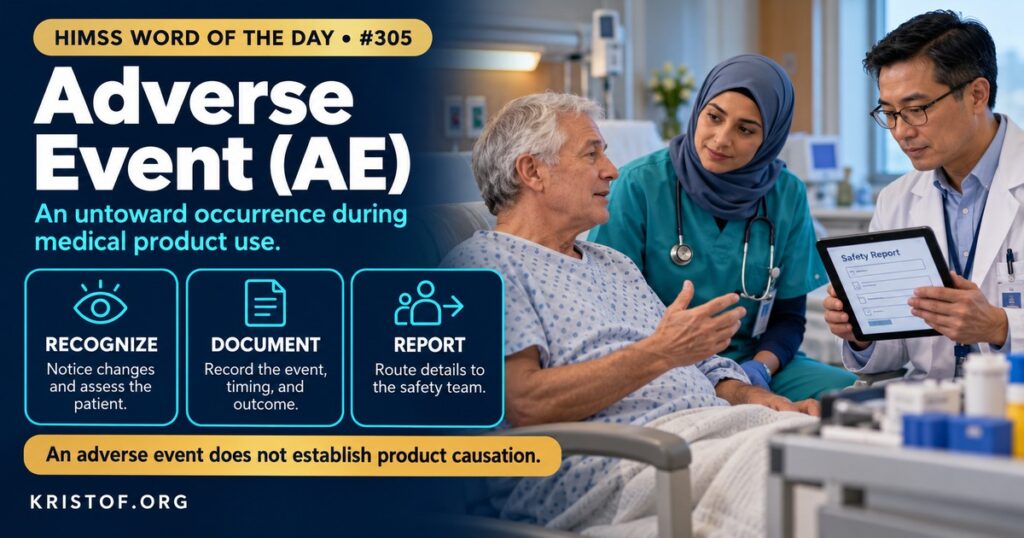
In drug and medical product safety, an adverse event (AE), also called an adverse experience, is any untoward medical occurrence in a person who has used a drug or other medical product, whether or not the product is considered the cause. The HIMSS Dictionary gives slightly different versions for the pre-marketing setting, the United States postmarketing setting, and the European Union, and the US postmarketing version includes events from overdose, withdrawal, and failure of expected pharmacologic action. The key idea is that an AE records something that happened, not a conclusion about why.
The FDA’s regulation for investigational drugs, 21 CFR 312.32, uses the same logic and adds related terms. An adverse event is any untoward medical occurrence tied to the use of a drug in people, regardless of whether it is judged to be drug related. A suspected adverse reaction is an adverse event for which there is a reasonable possibility that the drug caused it, meaning evidence suggests a causal relationship. A serious event is one that, in the view of the investigator or sponsor, results in death, a life-threatening event, inpatient hospitalization or prolonged hospitalization, persistent or significant incapacity, or a congenital anomaly or birth defect, and important medical events can also qualify. An unexpected event is one not listed in the investigator brochure at the observed specificity or severity.
These distinctions drive reporting deadlines. Under 312.32(c), a sponsor must notify the FDA and investigators of potential serious risks in an IND safety report as soon as possible and no later than 15 calendar days after determining that the information qualifies, and must report an unexpected fatal or life-threatening suspected adverse reaction no later than 7 calendar days after initial receipt. After approval, 21 CFR 314.80 requires applicants to submit 15-day “Alert reports” for each serious and unexpected adverse drug experience, and periodic reports quarterly for three years after approval and annually after that.
| Term | Meaning | Causality Required? |
|---|---|---|
| Adverse event (AE) | Any untoward occurrence during product use | No |
| Adverse reaction | Adverse event caused by the drug | Yes |
| Suspected adverse reaction | AE with reasonable possibility of drug cause | Possible |
| Serious AE | AE with death, hospitalization, disability, or similar outcome | No |
| Unexpected AE | Not described in the product’s reference information | No |
⚠️ Exam Alert: An AE is any untoward event, without proof of drug causation; an adverse reaction implies causation. Serious refers to the outcome, not the severity of symptoms. Unexpected refers to whether it is described in product information. In hospital quality work, the same words often mean harm from care, a broader and different use.
🌐 Why It Matters: Real-World Healthcare IT Context
Drug approval studies include limited numbers of patients for limited periods, so safety monitoring continues after a product reaches the market. The FDA’s MedWatch program collects reports from health professionals and consumers, and manufacturers must submit reports under the regulations above. The system works only if events are noticed, recognized as possibly related to a product, and reported.
Underreporting is a well-known weakness of spontaneous reporting. A 2026 study in Drug Safety evaluated a method of proactively searching electronic health records for adverse drug reactions. Between August 2022 and August 2025, researchers used a text-mining tool to run targeted searches across about 2,750,000 health records from two Dutch hospitals, with search criteria derived from existing spontaneous reports of specific drug-event associations. After manual verification, they reported 147 cases to the Netherlands Pharmacovigilance Centre Lareb, covering 41 drug-event associations. These cases contributed to 34 signal detection analyses and supported the assessment of seven safety signals. In 75 percent of cases, clinicians had documented a suspected causal relationship in notes, and EHR-derived cases accounted for up to 73 percent of the reports in the seven signals. The authors concluded that health records can be an additional source of case reports, though the approach had limits in efficiency.
Automated language analysis is also being tested. A 2026 study in the Journal of Medical Internet Research evaluated natural language processing models for identifying adverse drug events characterized by medication replacement in primary care records from Manitoba. Of 1,085 annotated encounter notes, 355 included an event. Models trained on notes reformatted into the SOAP structure generally outperformed those trained on the original notes, and the best model reached a mean F1 score of 72.5 percent. Extracting the specific words and the drug-event relationships was harder, with a mean relaxed F1 of 0.455. The results show that automated detection is possible but not yet ready to replace human review, and the authors noted room for improvement as models evolve.
A 2026 narrative review in the American Journal of Cardiovascular Drugs reached a similar conclusion for cardiology: machine learning on FAERS, VigiBase, and EHR data improved discrimination for outcomes such as bleeding on direct oral anticoagulants, acute kidney injury in heart failure, and QT prolongation, mostly in internal validation, while challenges remain. Taken together, these studies suggest that health records can complement spontaneous reports but require validation.
Informatics teams support AE work in practical ways. They design documentation so that a possible reaction is recorded in a structured field, not buried in a note, and so that allergy and intolerance lists distinguish allergy, intolerance, and side effect. They build reporting workflows that let clinicians send information to the pharmacy, the safety team, or MedWatch with few clicks, and they connect clinical trial systems with the EHR so that events in research participants are captured and routed to sponsors on time. They also ensure that safety reports contain accurate dates, product identifiers, and outcomes, since weak data limit signal detection.
Common AE reporting problems:
- Reactions documented in free text and never reported
- Confusion between allergy, intolerance, and side effect
- Clinicians unsure what to report or where
- Research events not communicated to sponsors on time
- Reports missing product identifiers or dates
- Automated tools used without validation
What supports reliable AE reporting:
- Structured documentation of reactions and outcomes
- Simple reporting links within the EHR
- Clear internal policy on what and when to report
- Trial and EHR integration for research events
- Periodic review of reports by a safety committee
- Validated text-mining and NLP to find missed events
🏥 The Nurse’s Perspective: Clinical, Bedside, & Workflow
Nurses are often the first to see a reaction and are central to getting it reported.
At the Bedside
After giving a medication, nurses monitor for rash, breathing changes, vital sign shifts, confusion, and other unexpected effects. They stop the infusion or hold the next dose when protocol requires, notify the prescriber, and document what happened, when, what was done, and the patient’s response.
In Clinical Workflow
Unit nurses report events through the organization’s safety system and, where applicable, to MedWatch or the research team. Nurses on clinical trials follow the protocol’s definitions and deadlines for serious events. Nurse managers review reports to look for patterns, such as the same reaction on the same drug in several patients.
Nurse informaticists build and refine reaction documentation, allergy lists, and reporting tools, check that the information flows to pharmacy and safety committees, and work on surveillance reports based on record data.
In EHR Implementation (Go-Live Perspective)
An Epic Go-Live changes where reactions are recorded and how reports are launched. At-the-elbow support analysts hear when nurses cannot find the reaction field or do not know how to report, and those questions guide build changes and quick reference guides.
🎓 CAHIMS / CPHIMS & HIMSS Perspective
CAHIMS Exam Domain Mapping
Adverse events appear in safety, regulation, and data questions:
| CAHIMS Domain | How Adverse Events Appear |
|---|---|
| Healthcare & Technology Environments | FDA regulation, pharmacovigilance, research oversight |
| Clinical Informatics | Reaction documentation, decision support, surveillance |
| Healthcare Information & Systems Management | Safety databases, text mining, EHR-to-trial integration |
| Management & Leadership | Safety governance, reporting policy, quality improvement |
Key Terms to Know Alongside AE
- Pharmacovigilance — science of detecting, assessing, and preventing adverse effects of drugs
- MedWatch — FDA program for reporting safety problems with medical products
- Serious Adverse Event — event with death, life-threatening risk, hospitalization, disability, or birth defect
- Suspected Adverse Reaction — adverse event with a reasonable possibility of drug causation
- Signal Detection — analysis that identifies a possible new safety problem from reports or data
- Spontaneous Reporting — voluntary submission of reports by clinicians, patients, or manufacturers
HIMSS Organizational Position
HIMSS supports medication safety and the use of health information technology to improve patient safety through its research, education, and community work. Members can find related resources through the HIMSS Resource Center.
🔗 Explore Further: External References
- eCFR — 21 CFR 312.32, IND Safety Reporting https://www.ecfr.gov/current/title-21/chapter-I/subchapter-D/part-312/subpart-B/section-312.32
- eCFR — 21 CFR 314.80, Postmarketing Reporting of Adverse Drug Experiences https://www.ecfr.gov/current/title-21/chapter-I/subchapter-D/part-314/subpart-B/section-314.80
- von Kreijfelt et al. (2026), Drug Safety — Strengthening Signal Detection by Proactive Adverse Event Case Identification in Electronic Health Records Using a Text-Mining Tool https://pubmed.ncbi.nlm.nih.gov/42900349/
- Katz et al. (2026), Journal of Medical Internet Research — Using Natural Language Processing to Identify Adverse Drug Events Characterized by Medication Replacement in Primary Care Electronic Medical Records: Algorithm and Validation Study https://pubmed.ncbi.nlm.nih.gov/42574465/
- Shahabinejad et al. (2026), American Journal of Cardiovascular Drugs — Using Artificial Intelligence to Identify Patterns and Predictors of Adverse Drug Reactions in Cardiovascular Patients: A Comprehensive Narrative Review https://pubmed.ncbi.nlm.nih.gov/42461503/
- FDA — MedWatch: The FDA Safety Information and Adverse Event Reporting Program https://www.fda.gov/safety/medwatch-fda-safety-information-and-adverse-event-reporting-program
Term source: HIMSS Dictionary of Health Information and Technology Terms, Acronyms, and Organizations, 6th Edition (2025). All definitions in this series are paraphrased for editorial purposes. Readers are encouraged to consult the primary source for exact language.
Eric Andrew Kristof, RN, CAHIMS is a Healthcare IT professional and HIMSS Arkansas Chapter member based in Hot Springs Village, AR, with hands-on Epic Go-Live experience and a diverse healthcare and IT background. He writes at kristof.org at the intersection of clinical care and healthcare technology.
Leave a Reply