By Eric Andrew Kristof, RN, CAHIMS | Healthcare IT Professional | HIMSS Arkansas Chapter Member
About This Series: The HIMSS Word of the Day is a running blog series drawing from the HIMSS Dictionary of Health Information and Technology Terms, Acronyms, and Organizations, 6th Edition (2025) — the authoritative reference for healthcare IT professionals and the primary study resource for CAHIMS and CPHIMS certification. Each post paraphrases the term in plain language, grounds it in real-world healthcare IT context, and adds a bedside nursing perspective you won’t find in a textbook.
📖 The Term: Consent Directive
Source: HIMSS Dictionary of Health Information and Technology Terms, Acronyms, and Organizations, 6th Edition (2025)
🔍 Plain-Language Definition
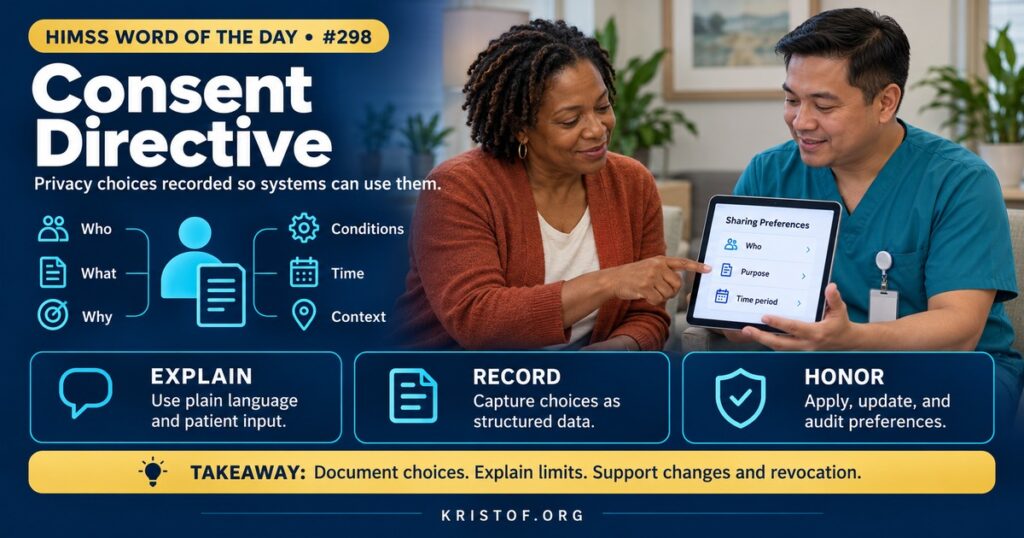
A consent directive is the record of a person’s privacy choices about their health information. The HIMSS Dictionary describes it as a record of a consumer’s privacy choices that permits or refuses consent along several dimensions: which individuals or roles may act (the principals), which operations they may perform (such as collect, access, use, disclose, amend, or delete), for what reasons (such as care, billing, running the organization, research, public health, quality measurement, outside evaluation of health status, or marketing), under which conditions (for example, when the person is unconscious), during what period (with effective and expiration dates), and in what context (such as an emergency).
The term emphasizes structure. A paper consent form can be filed and read by a person, but a consent directive is meant to be captured as data that systems can store, exchange, and apply. HL7 FHIR defines a Consent resource for this purpose, and standards such as data segmentation for privacy support labeling and handling sensitive data.
Federal rules set content requirements for some consents. For records of substance use disorder programs, 42 CFR 2.31 says a written consent may be paper or electronic and must include the patient’s name; the persons authorized to disclose; a specific description of the information; the recipients or class of recipients; the purposes; the patient’s right to revoke in writing; an expiration date or event; and the patient’s signature or that of a person authorized to sign. The rule allows a single consent for all future uses and disclosures for treatment, payment, and health care operations, with a general description of recipients such as treating providers, health plans, and third-party payers.
| Dimension | Question | Example Setting |
|---|---|---|
| Principal | Who may act? | Treating team, a named researcher |
| Operation | What may they do? | View, disclose, amend |
| Purpose | Why? | Treatment, research, public health |
| Condition | Under what circumstances? | Emergency access only |
| Time | For how long? | Until end of treatment |
| Context | In what situation? | Disclosure to a health information exchange |
⚠️ Exam Alert: A consent directive records a person’s choices; an authorization under HIPAA is a specific written permission for a use or disclosure. Consent can be opt-in or opt-out. Data segmentation applies labels so that sensitive data can be handled according to consent and law.
🌐 Why It Matters: Real-World Healthcare IT Context
Patients decide what to share based on trust. When they fear stigma, discrimination, or misuse, they may withhold information from clinicians, which harms care. Consent directives are meant to give them real control while allowing safe sharing of the information that care needs. The difficulty is turning that principle into working systems.
A 2026 study in Applied Clinical Informatics interviewed 16 expert stakeholders from clinical, health IT, governance, and policy backgrounds about designing a granular, patient-facing consent tool for sensitive health data. The most common theme, raised by 75 percent, was the need for a patient-centered, trauma-informed experience that recognizes past stigma, discrimination, or harm and uses plain language and education. Lack of trust, stigma, and workflow burden were cited as major barriers to sharing sensitive data (63 percent), alongside technical limits in EHRs that prevent reliable segmentation and enforcement of preferences (56 percent). Half said granular, computable consent was essential and half said legal and policy fragmentation complicates implementation; 44 percent raised proxy and adolescent configurations and 19 percent mentioned standards such as FHIR Consent and Data Segmentation for Privacy. The authors concluded that effective consent management needs alignment of patient-centered design, technical computability, and governance. The sample is small and the percentages describe how often topics came up, not how many organizations have a given problem.
Prototype work shows what is technically possible. A 2026 JAMIA Open paper described the authentication and authorization module of iAgree, a platform that lets patients manage consent preferences and share EHR data with researchers across multiple health systems. Patients sign in with federated credentials, link their identities by signing into each participating system’s patient portal, and select granular sharing preferences; identity attributes retrieved through a FHIR API are transformed into de-identified tokens, and consent preferences are recorded immutably using blockchain technology. The platform was installed in a proof-of-concept environment at three health systems, and functional testing with test patients showed that identities could be safely bound across sites. This was a feasibility test with test patients, not an evaluation of real-world use.
The practical challenges are familiar to anyone who has implemented consent. Rules differ by state and data type, so a single consent model rarely fits every record. Some EHRs cannot segment a single note or result, so a patient’s choice may be honored only by blocking the whole chart. Legal requirements change when substance use disorder, mental health, reproductive health, or minor consent is involved. Consent must also travel: if a patient limits sharing, the limit must be visible to the exchange partners that receive the data. And patients need to be able to change their minds, which requires clear revocation workflows and timely enforcement.
Good programs begin with the use cases that matter most, such as research sharing, health information exchange participation, or sensitive records, and design consent around them with patient input. They decide what can be enforced technically and what must be handled through policy and training, and they are honest with patients about the difference. They also audit that stated preferences match system behavior.
Common consent directive challenges:
- Legal rules that differ by data type and state
- EHRs that cannot segment records at a fine level
- Consent captured as scanned images that systems cannot read
- Preferences that do not follow data to exchange partners
- Proxy and adolescent situations handled by workaround
- Patients unsure what they agreed to or how to change it
What supports workable consent management:
- Use cases defined with patients and privacy staff
- Plain-language, trauma-informed explanations
- Computable consent using standards such as FHIR Consent
- Segmentation and labels for sensitive data
- Clear revocation and update workflows
- Audits that compare preferences with actual access and disclosure
🏥 The Nurse’s Perspective: Clinical, Bedside, & Workflow
Nurses frequently explain, collect, and honor consent at the point of care.
At the Bedside
Nurses explain what a consent covers, check that a patient is able to decide, and report when a patient asks to limit information, for instance who may be told about their admission. They need to know where preferences are recorded and which ones the system can actually enforce.
In Clinical Workflow
Registration and clinic nurses handle forms for release of information, research, and health information exchange participation. Nurse managers make sure staff know when a special consent is required and how to document a revocation. In behavioral health and addiction treatment settings, nurses follow stricter rules for disclosure.
Nurse informaticists contribute to consent workflows and screens, test whether a documented preference blocks or flags the right information, and help write plain-language explanations that patients can understand.
In EHR Implementation (Go-Live Perspective)
An Epic Go-Live must map consent types and privacy flags into the new system. At-the-elbow support analysts hear when a staff member cannot find a patient’s restriction or does not know what a flag means, and those reports guide fixes and training before sensitive information is misused.
🎓 CAHIMS / CPHIMS & HIMSS Perspective
CAHIMS Exam Domain Mapping
Consent directives appear in privacy, standards, and workflow questions:
| CAHIMS Domain | How Consent Directives Appear |
|---|---|
| Healthcare & Technology Environments | HIPAA, 42 CFR Part 2, state law, ethics |
| Clinical Informatics | Patient preferences, sensitive data, shared decision making |
| Healthcare Information & Systems Management | FHIR Consent, segmentation, access control, exchange |
| Management & Leadership | Privacy governance, audits, policy alignment |
Key Terms to Know Alongside Consent Directive
- Authorization — HIPAA written permission for a specified use or disclosure
- Opt-In and Opt-Out — consent models in which sharing requires affirmative choice or continues unless refused
- Data Segmentation for Privacy (DS4P) — standard approach for labeling sensitive data so that handling rules can be applied
- FHIR Consent Resource — HL7 FHIR data structure that records consent
- Proxy — person authorized to make decisions for another
- Revocation — withdrawal of previously given consent
HIMSS Organizational Position
HIMSS supports privacy and security in health information through its public policy work, Healthcare Cybersecurity Community, and research. Members can find related resources through the HIMSS Healthcare Cybersecurity Community page.
🔗 Explore Further: External References
- eCFR — 42 CFR 2.31, Consent Requirements https://www.ecfr.gov/current/title-42/chapter-I/subchapter-A/part-2/subpart-C/section-2.31
- HL7 FHIR R4 — Consent https://hl7.org/fhir/R4/consent.html
- Cooper et al. (2026), Applied Clinical Informatics — Designing Granular Consent Tools for Sensitive Health Data: Challenges, User Needs, and Stakeholder Guidance https://pubmed.ncbi.nlm.nih.gov/42447927/
- Soohoo et al. (2026), JAMIA Open — Development of the Authentication and Authorization Processes for the iAgree Portal, a Platform for Patient-Controlled Data Sharing Across Health Systems https://pubmed.ncbi.nlm.nih.gov/42344107/
- eCFR — 45 CFR 164.502, Uses and Disclosures of Protected Health Information: General Rules https://www.ecfr.gov/current/title-45/subtitle-A/subchapter-C/part-164/subpart-E/section-164.502
Term source: HIMSS Dictionary of Health Information and Technology Terms, Acronyms, and Organizations, 6th Edition (2025). All definitions in this series are paraphrased for editorial purposes. Readers are encouraged to consult the primary source for exact language.
Eric Andrew Kristof, RN, CAHIMS is a Healthcare IT professional and HIMSS Arkansas Chapter member based in Hot Springs Village, AR, with hands-on Epic Go-Live experience and a diverse healthcare and IT background. He writes at kristof.org at the intersection of clinical care and healthcare technology.
Leave a Reply