By Eric Andrew Kristof, RN, CAHIMS | Healthcare IT Professional | HIMSS Arkansas Chapter Member
About This Series: The HIMSS Word of the Day is a running blog series drawing from the HIMSS Dictionary of Health Information and Technology Terms, Acronyms, and Organizations, 6th Edition (2025) — the authoritative reference for healthcare IT professionals and the primary study resource for CAHIMS and CPHIMS certification. Each post paraphrases the term in plain language, grounds it in real-world healthcare IT context, and adds a bedside nursing perspective you won’t find in a textbook.
📖 The Term: AUC (Appropriate Use Criteria)
Source: HIMSS Dictionary of Health Information and Technology Terms, Acronyms, and Organizations, 6th Edition (2025)
🔍 Plain-Language Definition
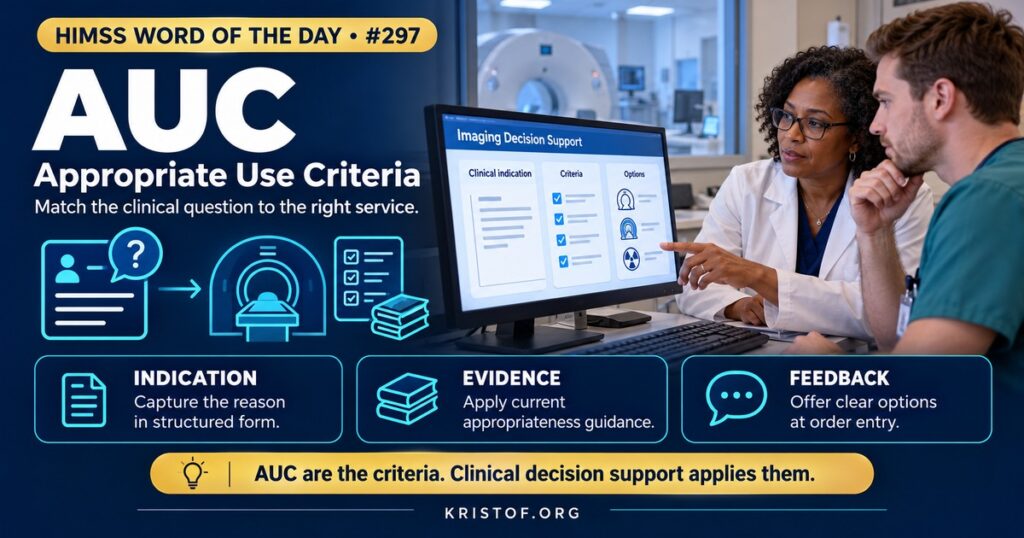
Appropriate use criteria (AUC) are guidance tools that help clinicians who order and perform services pick the most suitable option for a particular clinical condition. The HIMSS Dictionary describes them as evidence-based to the extent feasible and ties the term to the Medicare AUC Program for advanced diagnostic imaging, which Congress mandated through the Protecting Access to Medicare Act of 2014 (PAMA) and its section 218(b). The regulation that implemented the program defined AUC as criteria developed or endorsed only by national professional medical specialty societies or other provider-led entities.
The Medicare program used a three-part design. Specialty societies and other provider-led entities developed AUC. Qualified clinical decision support mechanisms (CDSMs) built into or alongside ordering systems applied the criteria when a clinician ordered an advanced imaging study such as MRI, CT, or nuclear medicine, including PET. Claims for these services would later carry information showing that the ordering clinician had consulted a CDSM.
The program’s status has changed. The implementing regulation, 42 CFR 414.94, now reads “[Reserved]” in the eCFR, and the section’s version history shows that its last change took effect on January 1, 2024, so organizations should not assume the former claims requirement is in force. AUC themselves remain useful, since specialty societies continue to publish appropriateness guidance and many health systems build it into order sets and decision support for quality and cost reasons.
| Component | Role | Informatics Link |
|---|---|---|
| Criteria | Rate the suitability of tests for a clinical scenario | Rules, content libraries, order sets |
| Clinical indication | The reason for the order | Structured indication fields |
| Decision support mechanism | Applies criteria at order entry | CDS inside CPOE |
| Feedback | Suggests alternatives or confirms the order | Alerts, scores, links to evidence |
| Measurement | Tracks use and outcomes | Reports on scored orders and overrides |
⚠️ Exam Alert: AUC are criteria; a CDS mechanism is the tool that applies them. PAMA is the law that directed the Medicare imaging program. A structured indication can be scored by the system, while a free-text indication usually cannot. Do not confuse AUC with clinical practice guidelines, which are broader recommendations.
🌐 Why It Matters: Real-World Healthcare IT Context
Imaging is useful but easy to overuse, and orders often reflect habit, patient expectation, or fear of missing something. AUC aim to bring evidence into the ordering moment. The idea is attractive, but experience shows that the quality of the informatics determines whether the idea works.
The federal Medicare Imaging Demonstration tested the concept before PAMA. Beginning in 2011, CMS tested whether exposing ordering clinicians to appropriateness guidelines for advanced imaging would reduce inappropriate orders. The evaluation examined utilization trends from January 1, 2009 through November 30, 2013. It reported small changes in ordering patterns, but found that decision support systems could not assign appropriateness ratings to many orders, which limited their potential effectiveness, and identified many opportunities to refine decision support.
A 2021 study in the Journal of the American College of Radiology shows the same problem in a real health system. After initial AUC deployment in a large multisite system, researchers analyzed all 39,533 outpatient advanced imaging orders placed over one month in late 2017. Fifty-nine percent of orders (23,267) were unscored by the system. Free-text indications appeared in 71 percent of unscored orders and 42 percent of all orders. When the authors manually reviewed the two examinations with the most free-text indications, enhanced CT of the abdomen and pelvis and unenhanced CT of the head, 97 percent of the free-text entries (3,132) could have been mapped to a single existing structured indication. The finding points to a design issue and not only a behavior problem: if the structured list is hard to use, clinicians type free text and the criteria never apply.
A 2019 article in Annals of Internal Medicine summarized the program for physicians as it was then scheduled to begin: documentation of an interaction with a certified CDS system using approved criteria would be required on Medicare claims for advanced imaging in emergency department and outpatient settings starting in 2020, initially covering eight priority clinical areas such as headache and low back pain. The authors warned that substantial resources and planning would be needed and that robust evidence that the program would reduce inappropriate imaging was lacking. The experience illustrates a recurring policy lesson: mandating a tool does not guarantee its effect.
For informatics teams, AUC projects succeed when they are treated as clinical workflow design. Teams choose the criteria source and keep it current. They build structured indications that match how clinicians think and test them with real orders, since a long, awkward list leads to free text. They place guidance where the clinician decides, with a clear message and an easy way to choose a better option or document a reason for proceeding. They measure what happens: how many orders are scored, how often clinicians change their order, and whether utilization, delays, or patient outcomes change. And they watch for unintended effects such as delays for urgent patients, workaround behaviors, or alert fatigue. Governance with radiology, ordering specialties, and nursing makes the rules legitimate.
Common AUC implementation problems:
- Structured indication lists that do not fit clinical reasoning
- High rates of unscored orders from free text
- Alerts that interrupt without offering a usable alternative
- Criteria that go out of date
- Little measurement of effects on patients and workflow
- Policy mandates that change faster than builds
What supports effective appropriateness guidance:
- Evidence from recognized specialty societies, kept current
- Indications designed with clinicians and tested on real orders
- Short, actionable guidance at the point of ordering
- Reports on scoring rates, overrides, and utilization
- Governance that includes radiology and ordering clinicians
- Review of unintended consequences
🏥 The Nurse’s Perspective: Clinical, Bedside, & Workflow
Nurses often handle imaging logistics and teach patients about tests, so changes in ordering affect their work.
At the Bedside
Nurses prepare patients for CT, MRI, and nuclear medicine studies, screen for contrast allergies and implanted devices, and explain what to expect. When an order is changed after decision support suggests an alternative, the nurse may need to update the patient and the schedule.
In Clinical Workflow
In clinics and emergency departments, nurses and medical assistants sometimes enter or pend orders under protocol. Their workflow must support structured indications so that criteria apply. Nurse managers help resolve delays when a study is changed or needs additional information.
Nurse informaticists take part in design reviews of order entry, test the clarity of indication choices, and help determine how nurse-entered orders work with decision support.
In EHR Implementation (Go-Live Perspective)
An Epic Go-Live that includes imaging decision support changes order entry for many clinicians at once. At-the-elbow support analysts hear when the structured indication list does not match what clinicians want to say, and when alerts appear at awkward moments. That feedback shows the build team where to simplify before habits form.
🎓 CAHIMS / CPHIMS & HIMSS Perspective
CAHIMS Exam Domain Mapping
AUC appear in decision support, policy, and quality questions:
| CAHIMS Domain | How AUC Appear |
|---|---|
| Healthcare & Technology Environments | PAMA, Medicare policy, professional societies |
| Clinical Informatics | Clinical decision support, CPOE, appropriateness, human factors |
| Healthcare Information & Systems Management | Structured indications, CDS integration, reporting |
| Management & Leadership | Governance, change management, measurement of effect |
Key Terms to Know Alongside AUC
- Clinical Decision Support (CDS) — tools that give clinicians knowledge and patient-specific information at the point of care
- CPOE — computerized provider order entry
- Advanced Diagnostic Imaging — MRI, CT, and nuclear medicine, including PET
- Structured Indication — coded reason for an order selected from a defined list
- Alert Fatigue — reduced response to alerts caused by too many or low-value alerts
- PAMA — Protecting Access to Medicare Act of 2014
HIMSS Organizational Position
HIMSS supports the effective use of clinical decision support and evidence-based practice through its research, education, and community work. Members can find related resources through the HIMSS Resource Center.
🔗 Explore Further: External References
- eCFR — 42 CFR 414.94, Appropriate Use Criteria for Advanced Diagnostic Imaging Services (current text: [Reserved]) https://www.ecfr.gov/current/title-42/chapter-IV/subchapter-B/part-414/subpart-B/section-414.94
- Timbie et al. (2015), Rand Health Quarterly — Medicare Imaging Demonstration Final Evaluation: Report to Congress https://pubmed.ncbi.nlm.nih.gov/28083357/
- Fried et al. (2021), Journal of the American College of Radiology — Lessons From the Free-Text Epidemic: Opportunities to Optimize Deployment of Imaging Clinical Decision Support https://pubmed.ncbi.nlm.nih.gov/33663756/
- Hentel et al. (2019), Annals of Internal Medicine — What Physicians and Health Organizations Should Know About Mandated Imaging Appropriate Use Criteria https://pubmed.ncbi.nlm.nih.gov/31181572/
- CMS — Value-Based Programs https://www.cms.gov/medicare/quality/value-based-programs
Term source: HIMSS Dictionary of Health Information and Technology Terms, Acronyms, and Organizations, 6th Edition (2025). All definitions in this series are paraphrased for editorial purposes. Readers are encouraged to consult the primary source for exact language.
Eric Andrew Kristof, RN, CAHIMS is a Healthcare IT professional and HIMSS Arkansas Chapter member based in Hot Springs Village, AR, with hands-on Epic Go-Live experience and a diverse healthcare and IT background. He writes at kristof.org at the intersection of clinical care and healthcare technology.
Leave a Reply