By Eric Andrew Kristof, RN, CAHIMS | Healthcare IT Professional | HIMSS Arkansas Chapter Member
About This Series: The HIMSS Word of the Day is a running blog series drawing from the HIMSS Dictionary of Health Information and Technology Terms, Acronyms, and Organizations, 6th Edition (2025) — the authoritative reference for healthcare IT professionals and the primary study resource for CAHIMS and CPHIMS certification. Each post paraphrases the term in plain language, grounds it in real-world healthcare IT context, and adds a bedside nursing perspective you won’t find in a textbook.
📖 The Term: Workflow Management
Source: HIMSS Dictionary of Health Information and Technology Terms, Acronyms, and Organizations, 6th Edition (2025)
🔍 Plain-Language Definition
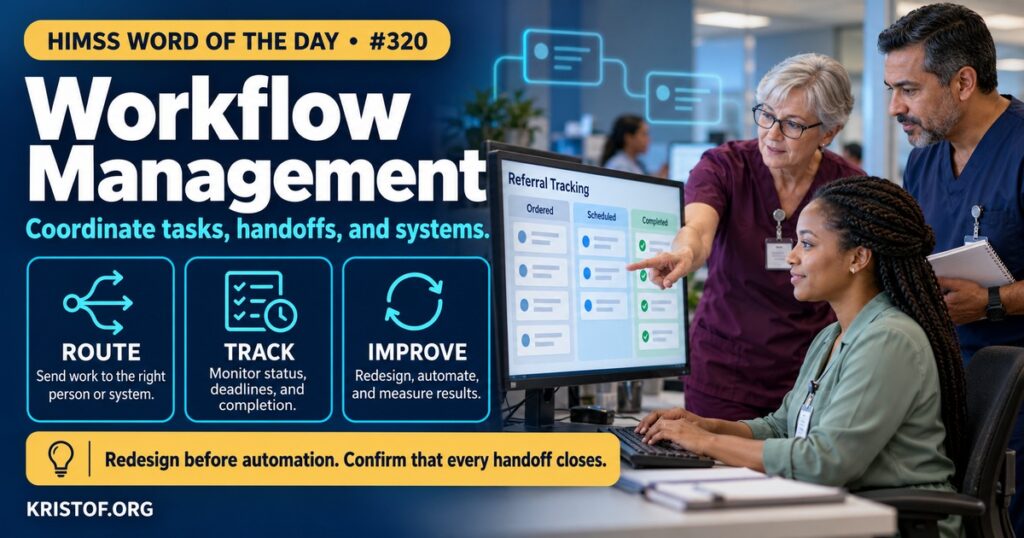
Workflow management is, in the HIMSS Dictionary’s wording, an approach for defining and controlling business processes that cross application boundaries. The Dictionary adds a second meaning: automated events or processes that let routine tasks run without manual handoffs. A hospital example is a referral that begins with an order in the EHR, creates a task for scheduling, sends a message to another organization, tracks the response, and alerts the ordering clinician when the loop is not closed. No single application owns the whole path, so something has to coordinate it.
A simple distinction helps. Workflow is the sequence of steps people and systems follow to complete a task. Workflow design is deciding what those steps should be. Workflow management is the ongoing control of the process: routing work to the right person or system, tracking status, enforcing rules and deadlines, and measuring performance. Workflow automation is handing individual steps to software.
| Workflow Element | Role | Example |
|---|---|---|
| Trigger | Starts the process | Order placed, result posted |
| Routing | Sends work to the right queue or person | Referral task to scheduling |
| Rules and deadlines | Enforce policy and timing | Escalate if unscheduled in seven days |
| Automation | Performs repetitive steps | Data transfer between systems |
| Monitoring | Tracks status and performance | Dashboard of open referrals |
⚠️ Exam Alert: Workflow management controls and automates processes across systems; workflow analysis studies how work is actually done. Process mining uses event logs to reveal real paths and delays. Automation should follow redesign, since automating a poor process preserves the problem.
🌐 Why It Matters: Real-World Healthcare IT Context
Most health care delays come from handoffs, not from any single step, which is why workflow management belongs in clinical informatics. Five studies show different ways of looking at it.
Process mining reveals how work really flows. A 2026 study in Tumori applied process mining to the event data of a high-volume radiation therapy department. The team analyzed 43,183 events tied to 8,608 treatments between 2017 and 2021, modeled the sequences of events, including prescription, scheduling, CT simulation, treatment start, cancellation, suspension, and end, and compared how long different paths took. A suspension during the path was associated with a significant delay in the start of treatment, and the effect on the interval from prescription to treatment start was significant for breast, genitourinary, gastrointestinal, metastatic, head and neck, gynecological, thoracic, and skin cancers. The authors concluded that process mining is a useful framework for finding delays, interruptions, and inefficiencies in care pathways. It is a single-center, retrospective analysis, so it identifies where delay occurs and does not show how to remove it, but it shows how event logs can replace guesswork with measurement.
Documentation tools affect referral workflow. A 2026 scoping review in Health Informatics Journal examined 16 studies published between 2020 and 2025 on digital interventions to improve referral documentation. Electronic referral systems, standardized documentation tools, and artificial intelligence approaches were associated with more complete documentation, better efficiency, and improved referral tracking, especially when they matched clinical workflows and organizational structures. The authors used the Donabedian model of structure, process, and outcome and concluded that aligning structures, documentation processes, and outcome measures is important for referral performance. The review summarizes mostly small studies of varied design, so it supports the principle more than a specific product.
Automation can save time when the task suits it. A 2026 study in the Journal of Clinical Medicine implemented robotic process automation (RPA) for gastric and breast cancer registry data abstraction in a production EHR at a tertiary hospital. Mean abstraction time per patient fell by 74 percent for the gastric registry (from 19.5 to 5.1 minutes) and by 30 percent for the breast registry (from 25.4 to 17.8 minutes), an estimated saving of more than 260 hours of manual work per year at 2024 surgical volumes. Researchers checked all automated outputs by hand, and interviews with 14 stakeholders found that RPA suited repetitive tasks but needed clinician cooperation and continuous monitoring. The authors noted that they did not formally assess accuracy and that gains depended on registry complexity, which is why the breast registry improved less than the gastric one.
Poor usability can undo workflow gains. A 2025 scoping review in the Journal of Evaluation in Clinical Practice screened 2,387 records and included 28 studies on how EHR usability problems contribute to documentation burden. It reported that poorly designed interfaces caused task switching, long screen navigation, and fragmented information, which led clinicians to use workarounds such as duplicating documentation or using outside tools, adding to the risk of data entry errors and longer documentation times. The authors called for human factors approaches that simplify information retrieval and remove unnecessary complexity. A 2020 time-motion study in the AMIA Annual Symposium Proceedings of 47 clinicians, 13 of them registered nurses, in acute care, intensive care, ambulatory, and emergency settings measured the problem directly. Clinicians switched tasks an average of 1.4 times per minute, and data viewing and data entry tasks were involved in 48.2 percent of all switches. The authors suggested that task switching could serve as a proxy for measuring burden. The sample was small and observational, but together the studies echo a common lesson: a workflow tool succeeds when it fits the work of the person using it.
Several practices follow from these studies. Teams map the current process by watching work and, where possible, analyzing event logs rather than relying on how a process is supposed to run. They define owners, rules, and measures for each handoff. They redesign before automating, then automate repetitive steps with testing and monitoring. They examine the effect on users, including documentation time and workarounds. And they review performance regularly, because processes drift when staff, systems, or policies change.
Common workflow management problems:
- Processes that cross systems but have no single owner
- Handoffs with no tracking, so tasks are lost
- Automation of a process that should have been redesigned
- Interface designs that force workarounds
- Measures defined after the fact or not at all
- No review after staffing or system changes
What supports effective workflow management:
- Process maps based on observation and event data
- Named owners and measures for each handoff
- Redesign before automation
- Testing and monitoring of automated steps
- User involvement in design and evaluation
- Regular review of performance and workarounds
🏥 The Nurse’s Perspective: Clinical, Bedside, & Workflow
Nurses live in the handoffs between systems, so they know where workflows work and where they break.
At the Bedside
A nurse who must open three screens to find one piece of information, re-enter the same data in two places, or track a task on paper is working around a workflow gap. These workarounds consume time at the bedside and can increase the chance of error, so reporting them gives informatics and quality teams a view into the real process.
In Clinical Workflow
Nurse managers watch for delays that cross departments, such as discharge steps that wait on transport, pharmacy, or authorization. They bring specific examples to process improvement teams, and they help decide who owns each step.
Nurse informaticists lead workflow analysis, observe how work happens on the unit, map steps with staff, test changes before release, and measure their effect on documentation time, task completion, and satisfaction.
In EHR Implementation (Go-Live Perspective)
Workflow decisions made before an Epic Go-Live determine how smoothly work moves afterward. At-the-elbow support analysts observe where nurses click through extra steps or devise workarounds, then bring those observations to the build team so that routing, tasks, and displays can be adjusted while the project team is still engaged.
🎓 CAHIMS / CPHIMS & HIMSS Perspective
CAHIMS Exam Domain Mapping
Workflow management appears in analysis, design, and implementation questions:
| CAHIMS Domain | How Workflow Management Appears |
|---|---|
| Healthcare & Technology Environments | Care coordination, process standards, quality programs |
| Clinical Informatics | Workflow analysis, usability, documentation burden |
| Healthcare Information & Systems Management | Process mapping, automation, interfaces, monitoring |
| Management & Leadership | Change management, process ownership, performance measures |
Key Terms to Know Alongside Workflow Management
- Workflow Analysis — study of how tasks are actually performed
- Process Mining — use of event logs to reconstruct and analyze real processes
- Robotic Process Automation (RPA) — software that performs repetitive tasks by imitating user actions
- Bottleneck — step that limits the speed of an entire process
- Workaround — informal method used to get around a system limitation
- Closed-Loop Process — workflow that confirms a task was completed
HIMSS Organizational Position
HIMSS supports effective, usable health information technology and workflow improvement through its research, education, and community work. Members can find related resources through the HIMSS Resource Center.
🔗 Explore Further: External References
- Mastroleo et al. (2026), Tumori — Analysing Workflows in Radiation Oncology: A Process Mining Approach to Identify Treatment Process Challenges https://pubmed.ncbi.nlm.nih.gov/42584161/
- Lopez et al. (2026), Health Informatics Journal — Digital Health Interventions to Improve Referral Documentation: A Scoping Review https://pubmed.ncbi.nlm.nih.gov/42961075/
- Jung et al. (2026), Journal of Clinical Medicine — Evaluating the Effectiveness of Robotic Process Automation for Cancer Registry Data Abstraction in a Production EHR Environment https://pubmed.ncbi.nlm.nih.gov/41976958/
- Olakotan et al. (2025), Journal of Evaluation in Clinical Practice — Usability Challenges in Electronic Health Records: Impact on Documentation Burden and Clinical Workflow: A Scoping Review https://pubmed.ncbi.nlm.nih.gov/40581989/
- Moy et al. (2020), AMIA Annual Symposium Proceedings — Time-Motion Examination of Electronic Health Record Utilization and Clinician Workflows Indicate Frequent Task Switching and Documentation Burden https://pubmed.ncbi.nlm.nih.gov/33936464/
Term source: HIMSS Dictionary of Health Information and Technology Terms, Acronyms, and Organizations, 6th Edition (2025). All definitions in this series are paraphrased for editorial purposes. Readers are encouraged to consult the primary source for exact language.
Eric Andrew Kristof, RN, CAHIMS is a Healthcare IT professional and HIMSS Arkansas Chapter member based in Hot Springs Village, AR, with hands-on Epic Go-Live experience and a diverse healthcare and IT background. He writes at kristof.org at the intersection of clinical care and healthcare technology.
Leave a Reply