By Eric Andrew Kristof, RN, CAHIMS | Healthcare IT Professional | HIMSS Arkansas Chapter Member
About This Series: The HIMSS Word of the Day is a running blog series drawing from the HIMSS Dictionary of Health Information and Technology Terms, Acronyms, and Organizations, 6th Edition (2025) — the authoritative reference for healthcare IT professionals and the primary study resource for CAHIMS and CPHIMS certification. Each post paraphrases the term in plain language, grounds it in real-world healthcare IT context, and adds a bedside nursing perspective you won’t find in a textbook.
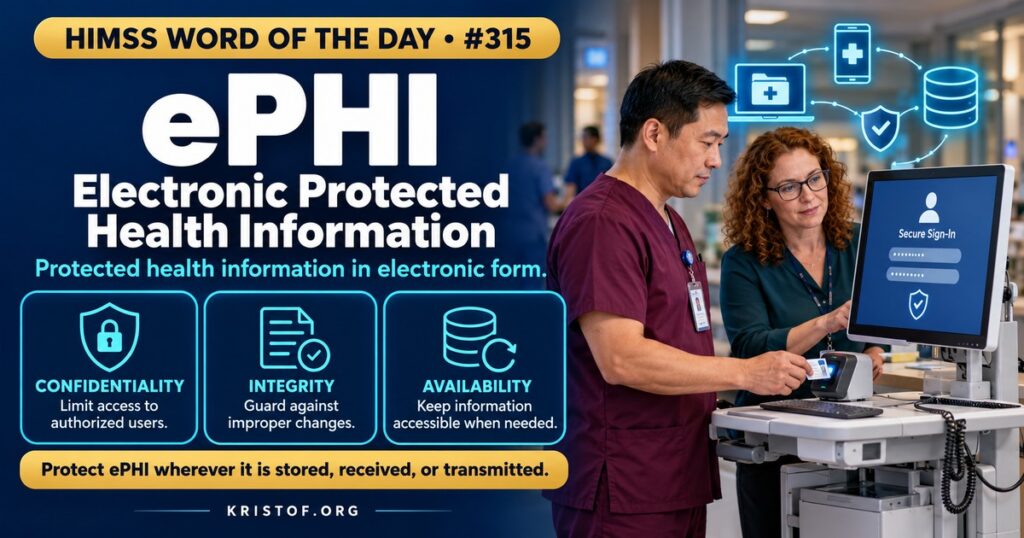
📖 The Term: ePHI (Electronic Protected Health Information)
Source: HIMSS Dictionary of Health Information and Technology Terms, Acronyms, and Organizations, 6th Edition (2025)
🔍 Plain-Language Definition
Electronic protected health information (ePHI) is protected health information that is created, stored, transmitted, or received in electronic form, according to the HIMSS Dictionary. The HIPAA regulation at 45 CFR 160.103 defines it by reference to the broader PHI definition: it is the PHI that is transmitted by or maintained in electronic media. That covers the EHR, a laboratory interface message, a scanned referral, a database extract, an email carrying a patient’s name and diagnosis, and a laptop or phone that holds any of these. Paper records and spoken information are still PHI, but they fall under the HIPAA Privacy Rule rather than the Security Rule.
The Security Rule applies to ePHI specifically. Under 45 CFR 164.306(a), covered entities and business associates must ensure the confidentiality, integrity, and availability of all ePHI they create, receive, maintain, or transmit, protect against reasonably anticipated threats to its security and integrity, protect against reasonably anticipated impermissible uses or disclosures, and ensure compliance by their workforce. Section 164.306(b) adds that the rule is flexible: organizations may choose security measures suited to their size, complexity, technical infrastructure, costs, and the probability and criticality of risks.
The technical safeguards in 45 CFR 164.312 give the main building blocks.
| Technical Safeguard | What It Requires | Example in Practice |
|---|---|---|
| Access control | Allow only authorized persons or programs to reach ePHI | Unique user IDs, role-based access |
| Audit controls | Record and examine activity in systems with ePHI | Access logs reviewed for snooping |
| Integrity | Protect ePHI from improper alteration or destruction | Checksums, change controls |
| Person or entity authentication | Verify that the user is who they claim to be | Passwords, badges, multifactor sign-in |
| Transmission security | Guard ePHI sent over a network | Encrypted connections |
In the current text of the rule, integrity controls and encryption for ePHI in transit are addressable implementation specifications, meaning an organization must implement them if reasonable and appropriate or document an equivalent alternative.
⚠️ Exam Alert: ePHI is PHI in electronic form, covered by the Security Rule; the Privacy Rule covers PHI in any form. The Security Rule’s aim is confidentiality, integrity, and availability. Addressable does not mean optional. Transmission security applies to ePHI sent over any network, wired or wireless.
🌐 Why It Matters: Real-World Healthcare IT Context
ePHI is the information attackers want and the information clinicians need to reach quickly, which is why most security work in a hospital is about managing the tension between access and protection. Two studies of US health care show where the exposure lies.
The first concerns the breach record. A 2026 longitudinal analysis in JMIR Medical Informatics examined 6,612 health care data breaches reported to the HHS Office for Civil Rights between October 2009 and December 2025. Hacking and IT incidents shifted from a minority of incidents to the dominant breach mechanism, and the odds that a breach involved a network server rose by about 29 percent per year. Breaches that involved business associates made up 29.5 percent of incidents but 48.8 percent of affected individuals, and the proportion of breaches involving business associates rose from 22.1 percent in 2009 to 2013 to 36.6 percent in 2020 to 2025. Mega breaches, those affecting 100,000 or more individuals, also became more common. The author interpreted the pattern as coinciding with cloud migration, digital transformation, and ransomware, and recommended stronger vendor security assessments and data compartmentalization. The data come from reports made to a federal portal, so they reflect reported breaches, not all incidents, but they show that ePHI risk is increasingly concentrated on servers and in vendor relationships.
The second concerns people. Email phishing is a major route into hospital systems. A 2019 study in JAMA Network Open analyzed 95 simulated phishing campaigns run by six US health care institutions between 2011 and 2018. Of 2,971,945 simulated emails, 422,062 (14.2 percent) were clicked. Median click rates across institutions ranged from 7.4 percent to 30.7 percent. Employees who had experienced more campaigns were less likely to click: the adjusted odds of clicking were lower after six to ten campaigns and lower still after more than ten. The authors concluded that nearly one in seven simulated emails were clicked and that simulation and awareness may help. A companion 2019 study in JAMIA followed a single institution’s 20 campaigns and 5,416 employees, of whom 772 clicked on at least five simulated emails. Only 17.9 percent never clicked, and 65.3 percent clicked on at least two. Click rates fell over time in every group, but a mandatory training program for the highest-risk employees, started after campaign 15, did not substantially change their click rates, and they remained more likely to click. Both studies come from institutions that chose to run simulations, and simulated clicks are not breaches. Even so, they suggest that repeated exposure and awareness help while one-time training for repeat clickers may not.
Putting these findings to work follows the structure of the Security Rule. An organization starts with an inventory of where ePHI lives, including vendors, cloud services, devices, and interfaces. It applies access control based on role, reviews audit logs for inappropriate access, authenticates users with more than a password where possible, encrypts data in transit and at rest where reasonable, and plans for backup and recovery so that availability is protected as well as confidentiality. It trains the workforce continuously and tests with simulations, and it manages vendors through business associate agreements and security reviews. The same safeguards also affect daily care. Strong authentication that is too slow at the bedside leads to workarounds, while access controls that are too loose lead to snooping. Balancing the two is a design decision for clinical and security staff together.
Common ePHI problems:
- Incomplete knowledge of where ePHI is stored and sent
- Shared accounts or workstation sessions left open
- Weak oversight of vendors and cloud services
- Audit logs that nobody reviews
- Data stored on unmanaged devices or in unapproved apps
- One-time training with no follow-up or testing
What supports protection of ePHI:
- An inventory and data flow map of ePHI
- Role-based access and strong authentication
- Audit log review tied to follow-up action
- Encryption and network protection suited to the risk
- Vendor assessments and business associate agreements
- Continuous awareness training with simulation
🏥 The Nurse’s Perspective: Clinical, Bedside, & Workflow
Nurses use ePHI more often than almost anyone in a hospital, so their daily habits are part of the security design.
At the Bedside
Nurses sign in to workstations and devices throughout a shift, view patient records in shared spaces, and discuss patient information with families and colleagues. Locking or logging out of sessions, not sharing credentials, and confirming a patient’s identity before sharing information are routine protections for ePHI.
In Clinical Workflow
Nurse managers set expectations on the unit about workstation use and screen privacy, follow up on audit alerts about inappropriate access, and ensure staff know how to report a suspicious email or lost device immediately. Nurses are also targets of phishing messages, which often imitate human resources, scheduling, or IT notices.
Nurse informaticists help configure role-based access so that it matches real duties, review break-the-glass processes for emergencies, and test security changes with clinicians before release so that the controls do not create unsafe workarounds.
In EHR Implementation (Go-Live Perspective)
An Epic Go-Live is the moment when many people receive access at once. At-the-elbow support analysts see which access requests are wrong, which roles are missing necessary privileges, and where login steps cause delays. They route those findings to security and access teams so that fixes balance protection with workflow.
🎓 CAHIMS / CPHIMS & HIMSS Perspective
CAHIMS Exam Domain Mapping
ePHI appears throughout privacy, security, and compliance questions:
| CAHIMS Domain | How ePHI Appears |
|---|---|
| Healthcare & Technology Environments | HIPAA Security Rule, breach notification, regulation |
| Clinical Informatics | Access to records, role-based privileges, clinical workflow |
| Healthcare Information & Systems Management | Technical safeguards, encryption, audit logs, backup |
| Management & Leadership | Risk analysis, workforce training, vendor management |
Key Terms to Know Alongside ePHI
- PHI — individually identifiable health information held or transmitted by a covered entity or business associate
- HIPAA Security Rule — standards for safeguarding ePHI
- Technical Safeguards — technology and related policies that protect ePHI and control access to it
- Addressable — implementation specification that must be implemented if reasonable and appropriate or replaced with a documented alternative
- Business Associate — organization that handles PHI on behalf of a covered entity
- Phishing — deceptive messages designed to obtain credentials or install malware
HIMSS Organizational Position
HIMSS supports healthcare cybersecurity through its Healthcare Cybersecurity Community, research, and education. Members can find related resources through the HIMSS Healthcare Cybersecurity Community page.
🔗 Explore Further: External References
- eCFR — 45 CFR 160.103, Definitions https://www.ecfr.gov/current/title-45/subtitle-A/subchapter-C/part-160/subpart-A/section-160.103
- eCFR — 45 CFR 164.306, Security Standards: General Rules https://www.ecfr.gov/current/title-45/subtitle-A/subchapter-C/part-164/subpart-C/section-164.306
- eCFR — 45 CFR 164.312, Technical Safeguards https://www.ecfr.gov/current/title-45/subtitle-A/subchapter-C/part-164/subpart-C/section-164.312
- Ignatovski (2026), JMIR Medical Informatics — Business Associates’ Involvement in US Health Care Data Breaches: Longitudinal Analysis https://pubmed.ncbi.nlm.nih.gov/42837534/
- Gordon et al. (2019), JAMA Network Open — Assessment of Employee Susceptibility to Phishing Attacks at US Health Care Institutions https://pubmed.ncbi.nlm.nih.gov/30848810/
- Gordon et al. (2019), Journal of the American Medical Informatics Association — Evaluation of a Mandatory Phishing Training Program for High-Risk Employees at a US Healthcare System https://pubmed.ncbi.nlm.nih.gov/30861069/
Term source: HIMSS Dictionary of Health Information and Technology Terms, Acronyms, and Organizations, 6th Edition (2025). All definitions in this series are paraphrased for editorial purposes. Readers are encouraged to consult the primary source for exact language.
Eric Andrew Kristof, RN, CAHIMS is a Healthcare IT professional and HIMSS Arkansas Chapter member based in Hot Springs Village, AR, with hands-on Epic Go-Live experience and a diverse healthcare and IT background. He writes at kristof.org at the intersection of clinical care and healthcare technology.
Leave a Reply