By Eric Andrew Kristof, RN, CAHIMS | Healthcare IT Professional | HIMSS Arkansas Chapter Member
About This Series: The HIMSS Word of the Day is a running blog series drawing from the HIMSS Dictionary of Health Information and Technology Terms, Acronyms, and Organizations, 6th Edition (2025) — the authoritative reference for healthcare IT professionals and the primary study resource for CAHIMS and CPHIMS certification. Each post paraphrases the term in plain language, grounds it in real-world healthcare IT context, and adds a bedside nursing perspective you won’t find in a textbook.
📖 The Term: Digital Health Literacy
Source: HIMSS Dictionary of Health Information and Technology Terms, Acronyms, and Organizations, 6th Edition (2025)
🔍 Plain-Language Definition
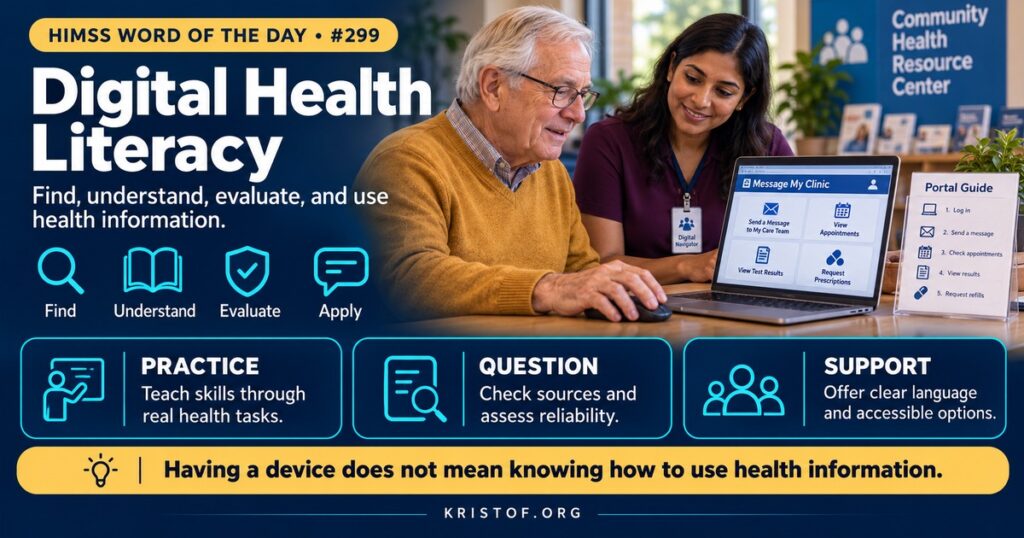
Digital health literacy, also called eHealth literacy, is the application of digital literacy skills to health. The HIMSS Dictionary describes it as the capacity to look for, locate, comprehend, and evaluate health information in electronic resources, and to put that knowledge to work on a health problem. It combines several skills: basic reading and numeracy, familiarity with devices and the internet, the ability to judge the quality of sources, and the confidence to act on what is found.
The concept matters because health systems increasingly depend on digital channels for scheduling, results, messaging, education, and monitoring. People who lack digital health literacy may be unable to use these channels, even when they are motivated, and that can widen existing disparities. It is also a moving target: skills that suffice for a portal login do not necessarily suffice for evaluating a symptom checker or an answer from an AI chatbot.
| Skill | What It Looks Like | Example Task |
|---|---|---|
| Find | Searching and navigating | Locating lab results in a portal |
| Understand | Reading and interpreting | Explaining what a result means |
| Appraise | Judging quality and relevance | Telling reliable sources from misleading ones |
| Apply | Using information to act | Messaging the clinic or adjusting a plan |
| Protect | Managing privacy and security | Deciding what to share with an app |
⚠️ Exam Alert: Digital health literacy is a person’s skill set; the digital divide describes unequal access to technology; health literacy is the broader ability to obtain and use health information. The eHealth Literacy Scale (eHEALS) measures self-perceived skills, not demonstrated performance.
🌐 Why It Matters: Real-World Healthcare IT Context
Digital tools can improve access, but only for those who can use them. Research is now looking at which interventions raise skills and what keeps patients from adopting digital tools.
A 2026 systematic review and meta-analysis in Social Science and Medicine examined digital health literacy interventions for older adults. It included 23 studies with 3,702 older adults, seven of them randomized controlled trials. Most interventions targeted knowledge and technological skills, and they varied in delivery channel, content source, and instructional approach. Five randomized trials contributed to the primary meta-analysis, which found a moderate improvement in digital health literacy favoring intervention groups over controls (standardized mean difference 0.47; 95 percent confidence interval 0.08 to 0.86). Exploratory subgroup analyses suggested larger improvements in interventions that combined digital knowledge and skills with health-related knowledge than in those focusing on digital competence alone, while no clear differences emerged by delivery channel, content source, instruction mode, or relational support. The authors cautioned that the number of trials was limited, heterogeneity was substantial, and the component findings were exploratory. The practical hint is to teach the digital skill inside a real health task, such as reading a lab result, and not as a general computer class.
Barriers and facilitators in specific conditions add detail. A 2026 systematic review in the Journal of Medical Internet Research, using the CFIR 2.0 framework, analyzed 13 studies with 3,002 patients with chronic kidney disease across eight countries. It identified 19 facilitators and 15 barriers to using digital health technology for self-management. The most frequently reported facilitator, in nine studies with high confidence, was a simple, easy-to-use interface. The finding reminds designers that literacy is not only a property of the user: a design that demands fewer skills lowers the bar for everyone.
The earlier post in this series on patient-centric care described a 2026 needs assessment in a New York safety-net clinic: among 204 patients, the average eHealth Literacy Scale score was 25.33 out of 40, only about half completed individual portal tasks correctly, and yet 71.6 percent wanted to learn digital health skills, including 83.1 percent of older adults and of Spanish speakers. Motivation was present; skill-building and culturally tailored support were missing.
Measurement is another challenge. A 2026 critical narrative review in Frontiers in Digital Health argued that existing instruments, including eHEALS, which was developed in 2006, lack AI-specific competencies and measure perceived skills and not actual ones. It identified six AI literacy dimensions missing from current tools: algorithmic literacy, bias awareness, data governance understanding, critical appraisal of AI outputs, trust calibration, and interpretation of explanations, and proposed a tiered framework for clinicians, patients, and governance professionals. It is a conceptual and normative paper rather than an empirical test, but it points to the next problem: as AI tools enter patient-facing care, people will need skills to question them.
Organizations can respond in several ways. They can screen for digital readiness and ask patients how they want to use digital tools. They can offer digital navigators or trained staff who teach hands-on skills, in the languages patients use, and keep non-digital options available. They can test patient-facing designs with people of low literacy and older age. And they can evaluate success by whether patients can complete real tasks, not by the number of accounts created.
Common digital health literacy challenges:
- Assuming that access to a device equals skill
- Training that teaches generic computer use, not health tasks
- Single-language or text-heavy education materials
- Measurement by self-report only
- Digital-only options for essential services
- AI tools introduced without teaching critical evaluation
What supports digital health literacy:
- Simple, accessible interface design
- Hands-on teaching using real health tasks
- Digital navigators and community partnerships
- Materials in the languages patients use
- Performance-based checks alongside self-report
- Retained non-digital pathways
🏥 The Nurse’s Perspective: Clinical, Bedside, & Workflow
Nurses teach patients to use digital tools more often than any other group and see the consequences when patients cannot.
At the Bedside
At discharge and in clinic, nurses help patients sign up for portals, find results, and connect devices. They notice who struggles with a small screen, a password reset, or unfamiliar medical words, and they use teach-back to confirm that patients can do the task alone.
In Clinical Workflow
Nurse educators build short, task-based teaching, such as how to message the clinic or read an after-visit summary. Nurse managers decide who has time to help and where printed materials and language support are available. Nurses in community settings and care management programs help patients with low connectivity or devices.
Nurse informaticists contribute to usability testing with patients, flag screens that depend on skills many patients lack, and help design navigation support and plain-language content.
In EHR Implementation (Go-Live Perspective)
An Epic Go-Live that changes the patient portal or adds patient-facing features triggers a wave of questions. At-the-elbow support analysts and front-desk teams hear the first confusion, and those reports help the team revise instructions and training before patients give up on the tool.
🎓 CAHIMS / CPHIMS & HIMSS Perspective
CAHIMS Exam Domain Mapping
Digital health literacy appears in equity, usability, and patient engagement questions:
| CAHIMS Domain | How Digital Health Literacy Appears |
|---|---|
| Healthcare & Technology Environments | Digital divide, health equity, social determinants |
| Clinical Informatics | Patient engagement, education, self-management tools |
| Healthcare Information & Systems Management | Usability, accessibility, portal design |
| Management & Leadership | Program design, navigators, outcome measurement |
Key Terms to Know Alongside Digital Health Literacy
- eHealth Literacy — ability to find, understand, and use electronic health information
- Digital Divide — gap between people with and without access to or skills for digital technology
- Digital Navigator — trained helper who assists people with digital health tools
- Health Literacy — ability to obtain, process, and understand health information to make decisions
- Teach-Back — method of confirming understanding by having the learner explain or demonstrate
- Accessibility — design that allows people with disabilities to use a system
HIMSS Organizational Position
HIMSS supports health equity and digital inclusion through its research, education, and community work. Members can find related resources through the HIMSS Nursing Informatics Community page.
🔗 Explore Further: External References
- Xie et al. (2026), Social Science and Medicine — Digital Health Literacy Interventions for Older Adults: A Systematic Review and Meta-Analysis of Effects and Intervention Components https://pubmed.ncbi.nlm.nih.gov/42874144/
- Su et al. (2026), Journal of Medical Internet Research — Facilitators and Barriers to Digital Health Technologies for Self-Management in Patients With Chronic Kidney Disease: Systematic Review Based on the Updated CFIR 2.0 Framework https://pubmed.ncbi.nlm.nih.gov/42766847/
- Glickstein et al. (2026), Frontiers in Digital Health — Digital Health Literacy in Safety-Net Primary Care: A Needs Assessment and Call to Action for Health Equity https://pubmed.ncbi.nlm.nih.gov/42866528/
- Tzortzatou Nanopoulou et al. (2026), Frontiers in Digital Health — AI Health Literacy as a Foundation for Responsible AI in Healthcare: A Framework for Trustworthy Implementation https://pubmed.ncbi.nlm.nih.gov/42553317/
- HIMSS — Nursing Informatics Community https://www.himss.org/networking/communities/nursing-informatics/
Term source: HIMSS Dictionary of Health Information and Technology Terms, Acronyms, and Organizations, 6th Edition (2025). All definitions in this series are paraphrased for editorial purposes. Readers are encouraged to consult the primary source for exact language.
Eric Andrew Kristof, RN, CAHIMS is a Healthcare IT professional and HIMSS Arkansas Chapter member based in Hot Springs Village, AR, with hands-on Epic Go-Live experience and a diverse healthcare and IT background. He writes at kristof.org at the intersection of clinical care and healthcare technology.
Leave a Reply