By Eric Andrew Kristof, RN, CAHIMS | Healthcare IT Professional | HIMSS Arkansas Chapter Member
About This Series: The HIMSS Word of the Day is a running blog series drawing from the HIMSS Dictionary of Health Information and Technology Terms, Acronyms, and Organizations, 6th Edition (2025) — the authoritative reference for healthcare IT professionals and the primary study resource for CAHIMS and CPHIMS certification. Each post paraphrases the term in plain language, grounds it in real-world healthcare IT context, and adds a bedside nursing perspective you won’t find in a textbook.
📖 The Term: QPP (Quality Payment Program)
Source: HIMSS Dictionary of Health Information and Technology Terms, Acronyms, and Organizations, 6th Edition (2025)
🔍 Plain-Language Definition
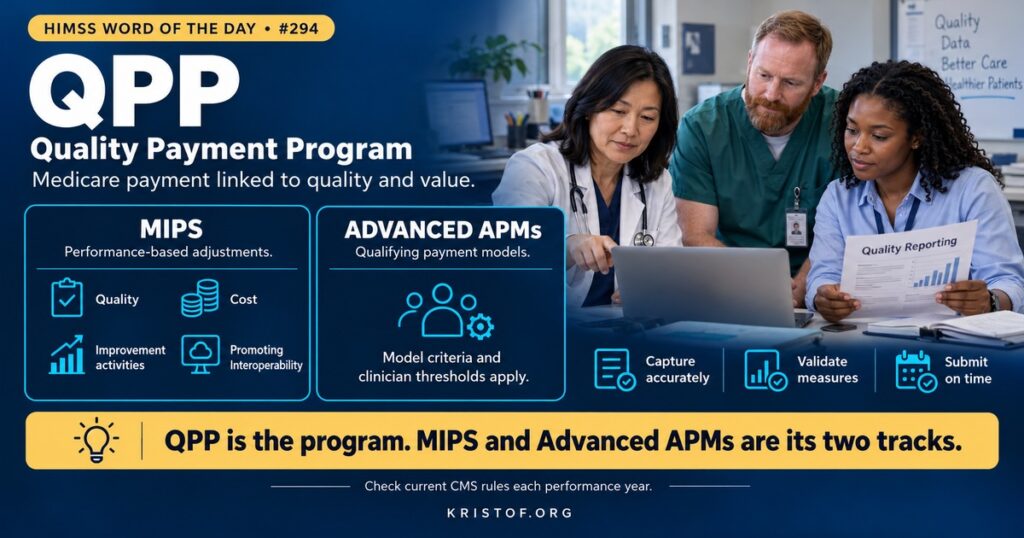
The Quality Payment Program (QPP) is the Medicare program that links payment for clinicians’ services to measures of quality and value. The HIMSS Dictionary says CMS created it under the Medicare Access and CHIP Reauthorization Act of 2015 (MACRA), that it replaced the Sustainable Growth Rate formula previously used to set Medicare payment, and that it began on January 1, 2017. Clinicians choose, or are placed in, one of two tracks: the Merit-based Incentive Payment System (MIPS) or Advanced Alternative Payment Models (Advanced APMs).
Under MIPS, eligible clinicians are scored in four performance categories, according to 42 CFR 414.1380: quality, cost, improvement activities, and Promoting Interoperability. Quality measures are scored from zero to 10 measure achievement points against benchmarks, cost measures from 1 to 10 points, improvement activities are scored against a total of 40 points, and Promoting Interoperability measures against a total of 100 points. The category scores combine into a final score from 0 to 100.
The final score determines the payment adjustment. Per 42 CFR 414.1405, CMS sets a performance threshold for each payment year; clinicians scoring at the threshold receive no adjustment, those above receive a positive adjustment on a sliding scale, and those below receive a negative adjustment. For payment year 2022 and later, the applicable percent is 9 percent, meaning the maximum negative adjustment is 9 percent. The regulation sets the performance threshold at 75 points for payment years 2024 through 2030 and allows a scaling factor, not to exceed 3.0, on positive adjustments to maintain budget neutrality. An additional adjustment for exceptional performance applied only for payment years 2019 through 2024. The Advanced APM track is covered in the preceding word of the day.
| QPP Track | Who Is In It | How Payment Changes |
|---|---|---|
| MIPS | Most eligible clinicians not in an Advanced APM | Adjustment based on a 0 to 100 final score |
| Advanced APM | Clinicians in qualifying models meeting thresholds | APM payment terms, financial risk, and an incentive that has declined |
| MIPS APM reporting | Clinicians in certain other models | Scored under MIPS using the model’s reporting |
⚠️ Exam Alert: QPP is the program; MIPS and Advanced APMs are its two tracks. MIPS has four performance categories: quality, cost, improvement activities, and Promoting Interoperability. MACRA is the law; QPP is the CMS program implementing it.
🌐 Why It Matters: Real-World Healthcare IT Context
For clinicians and health systems, QPP turns reporting into revenue. Documentation, measure definitions, and interoperability capabilities determine scores, and the scores determine whether payments rise or fall. For informatics teams, that means constant attention to the rules, which change frequently, and to the data that feed submissions. The regulation allows data to be submitted through third-party intermediaries such as qualified registries and qualified clinical data registries, which must meet approval criteria and certify that data are true, accurate, and complete.
Two recent studies show that the program’s results depend on pathway as well as performance. A 2022 economic evaluation in JAMA Ophthalmology used public CMS data for ophthalmologists in the 2019 performance year. In that year, 76.5 percent (13,621) of Medicare-registered ophthalmologists participated through MIPS; about 99 percent of the analyzed participants received nonnegative adjustments and 92.6 percent received positive adjustments. Individual filers were less likely to achieve exceptional performance scores than those reporting through an Advanced APM or as a group. Among the 78.4 percent of those with payment data who reached exceptional scores, the estimated mean adjustment per physician ranged from about 245 to 4,865 dollars, which the authors calculated as 0.07 to 1.33 percent of Medicare payments. The authors framed it as an economic evaluation of what MIPS scoring and reporting yield for a specialty.
A 2026 study in Baylor University Medical Center Proceedings used 2023 CMS data on 291,121 clinicians across 29 specialties and matched clinicians in MIPS APMs to comparable group-reporting clinicians. APM participation rates ranged from 7.6 percent in dermatology to 40.6 percent in hospital medicine. Across nearly all specialties, clinicians who participated through an APM received higher predicted payment adjustments than comparable group-reporting clinicians, by amounts from 100 dollars for obstetrics and gynecology to 2,327 dollars for radiation oncology. The authors concluded that MIPS payment reflects not only performance but also the structural pathway through which it is reported, and noted that MIPS participation carries estimated costs of several thousand dollars per physician annually, so specialties with limited APM access may bear a net financial burden. The study is observational and relies on matching, but it raises an equity question that the program’s designers continue to face.
A third study compared the two tracks directly. A 2024 analysis in Inquiry found that Medicare Part B medical services payments to primary care clinicians in ACOs, the main Advanced APM participants, increased more after QPP began than payments to MIPS clinicians. The authors stated that this may reflect higher payment adjustments for ACO clinicians or a shift toward outpatient services intended to prevent costlier inpatient care.
For health systems, preparing for QPP means managing it as a program. A designated lead tracks yearly rules and deadlines. Informatics teams map each required measure to documentation workflows, test measure calculations against chart review, and monitor performance during the year so that gaps can be fixed before the period ends. They also decide whether to report as individuals, groups, or through an APM entity, and whether to use a registry. Compliance staff keep evidence for improvement activities and Promoting Interoperability measures.
Common QPP challenges:
- Annual rule changes that disrupt workflows and measure builds
- Measures that depend on documentation unrelated to patient needs
- Specialties without relevant measures or APM options
- Small practices without staff for reporting
- Data submitted late, incomplete, or inconsistent with the chart
- Reporting costs that approach or exceed adjustments
What supports a strong QPP program:
- A named program lead and calendar
- Measure-to-workflow maps and chart validation
- Monitoring of scores during the performance year
- Choice of reporting pathway based on analysis
- Registry or vendor partnerships with clear certification of data
- Clinician education on why documentation matters
🏥 The Nurse’s Perspective: Clinical, Bedside, & Workflow
Nurses do not usually report to MIPS themselves, but their documentation and care processes influence many measures.
At the Bedside
In ambulatory settings, nurses and medical assistants capture the vital signs, screenings, immunizations, and medication reviews that quality measures draw from. Recording them in the designated fields, not in free text, allows the EHR to count them.
In Clinical Workflow
Clinic nurses run outreach for overdue screenings, close care gaps at visits, and complete standing-order protocols that raise performance on preventive measures. Nurse managers review measure reports with clinicians and decide which tasks belong to which role.
Nurse informaticists translate measure specifications into templates and workflows, validate reports against charts, and train staff on documentation expectations. They also help identify when a measure fails because of a workflow issue and not because care was not delivered.
In EHR Implementation (Go-Live Perspective)
An Epic Go-Live in ambulatory settings must set up measure capture before the performance period begins. At-the-elbow support analysts hear when a required field is hard to find or when staff chart in a way that does not count, and they pass these findings back to the build team promptly because a missed month of data may not be recoverable.
🎓 CAHIMS / CPHIMS & HIMSS Perspective
CAHIMS Exam Domain Mapping
QPP appears in payment policy, quality reporting, and EHR requirement questions:
| CAHIMS Domain | How QPP Appears |
|---|---|
| Healthcare & Technology Environments | MACRA, Medicare payment policy, regulation |
| Clinical Informatics | Quality measures, documentation workflows, clinical quality reporting |
| Healthcare Information & Systems Management | Measure calculation, registries, data submission |
| Management & Leadership | Program management, compliance, financial analysis |
Key Terms to Know Alongside QPP
- MACRA — law that created the Quality Payment Program
- Merit-based Incentive Payment System (MIPS) — QPP track that adjusts payment based on a performance score
- Advanced APM — QPP track for clinicians in qualifying risk-bearing payment models
- Promoting Interoperability — MIPS category for use of certified EHR technology and data exchange
- Performance Threshold — final score at which MIPS adjustment is neutral
- Qualified Clinical Data Registry (QCDR) — approved organization that collects and submits clinician data
HIMSS Organizational Position
HIMSS supports value-based care and the health information infrastructure that makes it possible through its public policy work, research, and education. Members can find related resources through the HIMSS Resource Center.
🔗 Explore Further: External References
- eCFR — 42 CFR 414.1380, Scoring https://www.ecfr.gov/current/title-42/chapter-IV/subchapter-B/part-414/subpart-O/section-414.1380
- eCFR — 42 CFR 414.1405, Payment https://www.ecfr.gov/current/title-42/chapter-IV/subchapter-B/part-414/subpart-O/section-414.1405
- Berkowitz et al. (2022), JAMA Ophthalmology — Economic Evaluation of the Merit-Based Incentive Payment System for Ophthalmologists: Analysis of 2019 Quality Payment Program Data https://pubmed.ncbi.nlm.nih.gov/35420641/
- Letchuman et al. (2026), Baylor University Medical Center Proceedings — Payment Adjustments by Physician Specialty and Participation Type in the Merit-Based Incentive Payment System https://pubmed.ncbi.nlm.nih.gov/42657815/
- Shrestha et al. (2024), Inquiry — ACO Clinicians Have Higher Medicare Part B Medical Services Payments Than MIPS Clinicians Under the Quality Payment Program https://pubmed.ncbi.nlm.nih.gov/38515280/
- CMS — Quality Payment Program https://qpp.cms.gov/
Term source: HIMSS Dictionary of Health Information and Technology Terms, Acronyms, and Organizations, 6th Edition (2025). All definitions in this series are paraphrased for editorial purposes. Readers are encouraged to consult the primary source for exact language.
Eric Andrew Kristof, RN, CAHIMS is a Healthcare IT professional and HIMSS Arkansas Chapter member based in Hot Springs Village, AR, with hands-on Epic Go-Live experience and a diverse healthcare and IT background. He writes at kristof.org at the intersection of clinical care and healthcare technology.
Leave a Reply