By Eric Andrew Kristof, RN, CAHIMS | Healthcare IT Professional | HIMSS Arkansas Chapter Member
About This Series: The HIMSS Word of the Day is a running blog series drawing from the HIMSS Dictionary of Health Information and Technology Terms, Acronyms, and Organizations, 6th Edition (2025) — the authoritative reference for healthcare IT professionals and the primary study resource for CAHIMS and CPHIMS certification. Each post paraphrases the term in plain language, grounds it in real-world healthcare IT context, and adds a bedside nursing perspective you won’t find in a textbook.
📖 The Term: Nutrition Informatics
Source: HIMSS Dictionary of Health Information and Technology Terms, Acronyms, and Organizations, 6th Edition (2025)
🔍 Plain-Language Definition
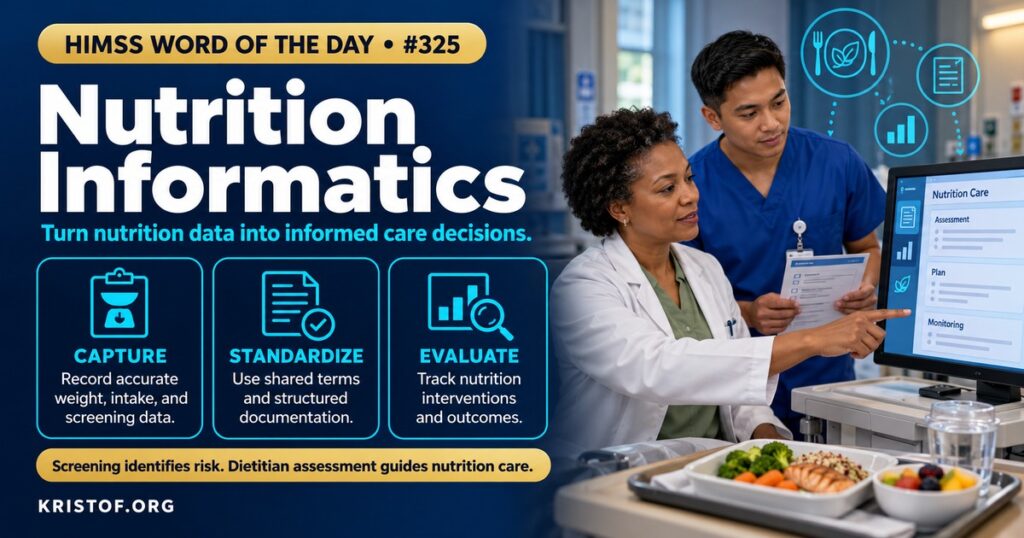
Nutrition informatics is, in the wording of the HIMSS Dictionary, the effective retrieval, organization, storage, and best use of information, data, and knowledge for solving problems and making decisions about food and nutrition. The Dictionary adds that this work rests on information standards, processes, and technology. Put another way, it is the application of informatics to dietetics and nutrition: how nutrition data are captured in the EHR, how they are coded, how screening and decision support work, and how the results are used for care and research.
A central framework is the Nutrition Care Process (NCP), a four-step approach used by dietitians: assessment, nutrition diagnosis, intervention, and monitoring and evaluation. The Nutrition Care Process Terminology (NCPT) provides standardized terms for each step so that documentation is consistent across clinicians and sites. Informatics extends this by building NCP-based templates and flowsheets, standard terms in the EHR, and reports.
| Informatics Element | Role in Nutrition Care | Example |
|---|---|---|
| Screening tools | Flag patients at nutritional risk | Automated screen from weight and BMI |
| Standardized terminology | Make documentation consistent | NCP terms for nutrition diagnoses |
| Documentation templates | Structure assessment and plans | NCP note in the EHR |
| Decision support | Prompt timely consults and orders | Alert for poor intake or weight loss |
| Data analysis | Measure outcomes and quality | Malnutrition rates by unit |
⚠️ Exam Alert: Nutrition informatics applies informatics principles to food and nutrition. The Nutrition Care Process has four steps: assessment, diagnosis, intervention, and monitoring and evaluation. A standardized terminology improves consistency and reuse of data. Screening identifies risk; a full assessment by a dietitian confirms diagnosis.
🌐 Why It Matters: Real-World Healthcare IT Context
Nutrition problems such as malnutrition are common, treatable, and often missed. Informatics affects whether they are found, documented, and acted on. Three studies illustrate the practical issues.
The first examines documentation quality. A 2024 audit in the Journal of Human Nutrition and Dietetics reviewed 92 electronic patient records at a multi-site Swiss hospital that adopted the Nutrition Care Process in 2013. The audit, using the Diet-NCP-Audit tool translated into French, rated documentation quality as high in 62 percent of records, and nutrition diagnoses were mostly documented. In half of the records, however, the nutrition assessment was not consistent with the nutrition diagnosis. Of the 73 nutrition problems defined in the NCP terminology, only four (5 percent) accounted for 58 percent of the 189 problems identified. The authors concluded that the entire process needs improved consistency and that the poorly documented link between steps and the narrow range of problems chosen could mean dietitians had not fully adopted the critical thinking the NCP stresses. The study is from one hospital, but its method is a model for how informatics teams can audit structured documentation.
The second examines adoption. A 2026 mixed methods study in Frontiers in Nutrition combined responses from 4,426 US registered dietitian nutritionists to a 2017 implementation survey with focus groups of 38 dietitians. Enablers included peer support, reported by 59 percent of clinical dietitians, and job requirements, reported by 52.9 percent. Barriers included limited time (28.9 percent of clinical dietitians) and insufficient education (25 percent). The focus groups added that integrating the NCP terminology into the EHR was an enabler, and that access to a subscription for the electronic terminology was a barrier. The survey is from 2017, so some of the numbers may have changed, but the finding that EHR integration helps and cost or time hinders is useful for planning.
The third examines automation. A 2026 study in the Journal of the American Medical Directors Association developed AutoMal, a malnutrition screening model based on routinely collected data, using 539 residents from 10 long-term care facilities in Australia and the Subjective Global Assessment as the reference standard. Body mass index and percent weight change over six months were retained in all bootstrapped samples. The model had an area under the curve of 0.8378, sensitivity of 78 percent, and specificity of 77 percent, and the authors noted that it uses two variables commonly found in electronic health records. It was validated only internally and in one country, so external validation is needed, and a screening tool with 78 percent sensitivity still misses some residents who are malnourished. It shows how routine EHR data can support early identification when it is accurate and timely.
These findings suggest priorities for nutrition informatics. Build documentation templates that follow the NCP so that each step links to the next, and audit them periodically. Make standardized terminology available inside the workflow, not behind a separate subscription or screen. Use routine data such as weight, BMI, intake, and lab results to trigger screening and referral, and validate any automated tool in the local population. Share data with quality teams so malnutrition and nutrition interventions can be measured. And include dietitians in EHR governance, since their documentation is often an afterthought in build decisions.
Common nutrition informatics problems:
- Free-text nutrition notes that cannot be analyzed
- Narrow use of the available standardized terms
- Assessment and diagnosis that do not connect
- Weight and intake data that are missing or inconsistent
- Terminology access that adds cost or steps
- Screening alerts that are not matched to staffing
What supports effective nutrition informatics:
- Templates built around the Nutrition Care Process
- Standard terminology integrated in the EHR
- Regular documentation audits
- Screening that uses routinely collected data
- Dietitian participation in EHR governance
- Reports that track malnutrition and intervention outcomes
🏥 The Nurse’s Perspective: Clinical, Bedside, & Workflow
Nurses collect much of the data that nutrition informatics depends on, including weights, intake, swallowing observations, and meal tolerance.
At the Bedside
Accurate weights, intake records, and notes about appetite or swallowing difficulty feed screening tools and dietitian assessments. A missing weight or an estimated one can hide a decline, and inconsistent intake documentation makes it hard for a dietitian to see the pattern.
In Clinical Workflow
Nurse managers monitor whether admission nutrition screens are completed and whether flagged patients receive a timely dietitian consult. They help teams decide who records weights, how often, and in which field.
Nurse informaticists work with dietitians to design screening questions and alerts, test them on the unit, and review the effect on workload. They also help align nursing and dietitian documentation so that both rely on the same weight and intake data.
In EHR Implementation (Go-Live Perspective)
An Epic Go-Live includes nutrition screening, diet orders, and meal documentation. At-the-elbow support analysts hear when a weight field is hard to find or a diet order change does not reach the kitchen, and these reports let the team fix flows that affect patient safety, such as allergies or swallowing precautions.
🎓 CAHIMS / CPHIMS & HIMSS Perspective
CAHIMS Exam Domain Mapping
Nutrition informatics appears in documentation, terminology, and decision support questions:
| CAHIMS Domain | How Nutrition Informatics Appears |
|---|---|
| Healthcare & Technology Environments | Professional standards, terminology organizations |
| Clinical Informatics | Screening, assessment, care process documentation |
| Healthcare Information & Systems Management | Templates, standard terms, reporting, data quality |
| Management & Leadership | Governance, auditing, interdisciplinary collaboration |
Key Terms to Know Alongside Nutrition Informatics
- Nutrition Care Process (NCP) — four-step approach to nutrition care used by dietitians
- Nutrition Care Process Terminology (NCPT) — standardized terms for each NCP step
- Malnutrition Screening — brief assessment to identify patients at nutritional risk
- Subjective Global Assessment — clinical tool for assessing nutritional status
- Flowsheet — structured EHR record of repeated measurements
- Clinical Decision Support — tools that prompt appropriate actions using patient data
HIMSS Organizational Position
HIMSS supports the use of informatics across health professions through its research, education, and community work, including the Nursing Informatics Community. Members can find related resources through the HIMSS Nursing Informatics Community page.
🔗 Explore Further: External References
- Aurélien et al. (2024), Journal of Human Nutrition and Dietetics — Evaluation of the Nutrition Care Process Documentation in the Patients’ Records Using the Diet-NCP-Audit: Experience in a Medium-Sized Multi-Site Swiss Hospital https://pubmed.ncbi.nlm.nih.gov/38268332/
- Asare et al. (2026), Frontiers in Nutrition — Exploration of Barriers and Enablers for the Use of the Nutrition Care Process Among a Diverse Sample of Registered Dietitian Nutritionists: A Mixed Methods Analysis https://pubmed.ncbi.nlm.nih.gov/41693946/
- Foo et al. (2026), Journal of the American Medical Directors Association — An Automated Malnutrition Screening Tool Using Routinely Collected Data for Older Adults in Long-Term Care: Development and Internal Validation of AutoMal https://pubmed.ncbi.nlm.nih.gov/39265634/
- HIMSS — Nursing Informatics Community https://www.himss.org/networking/communities/nursing-informatics/
- HealthIT.gov — Clinical Decision Support https://healthit.gov/clinical-quality-and-safety/clinical-decision-support/
Term source: HIMSS Dictionary of Health Information and Technology Terms, Acronyms, and Organizations, 6th Edition (2025). All definitions in this series are paraphrased for editorial purposes. Readers are encouraged to consult the primary source for exact language.
Eric Andrew Kristof, RN, CAHIMS is a Healthcare IT professional and HIMSS Arkansas Chapter member based in Hot Springs Village, AR, with hands-on Epic Go-Live experience and a diverse healthcare and IT background. He writes at kristof.org at the intersection of clinical care and healthcare technology.
Leave a Reply