By Eric Andrew Kristof, RN, CAHIMS | Healthcare IT Professional | HIMSS Arkansas Chapter Member
About This Series: The HIMSS Word of the Day is a running blog series drawing from the HIMSS Dictionary of Health Information and Technology Terms, Acronyms, and Organizations, 6th Edition (2025) — the authoritative reference for healthcare IT professionals and the primary study resource for CAHIMS and CPHIMS certification. Each post paraphrases the term in plain language, grounds it in real-world healthcare IT context, and adds a bedside nursing perspective you won’t find in a textbook.
📖 The Term: Arden Syntax
Source: HIMSS Dictionary of Health Information and Technology Terms, Acronyms, and Organizations, 6th Edition (2025)
🔍 Plain-Language Definition
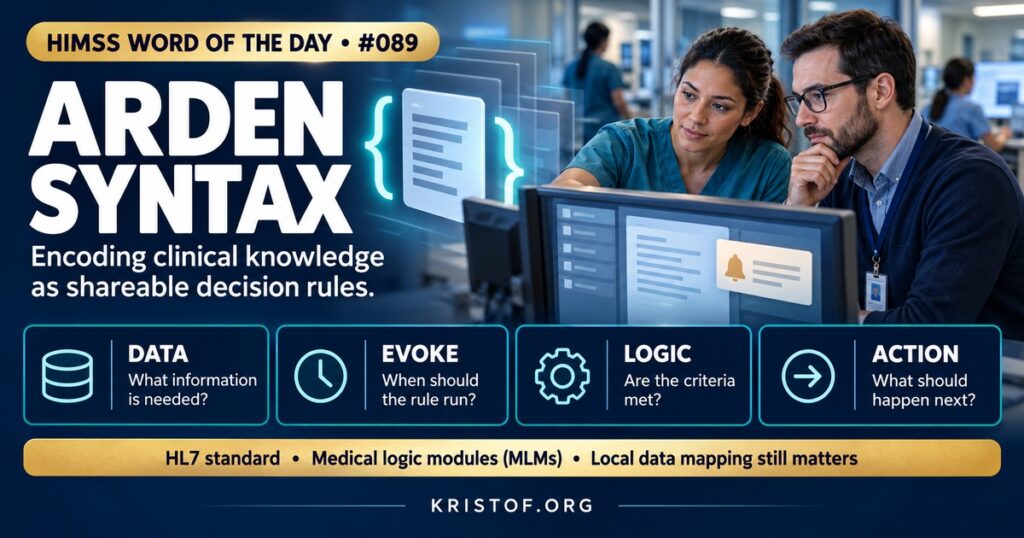
Arden Syntax is a standard language for writing clinical decision support rules so that computers can execute them and organizations can share them. Each rule is packaged as a medical logic module (MLM), a self-contained unit of clinical knowledge that describes when the rule runs, what data it checks, and what it does.
The HIMSS Dictionary describes Arden Syntax as a language designed to express the steps of a clinical protocol as situation-action rules that a computer can interpret, and to make it easier to exchange those rules between institutions.
According to a 2012 paper in the Journal of Biomedical Informatics by Matthias Samwald and colleagues, Arden Syntax has a history reaching back to 1989 and is maintained by HL7 International.
A medical logic module is organized into categories, each with slots that hold specific information:
| MLM Section | Purpose | Example Content |
|---|---|---|
| Maintenance | Identifies the module, author, version, and validation status | Title, institution, last reviewed date |
| Library | Explains the purpose and evidence | Rationale and citations for the rule |
| Knowledge: Data | Defines the data the rule needs | Most recent serum potassium; active digoxin order |
| Knowledge: Evoke | Defines when the rule runs | When a new potassium result is stored |
| Knowledge: Logic | The decision criteria | If potassium is low and the patient is on digoxin |
| Knowledge: Action | What happens when criteria are met | Send an alert to the ordering provider |
⚠️ Exam Alert: Arden Syntax is an HL7 standard for encoding decision rules in medical logic modules. Clinical Quality Language (CQL) is a newer HL7 standard for expressing clinical logic used in quality measures and decision support. CDS Hooks is an HL7 standard for calling external decision support services at specific points in EHR workflow. All aim to make decision support logic more shareable and consistent.
🌐 Why It Matters: Real-World Healthcare IT Context
Clinical decision support depends on encoding knowledge into rules: alerts for drug interactions, reminders for preventive care, warnings about abnormal results. Building those rules separately at every hospital is slow and inconsistent. Arden Syntax was designed to let institutions share rules instead of reinventing them.
In practice, sharing was harder than expected. Each MLM needs to retrieve data from the local system, and Arden Syntax left the details of those queries inside curly braces to be filled in by each institution. This became known as the curly braces problem: the clinical logic could be shared, but the data mappings inside the braces had to be rewritten for every system, which limited portability.
Arden Syntax has still been used successfully in production systems. Samwald and colleagues described a development environment, compiler, rule engine, and server for Arden-based decision support, applied in areas such as hepatitis serology interpretation and monitoring of hospital-acquired infections, and found the standard well suited to practical implementation.
Newer standards address the data problem more directly. FHIR provides standard data models and APIs, so logic can refer to common resources rather than local tables. CQL expresses logic in a way designed to work with standard data models, and CDS Hooks allows EHRs to call external decision support services at points such as opening a chart or signing an order. Together, they represent the modern version of Arden’s original goal.
Whatever the technology, decision support rules need governance. Poorly targeted rules contribute to alert fatigue, and rules that are never reviewed can become outdated or unsafe.
Common challenges with rule-based decision support:
- Local data mapping that limits sharing of rules
- Rules that fire too often, contributing to alert fatigue
- Outdated logic that no longer reflects current evidence
- Poor documentation of why a rule exists and who owns it
- Limited testing against real patient data before release
- Few measures of whether rules change outcomes
Characteristics of well-governed decision support:
- Clear ownership, evidence, and review dates for each rule
- Standard data models and terminologies behind rule logic
- Testing with realistic scenarios and silent-mode trials before go-live
- Monitoring of firing rates, override rates, and outcomes
- Clinician involvement in design and retirement of rules
- Use of modern standards such as CQL and CDS Hooks where appropriate
🏥 The Nurse’s Perspective: Clinical, Bedside, & Workflow
Nurses interact with rule-based decision support constantly, even if they never see the language behind it.
At the Bedside
Alerts about drug interactions, allergy conflicts, overdue reassessments, sepsis screening, and fall risk are all forms of rule-based decision support. A well-designed rule appears at the right time with clear, actionable guidance. A poorly designed one interrupts work without adding value, and repeated low-value alerts teach clinicians to click past important ones.
Nursing-specific rules are common: reminders to reassess pain after a PRN dose, prompts to complete restraint documentation, or alerts when a vital sign crosses a threshold. Nurses’ feedback about which rules help and which do not is essential for improving them.
In Clinical Workflow
When nurses respond to a rule, their response often becomes data. Override reasons, acknowledgments, and documented actions show whether the rule is working. Choosing accurate override reasons, rather than the first option in the list, helps decision support teams improve or retire rules.
Nurse informaticists frequently help design and review rules, translating clinical guidelines into logic, defining which data the rule needs, and testing whether the rule fires correctly.
In EHR Implementation (Go-Live Perspective)
During an Epic implementation, decision support rules from the legacy system are reviewed, rebuilt, retired, or replaced. Because the underlying data and workflows change, rules that worked before may fire differently in the new system, so testing with realistic scenarios is important.
At-the-elbow support analysts often hear about alerts that seem new, confusing, or excessive during the first weeks. Capturing specific examples, including the alert, the patient context, and what the user expected, helps decision support teams tune rules quickly during stabilization.
🎓 CAHIMS / CPHIMS & HIMSS Perspective
CAHIMS Exam Domain Mapping
Arden Syntax appears in decision support and standards questions:
| CAHIMS Domain | How Arden Syntax Appears |
|---|---|
| Healthcare & Technology Environments | History of decision support standards; HL7’s role |
| Clinical Informatics | Rule design, alert fatigue, clinician feedback, decision support governance |
| Healthcare Information & Systems Management | Medical logic modules, rule engines, data mapping, CQL, CDS Hooks, FHIR |
| Management & Leadership | Knowledge management, rule ownership, review cycles, measuring impact |
Key Terms to Know Alongside Arden Syntax
- Medical Logic Module (MLM) — a self-contained Arden Syntax rule containing data, trigger, logic, and action
- Curly Braces Problem — the challenge that local data queries in Arden rules must be rewritten for each system
- Clinical Quality Language (CQL) — an HL7 standard for expressing clinical logic for quality measures and decision support
- CDS Hooks — an HL7 standard for invoking decision support services at defined points in EHR workflow
- Rules Engine — software that evaluates rules against data and triggers actions
- Alert Fatigue — desensitization to alerts caused by excessive or low-value notifications
HIMSS Organizational Position
HIMSS supports effective, well-governed clinical decision support as part of clinical informatics and patient safety, and its education and maturity models emphasize decision support that improves outcomes without overwhelming clinicians. Members can find related education and research through the HIMSS Resource Center.
🔗 Explore Further: External References
- HL7 International — Arden Syntax v2.10 Product Brief https://www.hl7.org/implement/standards/product_brief.cfm?product_id=372
- Samwald et al. (2012), Journal of Biomedical Informatics — The Arden Syntax Standard for Clinical Decision Support https://pubmed.ncbi.nlm.nih.gov/22342733/
- HL7 — CDS Hooks https://cds-hooks.hl7.org/
- eCQI Resource Center — Clinical Quality Language (CQL) https://ecqi.healthit.gov/cql/versions
- ONC — Clinical Decision Support https://healthit.gov/clinical-quality-and-safety/clinical-decision-support/
- AHRQ PSNet — Alert Fatigue https://psnet.ahrq.gov/primer/alert-fatigue
Term source: HIMSS Dictionary of Health Information and Technology Terms, Acronyms, and Organizations, 6th Edition (2025). All definitions in this series are paraphrased for editorial purposes. Readers are encouraged to consult the primary source for exact language.
Eric Andrew Kristof, RN, CAHIMS is a Healthcare IT professional and HIMSS Arkansas Chapter member based in Hot Springs Village, AR, with hands-on Epic Go-Live experience and a diverse healthcare and IT background. He writes at kristof.org at the intersection of clinical care and healthcare technology.
Leave a Reply