By Eric Andrew Kristof, RN, CAHIMS | Healthcare IT Professional | HIMSS Arkansas Chapter Member
About This Series: The HIMSS Word of the Day is a running blog series drawing from the HIMSS Dictionary of Health Information and Technology Terms, Acronyms, and Organizations, 6th Edition (2025) — the authoritative reference for healthcare IT professionals and the primary study resource for CAHIMS and CPHIMS certification. Each post paraphrases the term in plain language, grounds it in real-world healthcare IT context, and adds a bedside nursing perspective you won’t find in a textbook.
📖 The Term: View, Download, and Transmit (VDT)
Source: HIMSS Dictionary of Health Information and Technology Terms, Acronyms, and Organizations, 6th Edition (2025)
🔍 Plain-Language Definition
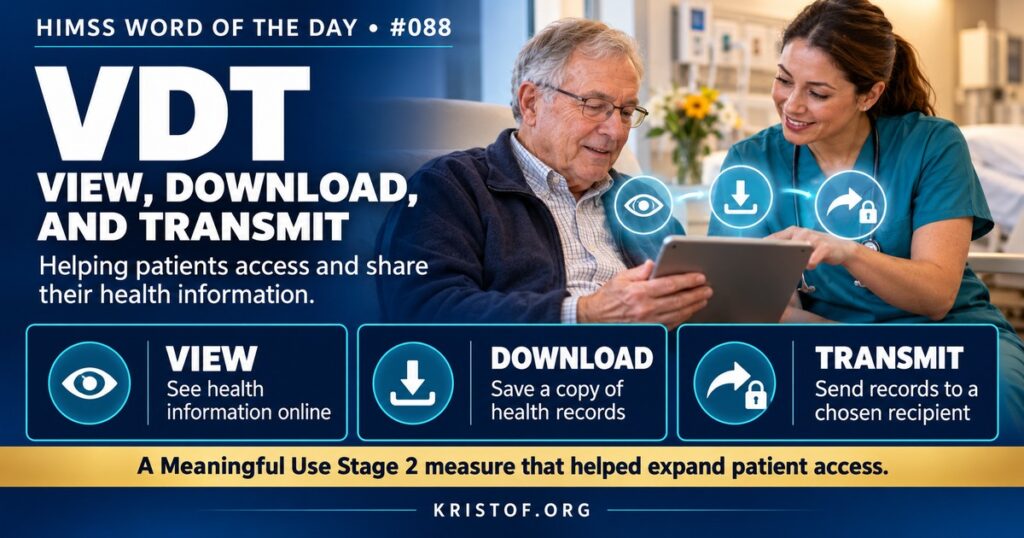
View, Download, and Transmit (VDT) describes three ways patients could use their electronic health information under the federal EHR incentive program known as Meaningful Use. Patients should be able to view their information online, download it, and transmit it to someone they choose.
The HIMSS Dictionary explains that VDT was previously one of the required core measures in Stage 2 of the CMS Meaningful Use program. In its description, view means that patients, or someone authorized to act for them, can look at their health information online; download refers to retrieving the visit or hospital summary that fits the care setting, either in human-readable form or in a format that follows the adopted standard with minimum required content; and transmit refers to sending those downloaded summaries to a third party.
| VDT Element | What It Enabled | Typical Implementation |
|---|---|---|
| View | Seeing health information online | Patient portal showing results, medications, allergies, and visit summaries |
| Download | Saving a copy of records | Human-readable summary or a standards-based clinical document |
| Transmit | Sending records to a chosen recipient | Secure transmission of a summary to another provider or service |
Meaningful Use Stage 2 measured VDT in two ways: whether organizations offered timely online access to most patients, and whether at least some patients actually viewed, downloaded, or transmitted their information.
⚠️ Exam Alert: VDT was a Meaningful Use Stage 2 measure under the CMS EHR Incentive Programs, which later became Promoting Interoperability. Patient portals were the main way organizations met it. The HIPAA right of access is a separate, ongoing legal right to obtain copies of records. Today’s standardized FHIR APIs and information blocking rules extend patient access well beyond VDT.
🌐 Why It Matters: Real-World Healthcare IT Context
VDT changed patient access from optional to expected. Before Meaningful Use, many organizations offered limited online access or none. Because VDT was tied to incentive payments and later to payment adjustments, hospitals and practices had strong reasons to launch portals, release information to them promptly, and encourage patients to sign up and log in.
The patient-use requirement was especially significant. Offering access was not enough; organizations had to show that some patients actually used it. That pushed workflows such as portal enrollment at registration, discharge teaching that included portal activation, and messaging that encouraged patients to view results.
VDT also connected to the broader patient access movement. The Blue Button initiative, which began at the Department of Veterans Affairs and spread to Medicare and other organizations, popularized the idea that patients should be able to download their own data with one click. Transmit capabilities often relied on secure Direct messaging so summaries could be sent to another provider.
Later policy went further. The 21st Century Cures Act and ONC’s rules require certified EHRs to provide standardized FHIR APIs that patients can use through apps of their choice, and information blocking provisions discourage unreasonable delays in making electronic health information available. CMS’s Promoting Interoperability measures continue to include patient electronic access. In effect, VDT was an early step on the road to today’s API-based patient access.
Release timing became a lasting issue. Once results and notes appear in portals, patients may see them before a clinician has discussed them, which can be reassuring for some and distressing for others. Organizations balance prompt access, which federal rules increasingly expect, with support such as clear explanations, timely clinician follow-up, and easy ways for patients to ask questions.
Lessons from the VDT era:
- Mandated measures can rapidly change organizational behavior
- Access alone does not guarantee use; enrollment workflows matter
- Downloads in technical formats were not always useful to patients
- Transmit features were underused without clear patient needs
- Portals improved engagement but raised new questions about result release timing
- Measures that count activity can encourage box-checking
What modern patient access emphasizes:
- Standardized APIs that work with many apps
- Timely release of results and notes
- Proxy access for caregivers with appropriate safeguards
- Plain-language summaries and education alongside data
- Support for patients with limited digital access
- Privacy guidance for patients connecting third-party apps
🏥 The Nurse’s Perspective: Clinical, Bedside, & Workflow
Nurses helped make VDT work in practice and continue to support patient access today.
At the Bedside
During the Meaningful Use era, many organizations built portal enrollment into nursing and discharge workflows. Nurses explained the portal, provided activation codes, and encouraged patients to log in before leaving. That role continues, because a patient who activates the portal at discharge can review instructions, results, and follow-up appointments at home.
Patients may ask nurses about results they see in the portal before a provider has discussed them. Nurses can explain how and when the care team will follow up and encourage patients to send questions through the portal or call the appropriate line.
Proxy access is a common nursing conversation. Parents of minors, adult children of aging parents, and other caregivers often need portal access, and organizations set rules for granting it that balance support with the patient’s privacy, especially for adolescents.
In Clinical Workflow
The after-visit summary and discharge summary are among the most commonly viewed portal documents. Clear, accurate nursing contributions, such as education provided, follow-up instructions, and medication changes, make these documents more useful when patients review them later.
Transmitting records also has practical uses. Patients seeing new specialists or moving to another region may want to send their records ahead. Nurses can point patients to the portal’s sharing features or the organization’s release-of-information process.
In EHR Implementation (Go-Live Perspective)
During an Epic Go-Live, the patient portal often changes along with the EHR. Patients may need to activate new accounts, and portal features, such as result release timing, messaging, and sharing, are reconfigured. Nurses and front-desk staff often field questions from patients about these changes.
At-the-elbow support analysts can help staff generate activation codes, explain proxy access processes, and find what patients can see. Consistent scripts for answering portal questions reduce confusion in the first weeks.
🎓 CAHIMS / CPHIMS & HIMSS Perspective
CAHIMS Exam Domain Mapping
VDT appears in policy history and patient engagement questions:
| CAHIMS Domain | How VDT Appears |
|---|---|
| Healthcare & Technology Environments | Meaningful Use stages; Promoting Interoperability; Cures Act and information blocking |
| Clinical Informatics | Portal enrollment workflows; discharge education; result release |
| Healthcare Information & Systems Management | Portal configuration, downloadable summaries, Direct messaging, FHIR APIs |
| Management & Leadership | Patient engagement strategy, measure tracking, compliance with access rules |
Key Terms to Know Alongside VDT
- Meaningful Use — the CMS EHR Incentive Program requirements established under the HITECH Act
- Patient Portal — a secure online tool through which patients access parts of their health record
- Blue Button — an initiative that lets individuals download and share their health information
- Direct Messaging — a standards-based method for securely sending health information to known recipients
- Information Blocking — practices that unreasonably interfere with access, exchange, or use of electronic health information
- HIPAA Right of Access — an individual’s right to inspect and obtain copies of their health information
HIMSS Organizational Position
HIMSS supports patient access to health information and engages on patient access and information blocking policy through its public policy work. Members can find related education and research through the HIMSS Resource Center.
🔗 Explore Further: External References
- CMS — Promoting Interoperability Programs https://www.cms.gov/medicare/regulations-guidance/promoting-interoperability-programs
- ONC — Patient Access to Health Records https://healthit.gov/patient-access-to-health-records/
- ONC — Information Blocking https://healthit.gov/information-blocking/
- ONC — Cures Act Final Rule https://healthit.gov/regulations/cures-act-final-rule/
- CMS — Blue Button API https://bluebutton.cms.gov/
- ONC — Health IT Legislation https://healthit.gov/legislation/
Term source: HIMSS Dictionary of Health Information and Technology Terms, Acronyms, and Organizations, 6th Edition (2025). All definitions in this series are paraphrased for editorial purposes. Readers are encouraged to consult the primary source for exact language.
Eric Andrew Kristof, RN, CAHIMS is a Healthcare IT professional and HIMSS Arkansas Chapter member based in Hot Springs Village, AR, with hands-on Epic Go-Live experience and a diverse healthcare and IT background. He writes at kristof.org at the intersection of clinical care and healthcare technology.
Leave a Reply