By Eric Andrew Kristof, RN, CAHIMS | Healthcare IT Professional | HIMSS Arkansas Chapter Member
About This Series: The HIMSS Word of the Day is a running blog series drawing from the HIMSS Dictionary of Health Information and Technology Terms, Acronyms, and Organizations, 6th Edition (2025) — the authoritative reference for healthcare IT professionals and the primary study resource for CAHIMS and CPHIMS certification. Each post paraphrases the term in plain language, grounds it in real-world healthcare IT context, and adds a bedside nursing perspective you won’t find in a textbook.
📖 The Term: Laboratory Information System (LIS)
Source: HIMSS Dictionary of Health Information and Technology Terms, Acronyms, and Organizations, 6th Edition (2025)
🔍 Plain-Language Definition
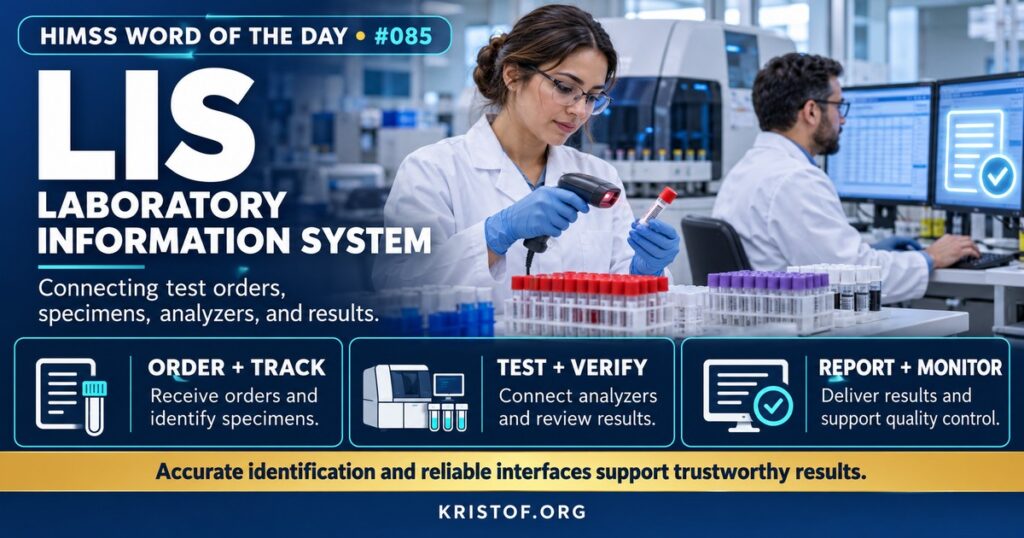
A laboratory information system (LIS) is the software that runs the clinical laboratory. It receives test orders, tracks specimens, connects to analyzers, manages quality control, and sends verified results to the EHR and other destinations.
The HIMSS Dictionary describes the LIS as an application that streamlines laboratory process management for core clinical services such as hematology and chemistry. It notes that the system may support microbiology reporting but generally does not handle blood bank functions. According to the Dictionary, the LIS interfaces automatically with laboratory instruments so verified results reach nursing units, charts, and remote physician offices; it lets users receive orders from designated locations, process them, and report results; and it maintains technical, statistical, and account information while reducing paperwork and manual calculation. The Dictionary also lists other names, including laboratory information management system (LIMS).
| LIS Function | What It Does | Example |
|---|---|---|
| Order Management | Receives and tracks test orders | A CBC and basic metabolic panel ordered from the EHR |
| Specimen Labeling and Tracking | Generates labels and follows specimens through the lab | Barcode labels printed at the bedside and scanned on receipt |
| Instrument Interfaces and Middleware | Sends work to analyzers and receives raw results | Chemistry analyzer results flowing into the LIS |
| Verification | Reviews results manually or with rules before release | Autoverification of normal results within defined limits |
| Result Reporting | Sends results to the EHR, providers, and other systems | Critical value flagged and called to the unit |
| Quality Control and Compliance | Tracks controls, calibrations, and regulatory documentation | Daily QC records for accreditation inspections |
⚠️ Exam Alert: The LIS manages clinical laboratory workflow. Blood bank systems usually run separately and are regulated more strictly. Anatomic pathology systems manage tissue and cytology workflows. LOINC identifies what test was performed, while HL7 messages carry orders and results. CLIA sets federal quality standards for laboratory testing.
🌐 Why It Matters: Real-World Healthcare IT Context
Laboratory results inform a large share of clinical decisions, and the LIS is the system that makes those results timely and trustworthy. It coordinates high volumes of specimens, many analyzers, and tight turnaround expectations, especially for emergency and critical care.
Federal oversight shapes lab operations. The Clinical Laboratory Improvement Amendments (CLIA), administered by CMS, set quality standards for laboratory testing performed on human specimens. Accreditation organizations, such as the College of American Pathologists, inspect laboratories against detailed standards, and the LIS stores much of the documentation that inspections require.
Integration is central to LIS value. Orders arrive from the EHR, results return through interfaces, and results are often sent onward to public health agencies through electronic laboratory reporting. Using LOINC codes for tests and standard units makes those results understandable to every receiving system. Middleware between analyzers and the LIS can apply rules that automatically verify routine results, flag unusual values for review, and request repeat testing, allowing staff to focus on results that need attention.
Pre-analytic errors, those occurring before testing begins, account for a substantial share of laboratory problems. Mislabeled specimens, wrong tubes, hemolyzed samples, and delays in transport can lead to wrong results attached to the wrong patient or unnecessary redraws.
Laboratory systems are also increasingly connected beyond the hospital. Outreach programs send orders and results to physician offices, reference laboratories exchange orders and results with hospital labs, and public health agencies receive electronic reports of notifiable conditions. Each connection adds value and adds another interface that must be tested, monitored, and maintained, with consistent patient identification and coding on both ends.
Common LIS-related problems:
- Mislabeled or unlabeled specimens
- Orders that do not match collected specimens
- Local test codes not mapped to LOINC
- Delayed results due to interface or middleware failures
- Critical values not communicated promptly
- Duplicate tests ordered because prior results were not visible
Characteristics of strong laboratory systems:
- Positive patient identification with barcode labeling at the bedside
- Real-time specimen tracking from collection to result
- Well-maintained autoverification rules with regular review
- Standard coding with LOINC and consistent units
- Reliable interfaces with monitoring and alerts
- Clear processes for communicating critical results
🏥 The Nurse’s Perspective: Clinical, Bedside, & Workflow
Nurses are a critical link in the laboratory chain, especially in specimen collection and identification.
At the Bedside
Many laboratory errors begin before the specimen reaches the lab. Nurses collecting blood, urine, or other specimens use two patient identifiers, print or retrieve the correct labels, and label specimens at the bedside in the patient’s presence. Scanning the patient’s wristband before printing labels, where supported, adds a layer of positive patient identification.
Correct tubes, proper volumes, and timely transport also matter. A hemolyzed potassium or a clotted CBC leads to redraws and delays, while a specimen labeled with another patient’s information can result in dangerous treatment decisions.
Add-on tests and timed specimens add complexity. When a provider adds a test to a specimen already in the lab, or orders serial troponins at set intervals, accurate collection times and clear communication with the lab keep results interpretable and avoid unnecessary redraws.
In Clinical Workflow
Point-of-care testing, such as bedside glucose, blood gas, or coagulation testing, often falls under laboratory oversight even when nurses perform it. Devices may upload results to the LIS or EHR, and operator certification, quality control, and correct patient association are part of the nurse’s responsibility.
Critical results require closed-loop communication. When the lab calls with a critical value, nurses document the call, read back the result, and notify the responsible provider promptly according to policy.
In EHR Implementation (Go-Live Perspective)
During an Epic Go-Live, lab ordering, specimen collection, and label printing workflows change. Nurses may learn new collection lists, new label printers, and new ways to document collection times. If the LIS remains a separate system, interfaces must be tested carefully for every test and specimen type.
At-the-elbow support analysts often help nurses find collection tasks, reprint labels, and troubleshoot label printers on the first days. When results appear in the lab but not in the chart, analysts escalate to integration teams with the order and accession details.
🎓 CAHIMS / CPHIMS & HIMSS Perspective
CAHIMS Exam Domain Mapping
The LIS appears in departmental systems and interoperability questions:
| CAHIMS Domain | How the LIS Appears |
|---|---|
| Healthcare & Technology Environments | CLIA and accreditation; public health lab reporting |
| Clinical Informatics | Specimen collection and labeling; critical results; point-of-care testing |
| Healthcare Information & Systems Management | HL7 interfaces, LOINC mapping, middleware, autoverification, label printing |
| Management & Leadership | Laboratory operations, turnaround metrics, error reduction, vendor management |
Key Terms to Know Alongside LIS
- Accession Number — the unique identifier assigned to a specimen or order in the laboratory
- Autoverification — rules-based automatic release of results that meet defined criteria
- Middleware — software between analyzers and the LIS that manages rules and data flow
- LOINC — a standard code system for identifying laboratory tests and observations
- CLIA — federal regulations establishing quality standards for clinical laboratory testing
- Positive Patient Identification — verifying patient identity, often with barcodes, before collection and labeling
HIMSS Organizational Position
HIMSS addresses laboratory systems as part of clinical informatics and interoperability, including standardized lab data exchange that supports care, public health, and research. Members can find related education and research through the HIMSS Resource Center.
🔗 Explore Further: External References
- CMS — Clinical Laboratory Improvement Amendments (CLIA) https://www.cms.gov/medicare/quality/clinical-laboratory-improvement-amendments
- College of American Pathologists https://www.cap.org/
- Regenstrief Institute — LOINC https://www.regenstrief.org/real-world-solutions/loinc/
- HL7 International — HL7 Version 2 Product Suite https://www.hl7.org/implement/standards/product_brief.cfm?product_id=185
- Association of Public Health Laboratories https://aphl.org/
- ONC — Interoperability Standards Platform https://isp.healthit.gov/
Term source: HIMSS Dictionary of Health Information and Technology Terms, Acronyms, and Organizations, 6th Edition (2025). All definitions in this series are paraphrased for editorial purposes. Readers are encouraged to consult the primary source for exact language.
Eric Andrew Kristof, RN, CAHIMS is a Healthcare IT professional and HIMSS Arkansas Chapter member based in Hot Springs Village, AR, with hands-on Epic Go-Live experience and a diverse healthcare and IT background. He writes at kristof.org at the intersection of clinical care and healthcare technology.
Leave a Reply