By Eric Andrew Kristof, RN, CAHIMS | Healthcare IT Professional | HIMSS Arkansas Chapter Member
About This Series: The HIMSS Word of the Day is a running blog series drawing from the HIMSS Dictionary of Health Information and Technology Terms, Acronyms, and Organizations, 6th Edition (2025) — the authoritative reference for healthcare IT professionals and the primary study resource for CAHIMS and CPHIMS certification. Each post paraphrases the term in plain language, grounds it in real-world healthcare IT context, and adds a bedside nursing perspective you won’t find in a textbook.
📖 The Term: Clinical Informatics
Source: HIMSS Dictionary of Health Information and Technology Terms, Acronyms, and Organizations, 6th Edition (2025)
🔍 Plain-Language Definition
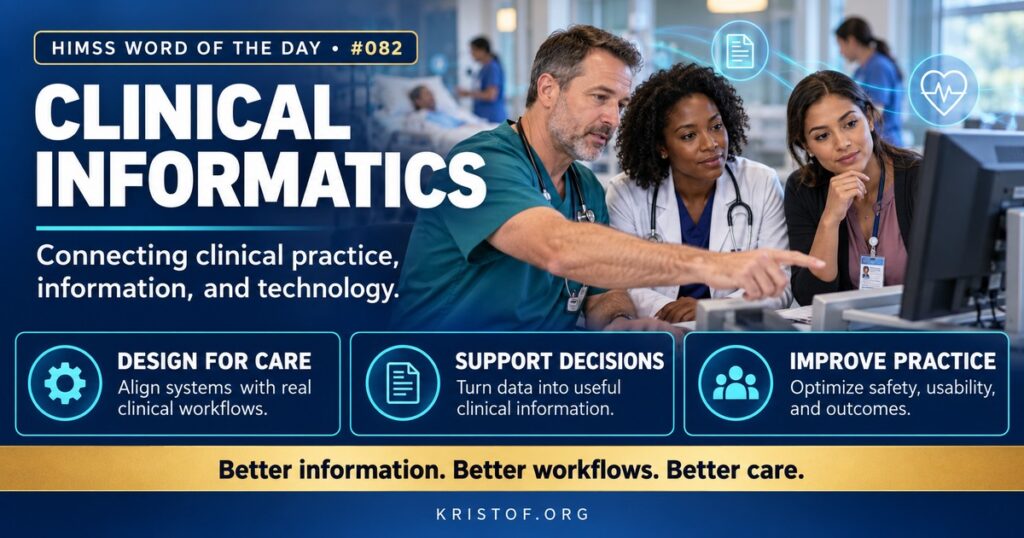
Clinical informatics is the field that uses information, data, and technology to improve how clinicians deliver care and how patients experience it. Clinical informaticists work at the intersection of clinical practice, information science, and computer systems.
The HIMSS Dictionary offers two related descriptions. First, clinical informatics advances the understanding, integration, and use of information technology in healthcare settings so that clinicians are well supported and best practices are followed. Second, it is the application of informatics and technology to the delivery of care, concentrating on how clinicians use information. The Dictionary notes that the field spans a broad range, from clinical decision support to medical images such as radiology, pathology, dermatology, and ophthalmology; from clinical documentation to provider order entry; and from system design to implementation, adoption, and optimization.
| Related Field | Focus | Example Work |
|---|---|---|
| Clinical Informatics | Information and technology in clinical care across disciplines | Designing decision support, documentation, and order sets |
| Nursing Informatics | Integration of nursing science with information and technology | Nursing documentation, care planning, medication administration workflows |
| Health Informatics | Information in health and healthcare broadly, including public and consumer health | Population health data, patient-facing tools |
| Biomedical Informatics | The scientific discipline spanning molecules to populations | Research methods, genomics, translational informatics |
| Health Information Management | Management of health records and health data as an asset | Coding, release of information, record integrity |
⚠️ Exam Alert: Clinical informatics focuses on information used by clinicians in care delivery. Nursing informatics is a recognized nursing specialty within that broader space. Health information management focuses on health records and data governance operations. Health IT refers to the technology itself. Expect questions that ask which discipline fits a given role or task.
🌐 Why It Matters: Real-World Healthcare IT Context
EHRs and other clinical systems are only as good as their fit with clinical work. Clinical informatics exists to make that fit better: designing systems around real workflows, turning data into useful decision support, reducing documentation burden, and preventing technology-related errors.
The field has matured into recognized specialties. A 2009 paper in JAMIA by Reed Gardner and colleagues defined the core content for a physician subspecialty in clinical informatics, and the American Board of Preventive Medicine now administers board certification in the subspecialty. For nurses, the American Nurses Credentialing Center offers informatics nursing board certification (NI-BC), and nursing informatics is recognized by the American Nurses Association as a nursing specialty with its own scope and standards of practice.
Organizations increasingly have formal informatics leadership. Chief medical information officers (CMIOs) and chief nursing information officers (CNIOs) lead clinical governance of technology, while physician and nurse informaticists, clinical analysts, and super users carry out the work.
Clinical informatics work is varied. A typical week for an informaticist might include leading a design session for a new order set, reviewing alert override data, meeting with nursing leaders about documentation burden, testing an upgrade, investigating a safety event involving the EHR, and teaching a group of new residents or nurses. The common thread is translating between clinical needs and technical possibilities, and using evidence and data to guide decisions.
Clinical informatics also addresses clinician well-being. Excessive clicks, inbox overload, alert fatigue, and after-hours documentation contribute to burnout, and informatics teams use data, design, and governance to reduce those burdens.
Common challenges for clinical informatics teams:
- Too few informaticists for the number of requests
- Optimization competing with regulatory and upgrade work
- Clinicians unaware of how to request changes
- Governance structures that move too slowly
- Difficulty measuring the value of informatics work
- Limited protected time for clinical informaticists who also practice
Governance is what turns individual requests into coherent improvement. Effective programs bring clinical leaders together to prioritize requests, set standards for documentation and decision support, and decide when to change or retire build. Without governance, systems accumulate inconsistent tools, duplicate forms, and alerts nobody owns.
What effective clinical informatics programs do:
- Establish clear clinical governance for design decisions
- Use data, such as audit logs and usage metrics, to find friction
- Involve frontline clinicians in design and testing
- Prioritize safety, usability, and burden reduction
- Provide training and career paths for informaticists
- Measure outcomes of optimization work
🏥 The Nurse’s Perspective: Clinical, Bedside, & Workflow
Nurses are central to clinical informatics, both as the largest group of clinical users and as informatics professionals.
At the Bedside
Every nurse practices a little informatics: deciding how to document an observation, choosing which data to review before a medication, or noticing that an alert does not make sense. Those everyday judgments are the raw material of informatics improvements. Reporting what works and what does not, with specific examples, is one of the most valuable contributions a bedside nurse can make.
Bedside experience also prepares nurses for informatics roles. Understanding how a medication pass, an admission, or a rapid response actually unfolds is knowledge that analysts and developers need and rarely have.
Nursing informatics has a long history. The American Nurses Association publishes a scope and standards of practice for the specialty, and professional groups bring nurse informaticists together to share practices and advocate for the field.
In Clinical Workflow
Nurse informaticists work on documentation design, care planning tools, medication administration workflows, device integration, alarm management, and training. They translate between clinical teams and technical teams, explaining clinical needs to builders and system constraints to clinicians. Many also lead or support optimization projects aimed at reducing documentation burden.
Paths into the field vary. Some nurses start as super users, become clinical analysts or trainers, pursue graduate education or certification, and move into informatics leadership. Others combine part-time clinical practice with informatics work.
In EHR Implementation (Go-Live Perspective)
An Epic implementation is an intensive clinical informatics experience. Clinicians on the project validate workflows, help design build, test scenarios, and support colleagues at Go-Live. At-the-elbow support work, in particular, builds a deep understanding of how design decisions affect real users.
Many nurses discover informatics careers through implementation projects. The combination of clinical credibility and system knowledge gained during Go-Live support is exactly what organizations look for in informatics roles afterward.
🎓 CAHIMS / CPHIMS & HIMSS Perspective
CAHIMS Exam Domain Mapping
Clinical Informatics is one of the four CAHIMS exam domains:
| CAHIMS Domain | How Clinical Informatics Appears |
|---|---|
| Healthcare & Technology Environments | Roles and disciplines in health IT; professional organizations and certifications |
| Clinical Informatics | Workflow, documentation, decision support, usability, clinician engagement |
| Healthcare Information & Systems Management | System design, testing, implementation, and optimization with clinical input |
| Management & Leadership | Clinical governance, CMIO and CNIO roles, prioritization, measuring value |
Key Terms to Know Alongside Clinical Informatics
- Nursing Informatics — the nursing specialty that integrates nursing science with information management and technology
- Chief Medical Information Officer (CMIO) — a physician leader responsible for clinical technology strategy and governance
- Chief Nursing Information Officer (CNIO) — a nurse leader responsible for nursing technology strategy and governance
- Clinical Decision Support (CDS) — tools that provide clinicians with knowledge and patient-specific information to guide decisions
- Usability — how effectively, efficiently, and satisfactorily users can complete tasks with a system
- Optimization — ongoing improvement of systems after implementation to better support users and outcomes
HIMSS Organizational Position
HIMSS is a leading professional home for clinical informatics, with communities for nursing informatics and physicians, the CAHIMS and CPHIMS certifications, and extensive education on informatics practice. Members can find related education and research through the HIMSS Resource Center.
🔗 Explore Further: External References
- Gardner et al. (2009), JAMIA — Core Content for the Subspecialty of Clinical Informatics https://pubmed.ncbi.nlm.nih.gov/19074296/
- American Board of Preventive Medicine — Clinical Informatics Subspecialty https://www.theabpm.org/become-certified/subspecialties/clinical-informatics/
- ANA — Informatics Nursing Certification (NI-BC) https://www.nursingworld.org/our-certifications/informatics-nurse/
- HIMSS — Nursing Informatics Community https://www.himss.org/networking/communities/nursing-informatics/
- HIMSS — Physician Community https://www.himss.org/networking/communities/physician/
- HIMSS — CAHIMS Certification https://www.himss.org/certifications/cahims
Term source: HIMSS Dictionary of Health Information and Technology Terms, Acronyms, and Organizations, 6th Edition (2025). All definitions in this series are paraphrased for editorial purposes. Readers are encouraged to consult the primary source for exact language.
Eric Andrew Kristof, RN, CAHIMS is a Healthcare IT professional and HIMSS Arkansas Chapter member based in Hot Springs Village, AR, with hands-on Epic Go-Live experience and a diverse healthcare and IT background. He writes at kristof.org at the intersection of clinical care and healthcare technology.
Leave a Reply